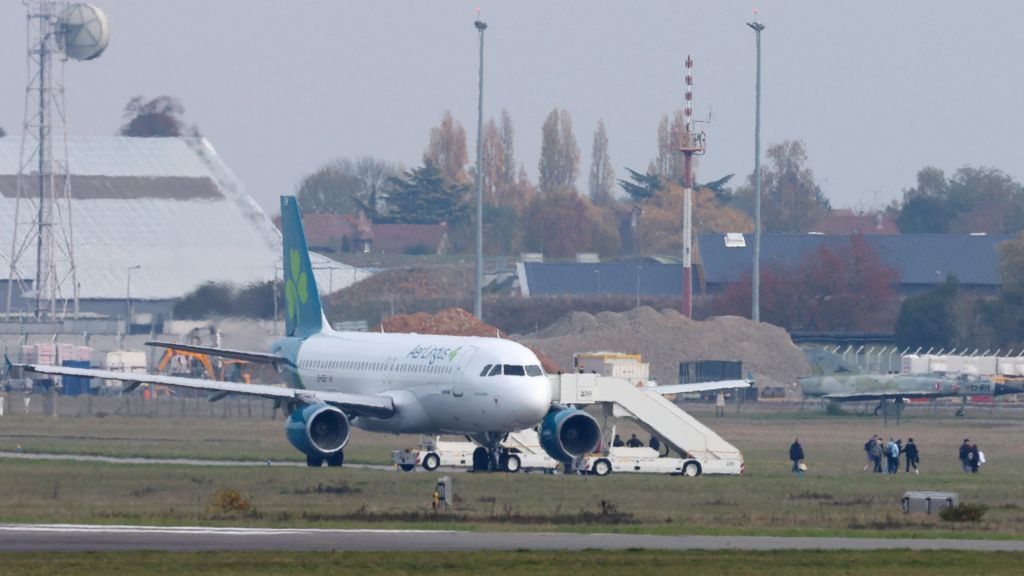
A sweeping series of coordinated false bomb threats targeting airports, commercial flights, and Irish media outlets across Western Europe has triggered widespread travel disruptions, emergency evacuations, and heightened cross-border security alerts in recent days, prompting senior European officials to warn of deliberate efforts to sow societal chaos. The wave of hoaxes first emerged early Thursday, at 07:21 local time, when a perfectly worded Italian-language email bearing the subject line “warning of a threat” was sent to multiple administrative contacts at Rome’s airport management firm Aeroporti di Roma (ADR) and staff at Fiumicino International Airport. The message, which claimed that operatives from the extremist misogynist group known as “Male State” had planted explosives on two incoming passenger flights as a protest against Italy’s “feminist regime”, led to immediate aviation safety interventions. One Aer Lingus service bound for Rome was diverted to a French military airbase, while a second incoming flight was escorted into Rome’s airspace by scrambled Italian Air Force fighter jets – the second such military deployment for the country this week. No explosive devices were recovered from either aircraft, or any other plane later targeted by similar threats. In the hours following the initial Rome alert, additional hoax threats surfaced across the continent: a Ryanair flight traveling from Rome to Lisbon was disrupted, and a Wizz Air service departing Prague for Rome was rerouted to Venice. On Friday, a string of identical false bomb warnings were sent to high-profile Irish media organizations, triggering mass evacuations of newsroom facilities, prompting the Irish government to publicly characterize the incidents as a deliberate “co-ordinated campaign of disruption”. When contacted by the BBC Russian Service via Telegram, accounts linked to the long-banned Russian extremist group “Male State” – which was outlawed by Russian authorities in 2021, and whose founder Vladislav Pozdnyakov is believed to currently reside in exile outside the country – issued a sarcastic, non-committal denial of any role in the threats. The group’s Telegram post mocked investigators for linking the defunct organization to the hoaxes, stating “What Male State? Where have you seen it? It hasn’t existed for many years. If tomorrow they sign a [threat] letter, say, from Putin, will you then try to reach our president to ask your stupid question?” – even as the same message made a passing, unsubstantiated claim that “fighters” from the group had planted explosives on two incoming flights. The group, which has rebranded some of its online channels under the new name “Male Legion” since its 2021 ban, has a well-documented history of virulent pro-Kremlin advocacy for Russia’s full-scale invasion of Ukraine, and regularly posts content designed to amplify social unrest and internal tensions across European nations. Open-source investigative collective Bellingcat first profiled the organization in 2022, describing it as a “vocal and vile online booster” of the Russian offensive, with a clear far-right extremist ideological framework. While the origin of the initial threat email is traced to an address linked to the state health service in Bogota, Colombia, investigators note that at least one of the subsequent Friday threats was delivered via phone call rather than email, indicating a potentially multi-channel coordinated campaign. A senior source at ADR told the BBC that the level of credibility assigned to the initial Italian-language threat stemmed from its unprecedented nature, noting that no similar widespread hoax campaign targeting Rome’s airports had been recorded in recent memory. Despite the group’s public denial, leading Italian daily newspaper La Stampa has asserted with confidence that “Male State” operatives are behind the disruption campaign, arguing in an editorial that the ability to carry out disruptive attacks while plausibly denying responsibility is a core tactic of Russian hybrid warfare strategy. Italy’s Defence Minister Guido Crosetto has echoed these concerns, warning publicly that the spate of false bomb threats is part of a deliberate “strategy to increase chaos” across Europe. Crosetto, who has spent years highlighting the growing risk of hybrid threats targeting European critical infrastructure, drew explicit parallels between the aviation hoaxes and a recent wave of cyberattacks that targeted supermarket refrigeration systems across the continent, raising temperatures to destroy massive volumes of perishable food and fuel public anxiety. “It seems to me that, day after day, from incidents involving refrigerators to the blood supply in France and now these false alarms, there are those who have an interest in fuelling tensions,” Crosetto stated, adding that Italian security agencies are prioritizing efforts to shore up national safety and mitigate further disruption. As of press time, cross-border European law enforcement teams are continuing their manhunt to identify the full network of actors behind the coordinated hoaxes, and to determine whether the wave of threats is being orchestrated by a single central group, or includes copycat actors piggybacking on the initial campaign to amplify disruption.