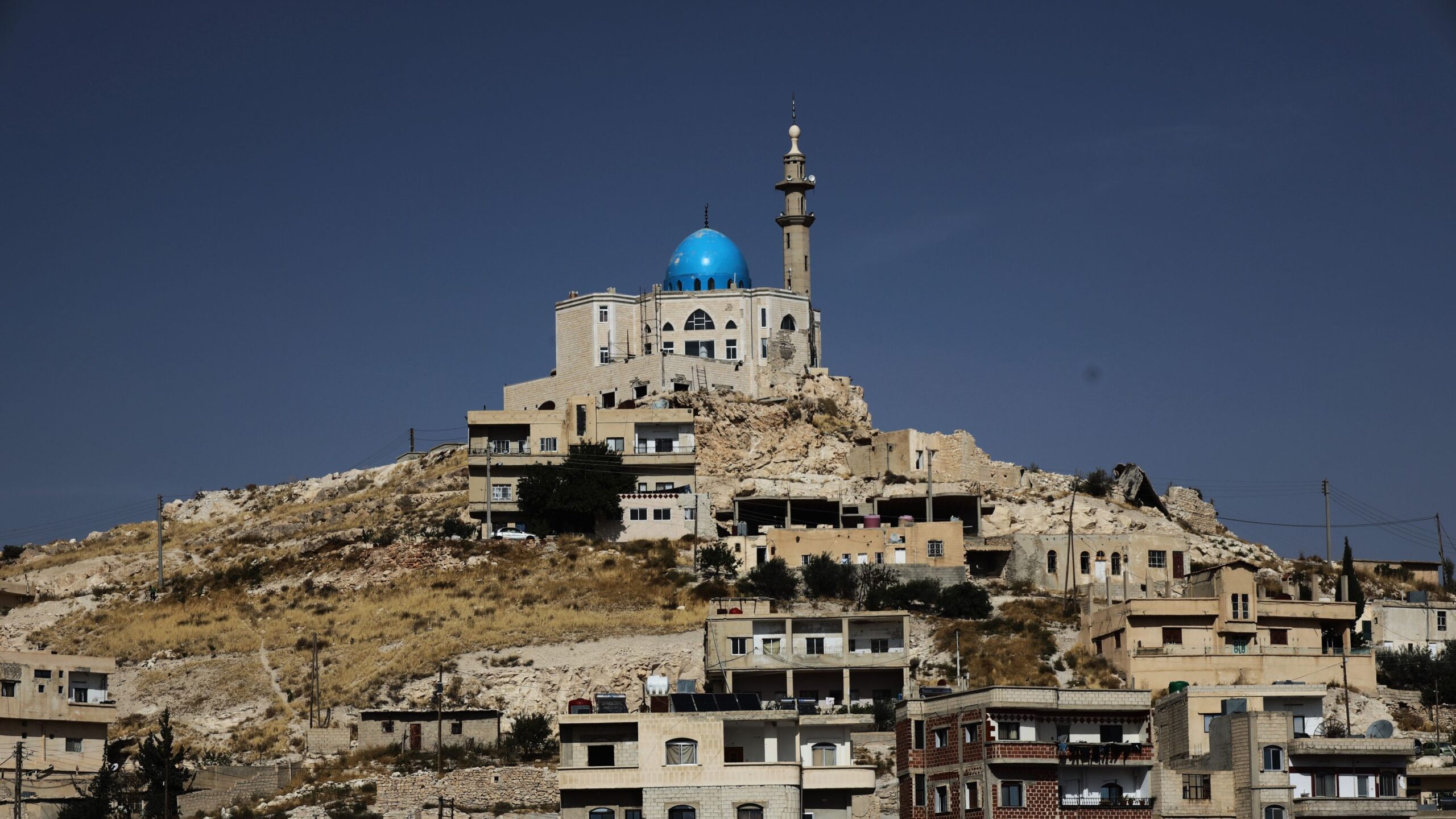
Traveling north from the Syrian capital of Damascus toward the Lebanese border, the route winds through desolate, untended apple and cherry orchards before climbing steeply into the rugged Qalamoun mountain range. It is here that the historic rebel stronghold of Rankous sits, where 33-year-old Abu Jad, a former Free Syrian Army (FSA) fighter who took up arms against longtime dictator Bashar al-Assad, waited on the main thoroughfare to greet the visiting reporter. Abu Jad, who lost full function of his right arm to a 2014 bullet wound, waved from behind the tinted window of his SUV with a tight, weary smile, and welcomed the visitor to what he called “the revolutionary capital of the Qalamoun region.”
That hard-won peace the town had cherished in the months following Assad’s ouster was shattered in the pre-dawn hours of 22 October, when Syrian internal security forces launched sweeping raids across Rankous, storming private homes and local businesses, detaining 45 residents and killing five young local men. The Syrian Ministry of Interior released an official statement framing the operation as a counterterrorism action, claiming the five deceased men held ties to the Islamic State, espoused extremist ideology, and had formally denounced the Syrian state as un-Islamic. But local residents paint a drastically different picture: three of the victims were completely unarmed at the time of the incursion, while the other two opened fire only after security forces breached private property, killing two members of the security detail in the exchange. Many families told reporters they initially mistook the raiding party for members of the Lebanese Hezbollah militia, which had occupied large swathes of Rankous during the civil war, explaining the split-second decision to resist.
In the days after the raid, hundreds of Rankous residents flooded the central town square — a space that had been scheduled to host a collective mass wedding for 12 local couples in less than two weeks’ time — to hold a multi-day funeral for the five slain young men. Instead of celebrating new life and the long-awaited end of 14 years of brutal war, the community was gathered to mourn sons who had spent their entire childhood and adolescence under bombardment, siege and regime persecution, only to be gunned down months after Assad’s government collapsed.
For Rankous, a town that lost more than 600 residents to the war, either killed in combat, detained, or disappeared into the notorious Saydnaya prison 15 minutes away, the October raid has deepened a pervasive sense of unmet justice and marginalization in the new post-Assad political order. Once a core hub of anti-regime resistance, where local rebel commander Firas al-Bitar rallied hundreds of residents to drive Assad’s forces out of the town in late 2012 and later fought off a full-scale Hezbollah incursion in 2014, Rankous’s fighters returned triumphantly alongside rebel forces from Idlib on 8 December 2024, only to find themselves systematically sidelined in the new national security architecture. As historic rivals of the now-dissolved Hay’at Tahrir al-Sham (HTS) faction that leads the new transitional government, FSA-affiliated fighters including Bitar’s Sham Liberation Brigade have been largely locked out of recruitment for the new national Syrian army, leaving thousands of former combatants unemployed and excluded from state support.
In interviews with grieving family members, almost all rejected the government’s claims that their sons held ties to IS. Ahmad al-Khattib, whose 21-year-old son Youssef was killed in his own living room after returning from dawn prayers, described a gentle young man who practiced taekwondo, danced at local weddings, and never even reprimanded his father for smoking, a behavior he noted would be unthinkable for a strict IS affiliate. Youssef had previously worked as an informant for HTS during the war, and briefly joined the new national army after Assad’s fall, but left after just a few months due to extremely low salaries and a deployment hundreds of miles away from his family. For 25-year-old victim Majd Suleiman, who was gunned down at the small local supermarket where he worked, his father recalled he had attended anti-regime protests from the age of 10, spent years in hiding to avoid Assad’s mandatory military conscription, and had never been accepted into the new army due to a lack of open positions. His long-planned wedding, scheduled for mid-November, was supposed to take place in the exact town square where his funeral was now held.
Local leaders say the transitional government has provided almost no resources for reconstruction in Rankous, forcing the community’s newly formed local development committee to fund all basic repairs for roads, street lighting, schools and mosques using only private resident donations. The World Bank has estimated total national reconstruction costs for Syria will reach $216 billion, a sum the transitional government has no current capacity to fund. Nihad al-Shahin, head of the Rankous local development committee, has called for a full, transparent public investigation into the raid, noting that even if authorities could produce verifiable evidence of alleged extremist ties, the heavy-handed, unannounced violent incursion was completely unjustified, and reflected the same oppressive security state mindset that defined the Assad era. As Syria approaches the second anniversary of Assad’s ouster, widespread unaddressed grievances among war-scarred former rebel communities across the country are creating vulnerable conditions that extremist groups like the Islamic State are actively seeking to exploit to rebuild their support networks.