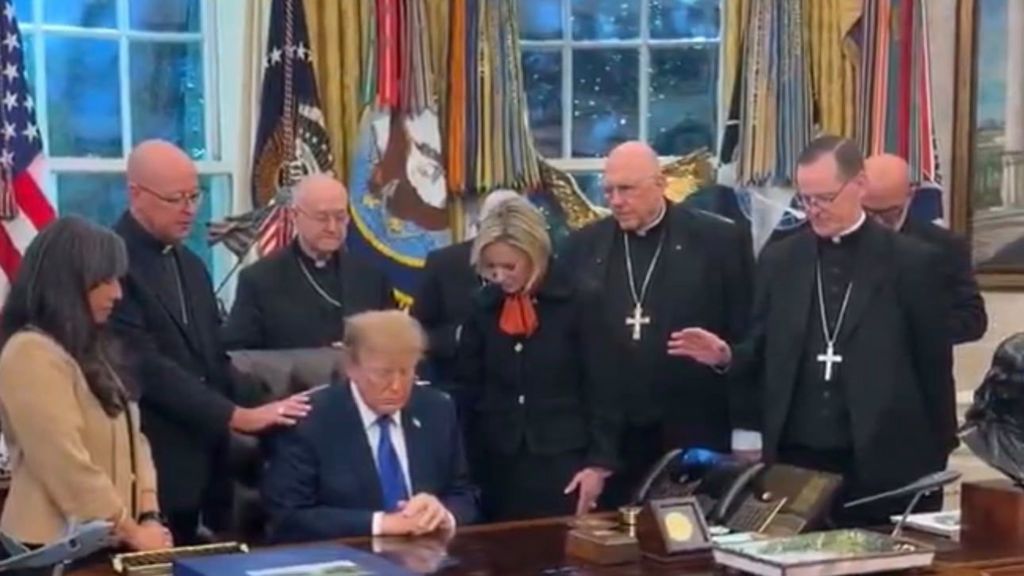
Two prominent U.S. Catholic clergymen have issued public statements of remorse following a 22 October closed-door gathering at the White House that spiraled into a viral partisan controversy after unapproved footage and photographs of the group praying alongside former and current U.S. President Donald Trump were circulated on social media. The clips and stills, captured around the iconic Resolute Desk in the Oval Office, were shared publicly by Margo Martin, a senior special assistant to the president and trusted communications aide who regularly posts exclusive behind-the-scenes content of Trump on the X social platform. The two bishops at the center of the fallout — Milwaukee Archbishop Jeffrey Grob and Des Moines, Iowa Bishop William Joensen — both emphasized that they entered the meeting under the explicit impression that all proceedings would remain private, with no public media component planned. The gathering had been coordinated by staff from the White House Faith Office to discuss substantive policy priorities aligned with Catholic social teaching, including reform of immigration frameworks, streamlined visa pathways for international clergy serving in U.S. parishes, and targeted interventions to end systemic exploitation of low-income and vulnerable marginalized communities. Neither cleric had granted consent for any visual documentation of the event to be distributed publicly, they confirmed in separate public remarks. Both leaders stated that they had no intention of issuing any formal or implicit endorsement of a political party or individual electoral candidate through their participation, particularly with the 3 November congressional midterm elections less than two weeks away. Joensen went a step further in his public statement, noting he regretted not anticipating the event would be weaponized for partisan gain: “I wish I had been more shrewd and less simple, like those who exploited our meeting for partisan political purposes.” Grob shared that he had received a flood of concerned messages from parishioners in his Milwaukee diocese in the days after the footage spread, including accounts from congregants who felt personally wounded by policies implemented under the Trump administration that have negatively impacted them or their immediate family members. Long-simmering tensions between the Trump administration and U.S. Catholic leadership have been well documented for months, rooted in widespread episcopal criticism of the administration’s hardline mass deportation policies that the U.S. Conference of Catholic Bishops has repeatedly condemned for sowing widespread community fear, fracturing family units, stripping due process protections for migrant populations, and demonizing immigrant neighbors. Additional points of friction include the administration’s initially announced — and later abandoned — plan to livestream a federal military execution, which the national bishops’ conference had formally denounced as incompatible with Catholic teachings on the dignity of all human life. Trump’s relationship with Pope Leo XIV has remained openly contentious throughout his second term, even as top Catholic administration figures including Vice-President JD Vance and Secretary of State Marco Rubio have made official diplomatic visits to the Vatican, and high-profile U.S. Catholic leaders such as Minnesota Bishop Robert Barron and former New York Archbishop Timothy Dolan accepted appointments to the president’s Religious Liberty Commission last year. A September 2025 survey from nonpartisan religious research body Pew Research Center reveals that approval ratings for Trump among U.S. Catholic voters have dropped sharply, falling to just 30% this month from a 47% favorable mark recorded when he took office for his second term at the start of 2025. The polling gap, which shows 42% of Catholic voters now supporting Democratic House candidates compared to 39% backing their Republican rivals, signals a potential shift in electoral dynamics that could shape partisan control of the U.S. Congress in the upcoming November contests. When approached for comment by BBC reporters, White House officials declined to directly address questions about the unsanctioned release of meeting footage or the bishops’ public statements of regret, instead issuing a blanket defensive remark from press secretary Taylor Rogers that claimed “There has never been a greater president for Catholic Americans than President Trump, and his strong record proves it.”