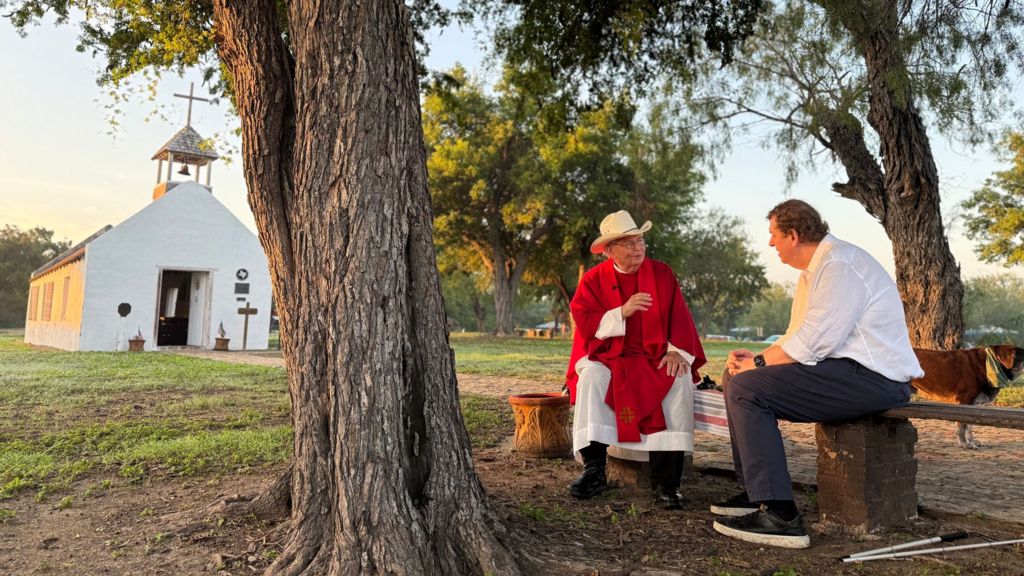
Dawn breaks softly over the scrub-dusted terrain of Texas’ Rio Grande Valley, where the 160-year-old La Lomita Catholic Chapel, a weathered whitewashed landmark dating back to the American Civil War, sits a mere 200 yards from the banks of the Rio Grande. For nearly 50 years, the parish’s spiritual leader has been Father Roy Snipes, a beloved local figure known far and wide across the borderlands as the “Cowboy Priest” for his signature Stetson hat, penchant for classic Roy Rogers country tracks, and unyielding advocacy for his predominantly Hispanic congregation.
Snipes first rose to regional prominence during Donald Trump’s first presidential term, when he led a fierce, high-profile campaign to block federal authorities from seizing the chapel’s historic land to make way for the administration’s proposed U.S.-Mexico border wall. Eight years later, amid Trump’s second term, the priest opened a recent early-morning Friday service for his 30-person congregation with a searing rebuke of current Immigration and Customs Enforcement (ICE) enforcement practices. “There is no moral or legal justification to detain, lock up, and deport hardworking, upstanding people who are our neighbors,” he told worshippers. He went on to note that while the public was initially told ICE operations would target only violent cartel members and high-level criminal offenders, the reality on the ground was far different: ordinary local workers were being routinely stopped, detained, and removed while commuting to their jobs, tearing families apart.
Two local educators who attended the service shared firsthand accounts of the human cost of the policy, noting that dozens of their students had been forced to leave school to relocate after their parents were targeted for deportation. “The unnecessary cruelty we are witnessing every day is shifting public sentiment – I truly hope that translates to real change at the polls,” one of the parishioners remarked.
New data from the independent Deportation Data Project shows Texas accounted for roughly one-third of all ICE arrests across the United States in July 2026, a larger share than any other state in the country. While Trump delivered on his 2024 campaign promise to slash illegal border crossings to the lowest level recorded in decades, that enforcement success has eroded much of the historic inroads the Republican Party made with Hispanic voters in Texas during the last presidential cycle, when Trump won a record 55% of the state’s Hispanic vote – a landmark haul that led GOP strategists to forecast a permanent partisan realignment along the border.
Javier Villalobos, the Republican mayor of McAllen, one of the Rio Grande Valley’s largest population centers, praised the Trump administration for curbing rampant border crossings that overwhelmed local communities during the Biden presidency, but acknowledged that the administration’s expanded deportation scope had become a major source of local backlash. “Most residents support removing violent criminals and people who contribute nothing to our communities, but when you start targeting law-abiding, productive members of our workforce, that’s where the policy breaks down,” he explained.
The shifting mood is embodied by Mario Guerrero, a Mexican-American small business leader and head of the South Texas Builders Association, who voted for Trump three consecutive times but now plans to cast his ballot for Democratic candidates in the November 3 midterms. Guerrero said he supported Trump’s 2024 pledge to fix the border crisis that had led to more than 2.5 million migrant apprehensions in a single year under the prior Democratic administration, but was horrified by the extreme, unforeseen levels of enforcement – including high-profile incidents involving ICE shootings in U.S. cities – that have gutted local labor pools. “A local contractor I know who used to have 35 full-time workers can now barely get 4 to 6 people to show up for shifts, because so many of our undocumented neighbors are too terrified to leave their homes,” he said.
Recent late-summer polling confirms that Trump’s once-strong Hispanic support across Texas has largely collapsed, with a majority of Hispanic voters now saying they disapprove of his presidential performance, and leaning toward Democratic candidates by a decisive margin. Prominent Republican Hispanic voter strategist Mike Madrid notes that this volatile electorate is far more likely to identify as independent than voters from any other demographic group, making them particularly receptive to candidates who avoid rigid partisan orthodoxy.
That shift has thrown a wrench into a 2021 Republican redistricting strategy that drew heavily on projections of permanent GOP Hispanic gains to redraw Texas congressional maps, including the 15th Congressional District, which was reconfigured twice – most recently in 2025 – to give Republican candidates a notional 18-point partisan advantage for the 2026 midterms. Despite that gerrymandered edge, current polling shows Democratic candidate Bobby Pulido, a two-time Latin Grammy-winning Tejano music star and local household name, leading by 5 to 6 percentage points. Pulido has deliberately distanced himself from national Democratic messaging focused on social justice and climate policy, prioritizing local economic issues that resonate with border voters. “This is not New York or Los Angeles,” he said. “What people here care about most are their pocketbooks, the cost of living, and supporting their families.”
Even at a local avocado festival, a beloved community gathering staple for the Rio Grande Valley’s Hispanic population, voters Dave Baldwin and Veronica Salazar cited skyrocketing cost of living as their top election priority, placing full blame for the price spikes on the Trump administration.
Republican campaign operatives across the region admit they are facing unexpected headwinds just weeks before Election Day, with volunteer organizers focused almost entirely on turning out their existing base rather than persuading undecided voters. Tano Tijerina, the GOP candidate running in the neighboring 28th Congressional District, acknowledged that the party faces significant national political headwinds, even as he praised Trump for breaking historic partisan barriers with Hispanic voters in 2024.
Political analysts note that even a modest swing back toward Democratic candidates in Texas could upend long-held political expectations, potentially putting a U.S. Senate seat in play for Democrats – a party that has not won a statewide Senate race in Texas in more than 30 years, with ripple effects that could shift the balance of power across the entire U.S. Congress.