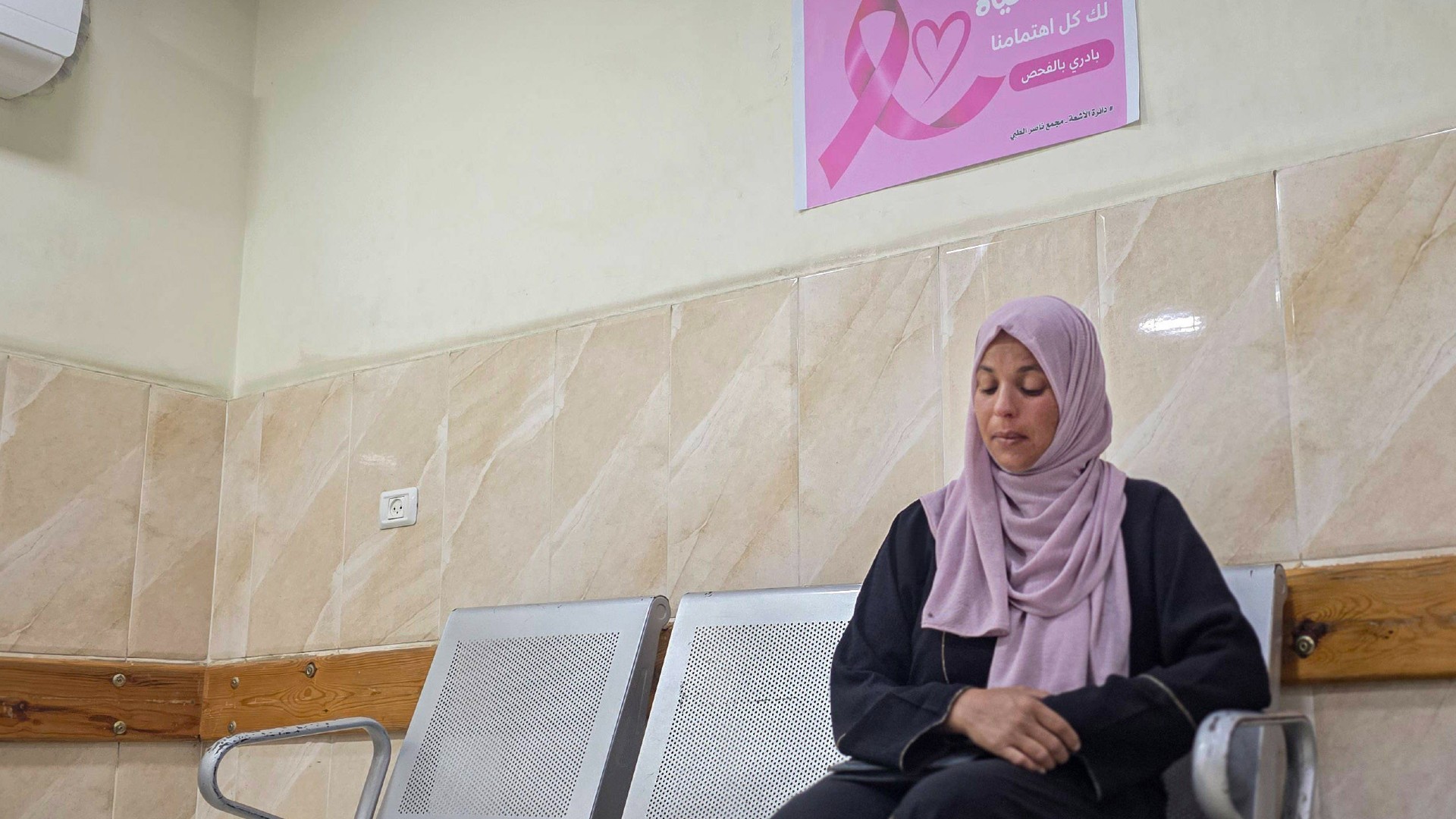
In the partially wrecked halls of Gaza City’s al-Shifa Hospital, 46-year-old Palestinian breast cancer patient Najat Abu al-Sheikh just completed another round of treatment. She and her husband now wait outside for a ride home, but the life-sustaining care she needs to beat her cancer remains tragically out of reach.
Abu al-Sheikh was diagnosed with stage two breast cancer in January 2026. Three weeks after her diagnosis, she received her first dose of chemotherapy at al-Helou International Hospital. She completed eight rounds of chemo and underwent a mastectomy, but her treatment regimen is still incomplete. The radiotherapy that was supposed to start in February cannot be accessed anywhere in the war-ravaged Gaza Strip, and the delay puts her at higher risk of cancer recurrence and sharply reduces her odds of a full recovery. Today, she only receives preventive targeted therapy at al-Shifa to lower that risk, and she waits desperately for permission to travel abroad for the missing radiotherapy treatment.
Abu al-Sheikh is far from alone in this agony. She is one of roughly 11,000 Gaza cancer patients who cannot get the full, life-saving care they need, according to the Palestinian Ministry of Health. The scope of the healthcare collapse in Gaza is staggering: the World Health Organization confirms that 94 percent of all hospitals in the enclave have been completely or partially destroyed during Israel’s military campaign. Al-Shifa, Gaza’s largest hospital, was raided twice by Israeli forces and rendered non-functional, only resuming limited operations in December 2025.
Despite registering for medical evacuation with the Palestinian health ministry back in April 2026, Abu al-Sheikh has not yet secured a spot for treatment abroad. Her doctor ordered her to leave for radiotherapy in February, and she remains stuck in a deadly waiting game. She is one of more than 21,000 patients who have waited for months to leave Gaza for urgent medical care. Israeli restrictions on departures have already led to the deaths of at least 1,570 waiting patients, including 505 cancer patients and 264 children, according to data from Physicians for Human Rights Israel.
The crisis of cancer care in Gaza extends far beyond individual patient stories. Dr. Mohammed Abu Nada, director of the Gaza Cancer Centre, reports that more than 500 new breast cancer cases were diagnosed in Gaza between 2024 and 2025, a number he calls “significant” — and he warns the true number is almost certainly higher. “These figures do not necessarily reflect the actual number of cases due to the disruption of diagnostic services, the difficulty of accessing medical services and hospitals, as well as the existence of cases that may not have been diagnosed or recorded,” he explained. Israel’s war has shattered every step of breast cancer care, from early screening and diagnosis to treatment and post-treatment follow-up, and only a tiny handful of hospitals can still offer any level of oncology services.
The destruction of Gaza’s healthcare infrastructure has been systematic: Israel’s ground invasion in October 2023 seized control of the Turkish-Palestinian Friendship Hospital, Gaza’s only dedicated cancer care facility, which Israeli forces converted into a military barracks before demolishing it months later. In June 2025, Israeli forces also seized control of the European Gaza Hospital, the main referral center for cancer patients in southern Gaza. While a 2025 ceasefire was supposed to end hostilities and open the border for critical medical supplies and equipment to restock Gaza’s damaged hospitals, Israel has continued to violate the agreement through ongoing bombardments and strict restrictions on aid entry.
Three years after the start of the conflict, Gaza’s cancer patients and healthcare workers still face crippling shortages of diagnostic tools, lab supplies, and essential medications. Dr. Abu Nada notes that critical imaging services are largely unavailable: before the war, Gaza had 15 mammography machines for breast cancer screening, and now only three remain functional across the entire enclave. The World Health Organization has repeatedly condemned the ongoing restrictions on medical imports, noting that securing an entry permit for even basic supplies takes a minimum of two and a half months, with requirements changing constantly. These shortages have forced clinicians to alter or delay treatment plans entirely, and in some extreme cases, doctors have been forced to use expired chemotherapy drugs because no other alternatives exist.
For patients, the struggle to access care is compounded by the collapse of every other basic service in Gaza. Widespread displacement, deep poverty, and the breakdown of transportation, electricity, and water infrastructure turn an already brutal battle with cancer into an even greater hardship. Even basic supportive care items are out of reach for many: Abu al-Sheikh cannot afford the vitamins her recovery requires, and there are no cosmetic creams available to help with the appearance of her mastectomy scar.
Thirty-four-year-old Tahrir Atallah, another stage two breast cancer patient waiting for evacuation approval, summed up the collective despair of Gaza’s cancer community: “Beyond all the suffering related to our health and treatment, life after the war makes us even more exhausted.” Like many others, she has to walk long distances to reach her chemotherapy appointments because no public transportation is operating, and she must manage household chores by hand when there is no electricity or gas for appliances, all while managing the debilitating side effects of treatment.
For thousands of cancer patients across Gaza, every day of delay is a day that brings them closer to preventable death, as the international community fails to hold violating parties accountable and ensure life-saving care reaches those who need it most.