In a landmark non-binding public ballot that put Canadian national unity to one of its most significant modern tests, residents of the western oil-rich province of Alberta have delivered a clear verdict: more than two-thirds of voters have rejected calls to pursue a formal binding independence referendum, choosing instead to remain part of Canada, according to preliminary projections from Elections Alberta with most ballots counted.
The ballot was initiated earlier this year by Alberta Premier Danielle Smith, who personally opposed separatism but moved forward with the vote after a grassroots pro-independence group collected 300,000 signatures on a petition demanding a binding separation referendum. That original petition was blocked by a court on the grounds that it failed to consult Indigenous First Nations communities, prompting Smith to proceed with the advisory vote instead. In a counter-move, anti-separation activists gathered more than 400,000 signatures on their own opposing petition, reflecting deep public division on the sovereignty issue. The core question on the ballot asked voters to choose between remaining a Canadian province or launching the constitutional process to hold a future binding independence referendum. Smith had previously stated that if voters backed the status quo, no separation referendum would be held during her tenure in office.
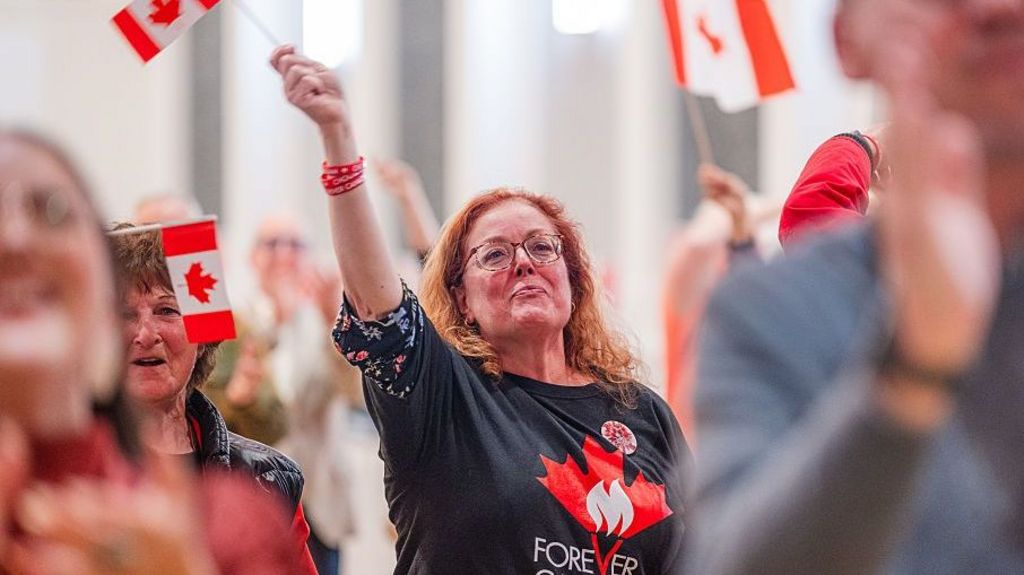
Canadian Prime Minister Mark Carney praised the outcome as a “clear choice” from Albertans, echoing Smith’s own reaction to the preliminary results. “Albertans have voted for a stronger Alberta in a united Canada,” Smith said, welcoming the verdict. Pro-union supporters gathered in Edmonton celebrated the projection, while the mood at a pro-separatist watch party in the same city shifted sharply when the results were announced: upbeat conversation quickly faded, and attendees packed up and departed shortly after overnight projections were released by CBC and other Canadian outlets.
Separatist arguments for breaking from Canada centered on claims that federal environmental policies out of Ottawa have held back the province’s energy-driven economic growth. Anti-separation campaigners, including Prime Minister Carney, framed the vote as a moment to maintain national unity amid mounting external pressures, including the ongoing trade dispute with the United States.
Despite the lopsided result against their position, separatist leaders have struck a defiant tone, insisting their movement is far from finished. Jeffrey Rath, a Calgary-based lawyer and leading separatist figure, told BBC World Service’s Newsday that the vote should be viewed not as a defeat, but as a critical first step for the movement. “Our movement isn’t stopping and we’re continuing to move forward,” Rath said, noting that the campaign had gained valuable lessons from the ballot process. When asked if the movement would continue pushing for repeat votes until it secured the outcome it wanted, Rath replied simply: “why not?”, adding that his side’s position is backed by solid economic and numerical analysis.
Looking ahead, separatist leaders have already laid out their next plan: they aim to oust Premier Smith from the leadership of her United Conservative Party and replace her with a candidate sympathetic to the separatist cause. It remains unclear whether the movement has enough support within the party to pull off the leadership challenge, but political analysts widely expect the debate over Albertan sovereignty to dominate provincial politics for years to come. Mitch Sylvestre, another leading separatist, acknowledged ahead of the vote that even a defeat would not extinguish public support for independence, saying “a lot of work will have to be done” to curb that appetite if the result went against his side.
This is not the first time Canada has faced a major challenge to its national unity: the province of Quebec held two high-profile independence referendums in 1980 and 1995, both of which failed. Alberta separatists have pointed to Quebec’s example, noting that the province used the persistent threat of independence to gain substantial political leverage from the federal government.
Alongside the core sovereignty question, Monday’s ballot included nine additional policy questions covering two broad themes: five focused on immigration, and four addressed issues related to the Canadian Constitution. Full official vote counting is ongoing, but the preliminary projection has already cemented the immediate outcome, while leaving the long-term future of the Albertan separatist movement unresolved.