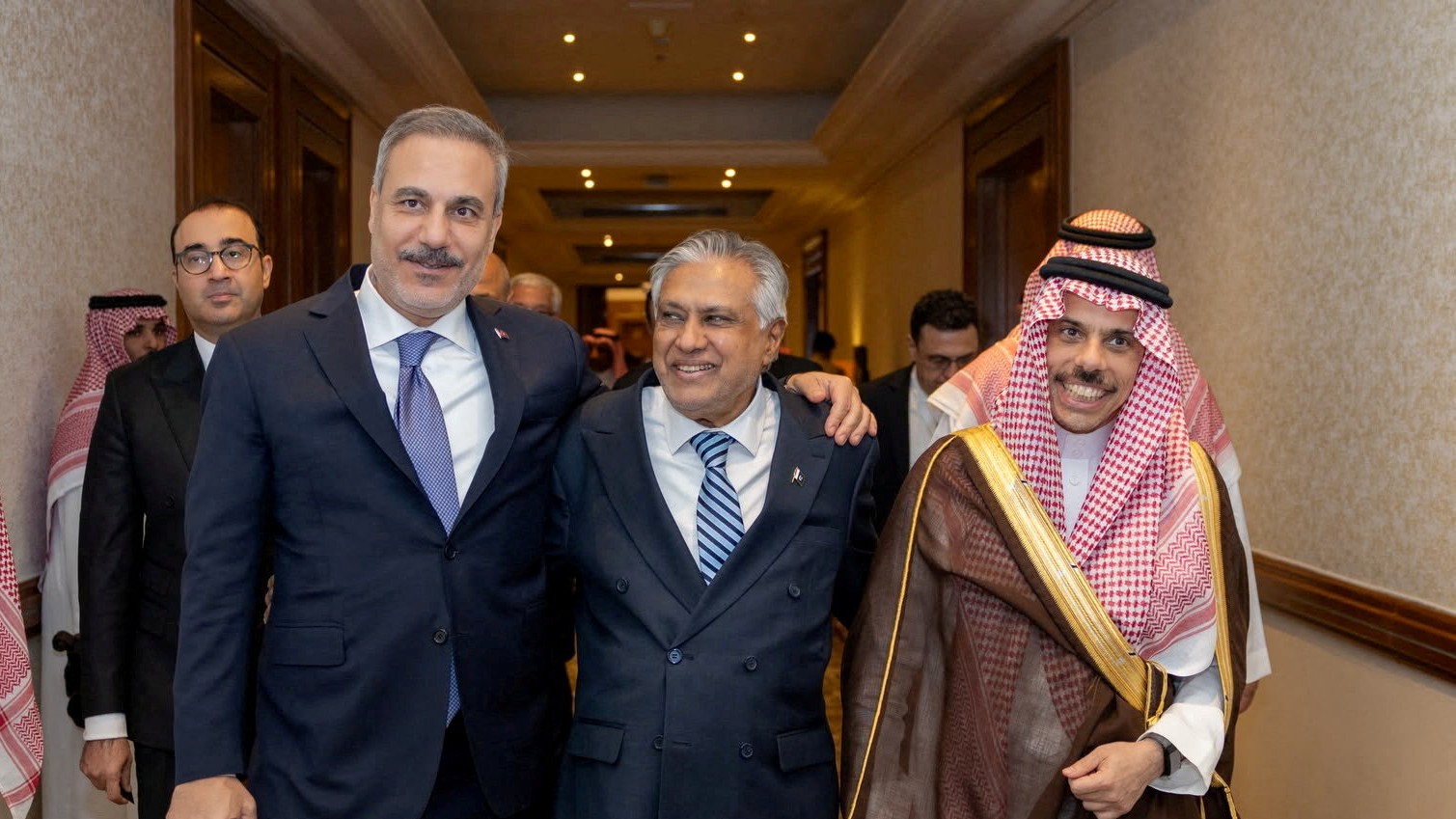
On Tuesday, the Turkish government formally transmitted the full text of a landmark mutual defence agreement, the Mecca Defence Pact, to the country’s national parliament for ratification. The 16-article accord, first signed in August by the governments of Turkey, Saudi Arabia, and Pakistan, establishes a new collective defence alliance structured around mutual security guarantees that echo the core principle of NATO’s Article 5.
The full text of the agreement, obtained in an exclusive report by Middle East Eye, does not name any specific nation or geographic region as an explicit threat to the three signatory states. Instead, the pact’s opening articles anchor its core commitment to collective security. The first article mandates that if any member’s territorial integrity, sovereignty, or internationally recognized borders face threat or danger, all parties will deploy every necessary measure to neutralize that risk. The second article goes further, clarifying that any external armed attack against one signatory will be treated as an attack against all three.
In the event of military aggression against any member, the agreement requires all parties to provide immediate assistance to the targeted state, utilizing all available mutual support capabilities at their disposal. The scope and nature of this support will be determined following an objective assessment of the attacked party’s needs, with all cooperation aligned to each member’s available resources, including military assets and operational capabilities.
Beyond the core collective defence commitment, the pact outlines a broad framework for deepening multi-faceted security cooperation between the three nations. Provisions include joint development of domestic defence industries, standardized training for armed forces, cross-supply of military equipment, fuel and other critical defence material, and the establishment of formal protocols for cross-border intelligence sharing.
A key structural feature of the alliance is its indefinite duration: the agreement has no fixed expiration date. Withdrawal is only permitted after the pact has been in force for 10 years, and any member seeking to exit must provide written notification of their intent to the other signatories no less than three months in advance.
The full text of the accord opens by grounding the alliance in foundational principles aligned with the United Nations Charter and international law, including mutual respect for sovereignty, non-interference in internal affairs, and the inviolability of internationally recognized borders. Signatories emphasize their shared commitment to advancing regional and global peace and security, deepening coordinated counter-terrorism efforts, and aligning policy positions on shared international interests within multilateral organizations.
To govern the alliance’s operations, the agreement establishes a permanent Strategic Political and Defence Committee, composed of each member’s foreign minister, defence minister, and chief of general staff. The committee is tasked with setting strategic direction for the alliance, advancing security cooperation, and resolving implementation challenges. It is scheduled to meet twice annually, with rotating host duties among the three members, and annual leader-level summits can be convened if required. A permanent Secretariat will be based in Saudi Arabia, led by a Secretary-General that rotates every three years among the core parties; the first Secretary-General will be a Pakistani national. The committee also holds the authority, via consensus, to set terms for the accession of additional future members.
Additional provisions cover logistical support during peace, war, and emergencies, confidentiality protocols for classified information (obligations that remain in force even if a member withdraws), mechanisms for amicable dispute resolution, and rules for amending the pact via unanimous core party agreement. The accord will enter into force once all three original signatories complete their domestic ratification processes and deposit the final ratification instrument with the alliance Secretariat, and any pre-existing international obligations of member states remain unaffected by the new agreement.