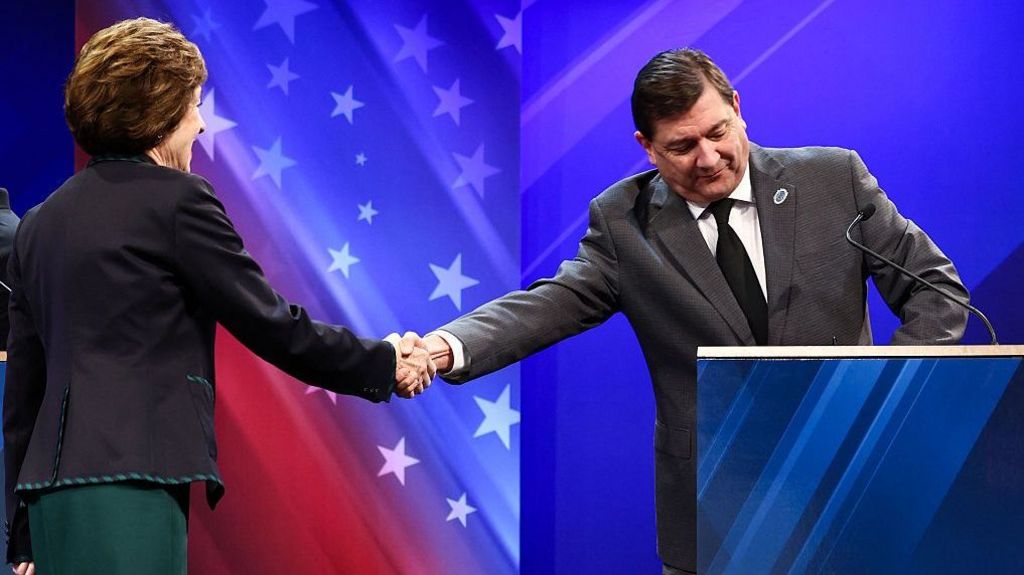
With the November 2026 US midterm elections just weeks away, candidates vying for control of the US Senate have taken the debate stage across the country, bringing with them fiery clashes, sharp ideological divides, and ugly personal attacks that highlight the high stakes of this year’s congressional battle. As both major parties fight to win a majority in the chamber, three defining themes have emerged across the most competitive Senate races, all centered on one persistent question that has defined Republican politics since 2016: where do candidates stand on former President Donald Trump?
For years, Republican candidates who have broken ranks with Trump have faced steep backlash from primary voters, and with Trump retaining enormous influence over the party, the 2026 cycle is no exception. This year, amid sagging approval ratings for Trump and widespread voter anxiety over soaring living costs and record-high fuel prices, Republicans are taking a range of approaches to their ties to the former president. A recent Reuters analysis found that roughly two-thirds of Republican candidates in competitive House and Senate races have broken with Trump on at least some policy or political positions this cycle, even as many others remain firmly aligned with his agenda.
Maine’s Susan Collins, a four-decade Senate incumbent running for her sixth term, has gone further than most to distance herself from Trump. During a recent debate with Democratic challenger Troy Jackson, Collins highlighted her cross-party voting record, noting: “I voted with President Biden 91% of the time. The fact is, this year alone, this Congress alone, I voted against President Trump 137 times.” The race has tightened far beyond what Collins expected, with conflicting polling leaving the outcome uncertain: a mid-September New York Times/Siena College poll gave Collins a 3% edge, while other surveys place Jackson narrowly ahead. Tensions boiled over during one recent debate when a protester interrupted the event, leading Collins to suggest the protester was linked to Jackson’s campaign. Jackson shot back sharply: “Oh shut up, I don’t even know that kid.”
Other Republican candidates have struck a middle ground, breaking with the Trump administration on specific policies while retaining public loyalty to Trump himself. In Iowa, a longstanding Republican stronghold, incumbent Congresswoman Ashley Hinson is facing a surprisingly competitive challenge from Democrat Josh Turek, who holds a narrow lead in most recent polling. Hinson has not fully separated from Trump like Collins, but she publicly pushed back on one of his administration’s major energy policy decisions during an October 13 debate. When asked about a Trump-era deal to import hundreds of thousands of tonnes of Russian fuel to the US, Hinson did not hold back: “We need to lower gas prices in this country, we need to lower diesel prices, but I don’t think we need to be making a deal with Russia to do it.”
Beyond debates over loyalty and policy, many matchups have devolved into harsh personal attacks that have dominated headlines in recent weeks. The open Senate race in Michigan, pitting Democrat Abdul El-Sayed, who would be the first Muslim US senator, against Trump-backed former congressman Mike Rogers, has been among the most bitter. During a recent debate, Rogers made a controversial incendiary remark, questioning whether any member of El-Sayed’s family was on a government “watchlist”. El-Sayed pushed back with scathing criticism, dismissing Rogers as “a sock puppet for the Trump administration” and calling him “weak, cowardly [and] won’t stand up until his poll numbers drop”.
In Georgia, incumbent Democratic Senator Jon Ossoff and his Trump-backed Republican challenger Mike Collins also traded vicious personal insults. What began as a policy exchange over Ossoff’s accusation that Collins steered public benefits to private data center developers quickly turned into a shouting match, with Ossoff labeling Collins a “bigot” who had “hired half the Third Reich”. The comment came amid ongoing controversy over antisemitic posts made by Collins’ son-in-law, David Alan Scheer II, who wrote in one post that “Israel and Zionist Jews” were pursuing policies to “undermine the white, Christian nature of America”. Collins defended himself against the accusations, claiming Ossoff was “spewing craziness” and saying he had “condemned racism, antisemitism, hate; I don’t care where the source is”.
While dozens of candidates have faced off on debate stages across the country, an ABC News analysis found that 21 of the 35 Senate seats up for election this cycle have no scheduled debates between the two major party candidates. One of the most high-profile absences has been in Texas, where Democratic state representative James Talarico is mounting a surprisingly competitive challenge to Republican former state attorney general Ken Paxton in a race that could decide control of the Senate. If Talarico flips the seat, it would give Democrats one of the four seats they need to claim a majority. Talarico has accepted four separate debate invitations from major news networks, but Paxton has declined all of them. Despite a July 2026 promise from Paxton’s campaign that he would debate, the candidate has not provided any further plans for public debates, even after primary backer Donald Trump publicly urged both candidates to participate.
Political observers warn that skipping debates carries major political risks. “One thing about not showing up is you lose the opportunity to make the case for yourself, and instead, what you do is you give your opponent the ability and the opportunity to make your case as negative as possible,” Peter Trumbore, a political science professor at Oakland University, told CBS News, the BBC’s US partner outlet.
As Election Day approaches, all eyes remain on these competitive toss-up races, where candidates’ positions on Trump and their performance on the debate stage could determine which party controls the US Senate for the next two years.