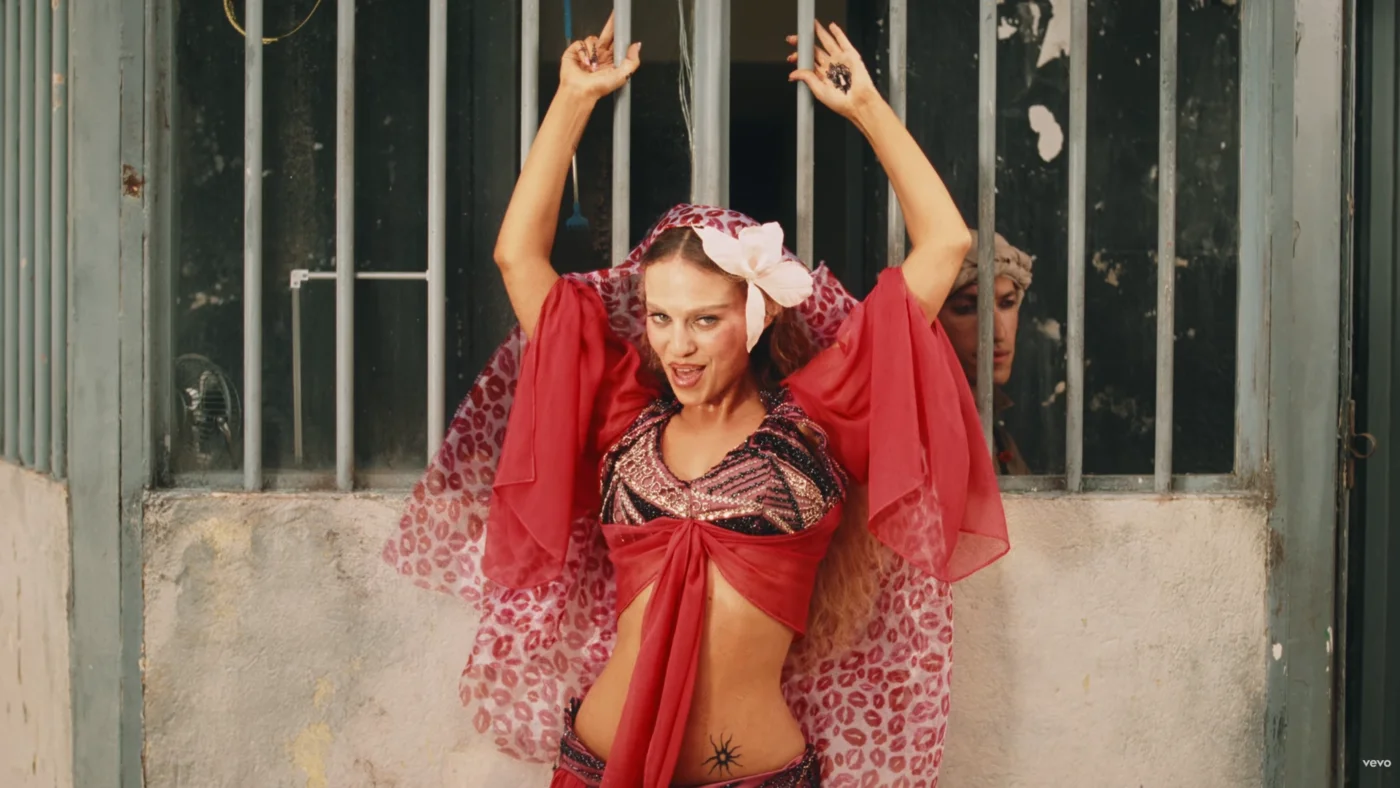
Rising Palestinian singer Elyanna is facing intense online criticism following the September 4 release of her latest music video *BOSA*, with many critics arguing the lighthearted clip’s prison-themed backdrop is deeply insensitive against the ongoing crisis of documented abuse facing Palestinian women detained in Israeli prisons.
The upbeat, playful visual opens with Elyanna positioned behind iron bars before shifting across a stone, prison-like compound, where she and a group of female dancers perform choreography across courtyards and alongside barred windows. Lyrically, the track centers on playful, sensual invitation, with the artist repeatedly asking listeners to “give [her] a kiss, kiss” before the video closes with the group walking confidently out of the compound. In a prior interview with Complex MENA, Elyanna framed the project as a celebration of feminine expression, explaining that “With BOSA, I invite women to be loud about their femininity, desire, confidence, and freedom.”
Despite the artist’s stated creative intent, the prison setting has drawn sharp backlash from many viewers, particularly Palestinian and Arab audiences, who argue the location cannot be disentangled from the lived reality of Palestinian detention under Israeli occupation. Commenters quickly raised objections across social platforms under promotional clips of the video, with one asking, “Wtf why is this set in a prison?” Another questioned whether any member of Elyanna’s production team had considered the concept could come across as deeply distasteful to those impacted by the reality of Israeli detention.
Beyond the setting, critics have also accused the artist of “self-orientalism,” arguing that the video’s use of Palestinian, Arab and South Asian dance and cultural motifs has been deliberately reframed as “exotic” aesthetics designed to cater to Western consumer expectations. Writer and Palestinian activist Nerdeen Kiswani pushed back against the “it’s just a music video” framing in a viral X post, writing “Prison is not an abstract symbol for Palestinians. The prison is an actual institution of colonial violence. Palestinian prisoners have been subjected to torture, sexual abuse, humiliation and other forms of [abuse].”
Critics have also highlighted the deeply unflattering timing of the video’s release: just days before *BOSA* dropped, on August 30, Israel’s far-right National Security Minister Itamar Ben Gvir drew widespread condemnation for a filmed visit to Damon Prison, which holds dozens of female Palestinian detainees. After a prisoner confronted Ben Gvir over the facility’s harsh conditions, including a lack of access to proper showers, he publicly responded, “I am pleased with these conditions.” Ben Gvir later dismissed the complaints as “whining” on social media, claiming that the era of “summer camp” conditions for Palestinian detainees was over, and boasted that he had reduced conditions to what he called the “bare minimum.”
Human rights organizations and former detainees have long documented systemic abuse facing Palestinian detainees in Israeli custody: currently, Palestinian advocacy groups confirm that nearly 100 Palestinian women and girls, including pregnant people and minors, are being held in Israeli detention. Reports of abuse include inadequate access to nutritious food, restricted hygiene and medical care, invasive strip searches, and ongoing psychological and physical mistreatment.
Against this backdrop, critics argue the contrast between the video’s fictional narrative of dancing women leaving a prison and the real-world suffering of detained Palestinian women is impossible to ignore. One X user wrote, “This so beyond tone deaf *especially* in this climate. Our women are burying their kids, getting kidnapped, jailed and sexually abused by the iof [Israeli Occupation Forces] every single day. and ‘give me a kiss’ at the men who locked her up… the orientalist gaze… yeah this is NOT it.” Another commenter asked, “what are you, as a palestinian woman, doing singing ‘give me a kiss’, while playing the role of a woman in captivity flirting with her jailors? what message is this sending? what are you trying to romanticise ya allah.”
Not all reactions to the video have been negative, however, with a cohort of fans and viewers pushing back against the backlash. Many argue critics are overinterpreting the creative concept, noting that *BOSA* is intended to be a simple, fun pop track about love and feminine desire. Others reject the accusation of self-orientalism, pointing out that as an Arab Palestinian artist, Elyanna cannot be guilty of commodifying her own culture for Western audiences. The artist herself has brushed off the criticism, replying with kiss emojis in Arabic to a video criticizing the orientalism claims. Some supporters also highlighted Elyanna’s well-documented history of pro-Palestinian activism, noting she made history as the first Palestinian artist to perform a full Arabic-language set at Coachella, where she openly called for Palestinian freedom and displayed a Palestinian keffiyeh. “Elyanna was born and raised in Palestine to a Palestinian mother and Palestinian Chilean father just say you hate the song and move on no need to write a think piece invalidating her whole identity and roots,” one supporter wrote.
Middle East Eye has reached out to Elyanna and her management team at SALXCO for additional comment on the backlash, but had not received a response as of this report’s publication.