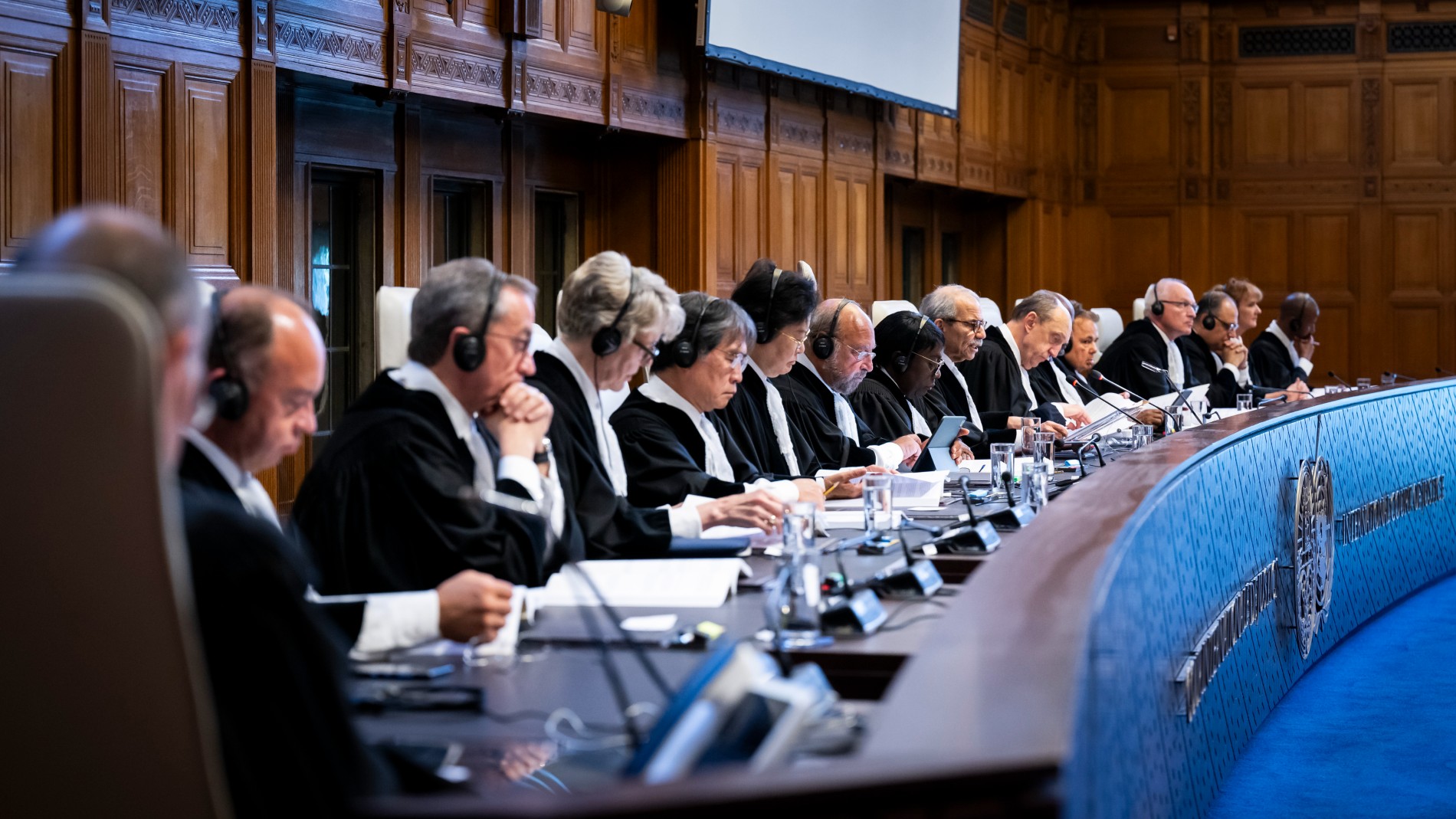
On a historic Tuesday in the UK Parliament, Foreign Secretary Ed Miliband unveiled long-awaited measures aligning British government policy with a landmark 2024 legal ruling from the International Court of Justice (ICJ), the United Nations’ highest judicial body. In a speech marking a sharp break from decades of ambiguous British policy, Miliband explicitly declared Israel’s decades-long occupation of Palestinian territory illegal, announced sweeping new sanctions targeting Israeli settlements, and implemented a full ban on arms licenses and all exports that materially contribute to sustaining the occupation.
Miliband further stated that the UK government has concluded Israeli settlers are perpetrating ethnic cleansing against Palestinian communities in the occupied West Bank, accusing the Israeli government of deliberately ignoring these widespread abuses and actively condoning the forced displacement of Palestinian people. “For a long time, the British government has correctly acknowledged that Israeli settlements are illegal under international law, but we have remained silent on the broader question of the legality of the entire occupation,” Miliband told lawmakers. “Today, I announce that the official view of the British Government is that the occupation is unlawful, because of Israel’s entrenchment of its control, its stated intention to extend permanent sovereignty over the territory, and its expansionist agenda pursued through illegal settlements.”
Miliband’s announcement represents the clearest endorsement to date from the United Kingdom of the ICJ’s landmark July 19, 2024, advisory opinion. The ruling, requested by the UN General Assembly, formally confirmed the illegality of Israel’s decades-long occupation of the West Bank and East Jerusalem, ordered all Israeli settlers to withdraw from occupied Palestinian territory, and mandated that all governments take action to end any support that sustains Israel’s unlawful presence in the region.
These findings have taken on renewed urgency in recent months as Israel accelerates settlement expansion, including advancing construction tenders for the controversial E1 project. British and international officials have repeatedly warned that the E1 development would split the occupied West Bank into disconnected fragments, eliminating any possibility of establishing a geographically contiguous and viable Palestinian state.
The UK did not act alone: on the same day as Miliband’s announcement, 11 other nations—Canada, Denmark, Finland, France, Iceland, Ireland, Norway, Poland, Portugal, Spain, and Sweden—joined the UK in signing a joint international statement. The signatories confirmed their intention to introduce national restrictions on trade in goods produced in illegal Israeli settlements, or support European Union-wide restrictions, with many nations actively evaluating additional measures in line with their domestic legislative procedures.
To contextualize the announcement, it is critical to revisit the full scope of the 2024 ICJ advisory opinion. Judges on the court concluded that Israel’s entire continued presence in the Occupied Palestinian Territory (OPT), not only its isolated settlements, violates international law on multiple overlapping grounds. The court ruled that Israel’s policy of transferring its own civilian population into the West Bank and East Jerusalem, and maintaining their presence there, directly violates the Fourth Geneva Convention’s explicit ban on an occupying power relocating its own citizens into occupied territory.
Additional findings confirmed that Israel’s seizure of Palestinian land for settlement construction breaches customary international law, that its exploitation of Palestinian natural resources exceeds the legal limits allowed for occupying powers, and that extending Israeli domestic law to settlers in occupied territory has no legal justification. The court also found that Israel’s policies have enforced near-total separation between Palestinian and Israeli civilian populations, violating the International Convention on the Elimination of All Forms of Racial Discrimination’s ban on racial segregation and apartheid.
When combined with state policies designed to push Palestinians to leave their land and widespread settler violence that Israel has systematically failed to prevent, the ICJ concluded these practices amount to de facto annexation of large swathes of the OPT. The court ordered Israel to end its unlawful occupation as rapidly as possible, halt all new settlement construction, withdraw all settlers from occupied territory, repeal all discriminatory legislation related to the occupation, and provide reparations for all harm caused to the Palestinian people.
The ruling also mandated that all other countries must not recognize Israel’s occupation as legal, must not provide aid or assistance that helps sustain the occupation, and must avoid economic or trade activities that support illegal Israeli settlements. Most fundamentally, the court reaffirmed that the Palestinian people’s right to self-determination is an absolute, peremptory norm of international law, and that Israel’s occupation fundamentally violates this right by fragmenting Palestinian territory, forcing mass displacement of Palestinian communities to alter the territory’s demographic makeup, denying Palestinians permanent sovereignty over their own natural resources, and creating a system of economic dependence that undermines Palestinians’ ability to pursue independent social, economic and cultural development. The court emphasized that the 60-plus year duration of Israel’s policies significantly aggravates this violation.
Notably, international law experts have flagged a key gap in Miliband’s parliamentary address. While Miliband mentioned the term “self-determination” twice, he did not connect it to the ICJ’s core finding that the occupation violates this fundamental right. Ralph Wilde, a professor of international law at University College London who represented the League of Arab States during the ICJ proceedings, noted in an interview with Middle East Eye (speaking in a personal capacity) that the omission is meaningful, because the right to Palestinian self-determination forms the foundational underpinning of the court’s entire ruling.
“The core point of the ruling is that Israel should not be there at all. This is not Israel’s sovereign territory, and its presence is a direct violation of Palestinian self-determination,” Wilde explained. “It is incorrect to omit the most important finding, which is that this is a violation of Palestinian self-determination. That omission misleadingly frames the issue as narrower than the fundamental denial of Palestinian freedom itself—a denial that has persisted since 1967.”
In the period following the ICJ’s 2024 ruling, settlement expansion has accelerated dramatically. By 2025, the annual rate of settlement growth hit its highest level since 2017, with an average of roughly 12,815 new housing units added each year. The total number of official Israeli settlements and unauthorized outposts grew from 141 in 2022 to approximately 210 by 2026. Israel has continued to advance the E1 project near Jerusalem, which would permanently break the territorial continuity of the West Bank and eliminate any realistic path to an independent Palestinian state.
In September 2024, the UN General Assembly adopted resolution A/RES/ES-10/24 by a vote of 124 to 14, with 43 abstentions, translating the ICJ’s findings into binding, concrete demands. The resolution gave Israel a 12-month deadline, expiring in September 2025, to end its unlawful presence in the OPT, and required all UN member states to halt imports of settlement goods and stop transferring arms that could be used in the occupied territory. At the time, the UK abstained from the vote, arguing it did not dispute the ICJ’s core findings but claimed the resolution lacked “sufficient clarity” to advance a negotiated two-state settlement. The September 2025 deadline passed without any compliance from Israel.
To date, most UN member states have failed to implement the ICJ ruling or meet the requirements of the General Assembly resolution. However, a growing bloc of European countries have begun taking incremental steps to fulfill their international legal obligations. Spain implemented a full ban on settlement goods imports in September 2025, Ireland enacted similar legislation in July 2026, and Belgium approved its own import ban that same month. The Netherlands adopted new restrictions on the import, purchase and sale of settlement goods, set to enter into force on September 22. Slovenia introduced restrictions in 2025, but its new government repealed the import ban in June 2026.
Norway strengthened official business guidance after the 2024 ICJ ruling, advising domestic companies against engaging in activities that sustain Israel’s occupation, and opened a public consultation in June 2026 on draft legislation to restrict settlement imports, exports and relevant property and service transactions. With Tuesday’s announcement, the UK, France and Canada have now joined the group of nations pledging national restrictions on settlement goods trade, bringing the total number of countries backing new measures to 12.