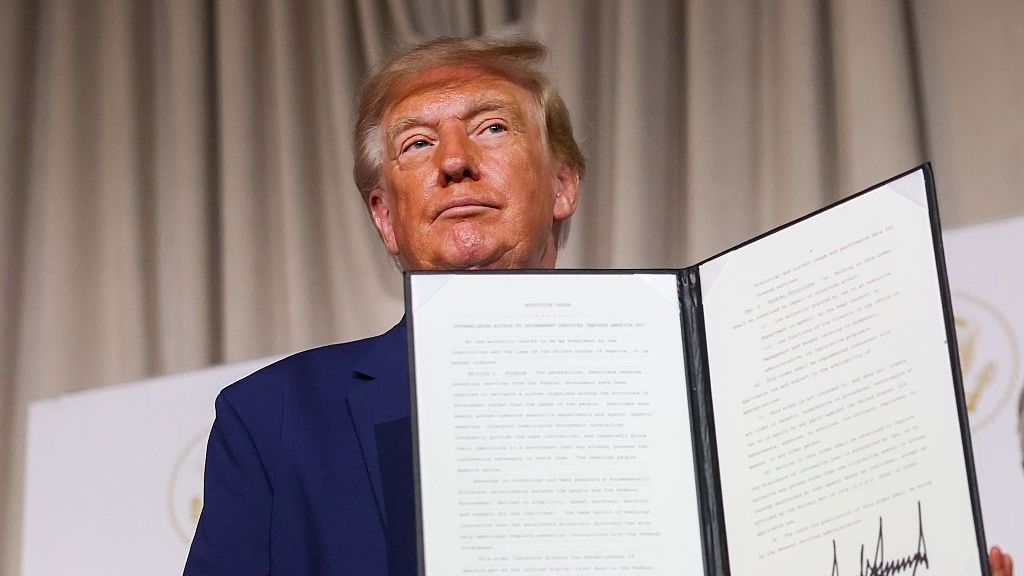
In a formal event held in Washington D.C. on Tuesday marking the rollout of America.gov, a new artificial intelligence-driven online platform built to simplify access to U.S. government services, sitting U.S. President Donald Trump made a firm declaration ruling out any form of joint AI development partnership with China. Trump framed any collaborative effort between the two global powers as an unacceptable compromise that would amount to handing over sensitive national technological information to what he labeled Washington’s top economic competitor.
Trump’s remarks come just one week after a high-profile diplomatic meeting at the White House between Trump and Chinese President Xi Jinping. Following that summit, Beijing and Washington had announced the establishment of two new bilateral mechanisms focused on AI: a formal dialogue track set to hold its next round of discussions in November, and a dedicated communication line designed to defuse miscommunication during unexpected AI-related incidents. Despite these agreed-upon confidence-building steps, Trump made clear that full collaborative development of AI technology remains off the table.
“The United States is leading by a lot” in the global AI race, Trump stated during his remarks at the portal launch. He added, “Frankly, there is nobody in third place… it’s all between us and China.” Arguing that opening the door to joint work would give Beijing unauthorised access to closely held American technological advancements, Trump emphasized his commitment to preserving Washington’s current leading position. “We’re leading now over China and everyone else, and I want to keep it that way,” he said.
Long before the bilateral summit, China’s Foreign Ministry had already pushed back against the framing of AI competition as a zero-sum confrontation, warning that so-called “threat narratives” and adversarial positioning only create barriers to productive global AI governance. Domestically, Trump’s stance on AI policy also puts him at odds with broad public opinion across the United States. Recent polling conducted by Politico and released in late September shows that two out of every three U.S. adults believe AI poses at least a moderate risk of existential harm to humanity. Even among Trump’s own political base, 44% of respondents support a temporary pause on advanced AI development to implement proper safety guardrails.
This is not the first time Trump has dismissed growing calls for stricter regulatory oversight of AI. The president has repeatedly downplayed safety concerns, dismissing warnings of unregulated AI growth as a deliberate “hoax.” He drew a parallel between AI safety advocacy and what he incorrectly refers to as the “global warming scam,” claiming both issues are being falsely promoted by what he called “radical left Democrats” to undermine economic growth. On the domestic policy front, Trump has also ruled out implementing restrictive AI regulations that he argues would stunt the sector’s future expansion in the United States.