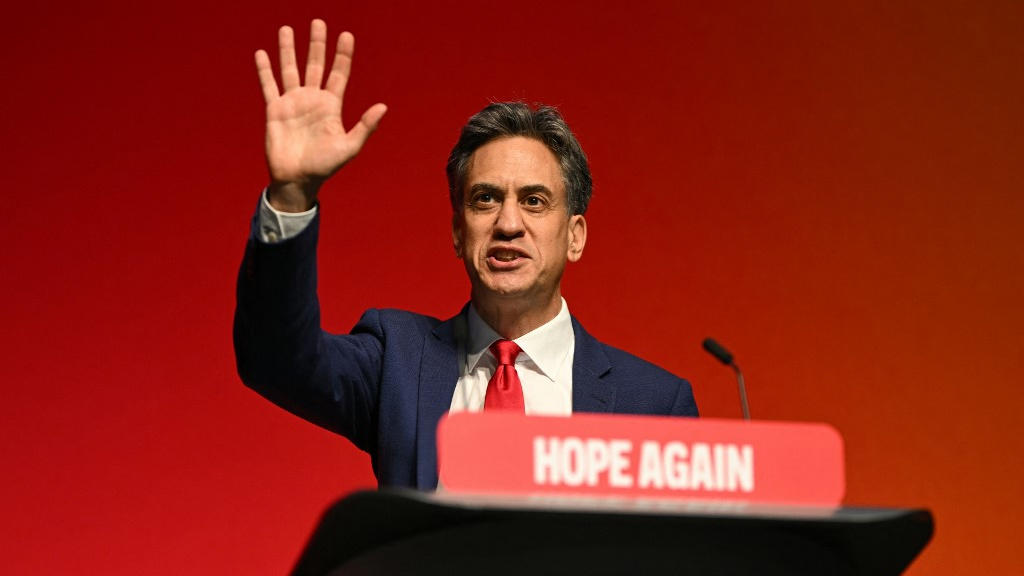
Delivering his first keynote address as UK Foreign Secretary at the Labour Party conference in Liverpool, Ed Miliband offered a direct response to millions of people across the UK and the globe who have been deeply moved and angered by the ongoing crisis facing the Palestinian people, telling them: “We hear you, you were right.”
Miliband used his debut speech in the senior diplomatic role to lay out a new direction for British foreign policy under the new Labour government led by Prime Minister Andy Burnham, who recently replaced Keir Starmer in Downing Street. The new administration has formally reset the UK’s approach to the Israeli-Palestinian conflict, breaking sharply from the prior government’s stance.
In his address, Miliband made clear the new government’s unambiguous commitments: it explicitly calls out ethnic cleansing carried out by settler terrorists in the occupied West Bank, confirms the documented evidence of war crimes in Gaza, and officially labels Israel’s decades-long illegal occupation of Palestinian territory. Crucially, Miliband emphasized that the new approach pairs public condemnation with concrete policy action.
These pledges build on announcements Miliband made earlier this month, when he first formally designated Israel’s occupation of Palestinian lands as illegal, unveiled sweeping sanctions targeting Israeli settlements, and enacted a full ban on all arms licenses and exports that could materially contribute to sustaining the occupation. In a significant diplomatic win for the Burnham government, France and Canada have since followed Britain’s lead in banning goods produced in illegal Israeli settlements.
Miliband framed the UK’s new policy as a catalyst for broader global action, noting that Britain’s decision to move first has mobilized the international community, with more nations joining the effort in sequence. “This is how to make change happen in today’s world,” he said. “Doing what is right and galvanising others to act too.” He added that Britain’s national interests are advanced when it upholds its core values on the global stage, and that building effective multilateral coalitions on pressing global issues depends on the country’s ability to bring other nations along.
The new foreign policy framework echoes what has become known as the Carney Doctrine, a concept outlined by Canadian Prime Minister Mark Carney last year that calls for a formal alliance of mid-sized powers. While unstated explicitly, the alliance is designed to act as a balanced counterweight to the influence of global superpowers, most notably the United States. Miliband also drew loud cheers from Labour Party delegates when he confirmed that the UK’s foreign policy future centers on building a stronger, deeper partnership with the European Union.
Outlining further concrete steps, Miliband reaffirmed that the government will prohibit all imports of goods originating from illegal Israeli settlements, disrupt supply chains linked to British finance, construction, and corporate services that support illegal settlement activity, and will block any efforts to eliminate the two-state solution as a path to peace. “When it comes to the attempt to destroy the two-state solution, this party, this movement, this government, says ‘we will not let you succeed’,” he said.
While Miliband acknowledged the grassroots pressure that pushed the government to adopt a new stance on Palestine, the new administration continues to face criticism for maintaining a controversial policy implemented under Starmer’s tenure: the proscription of the direct action group Palestine Action. On Sunday and overnight ahead of the conference, roughly 150 people were arrested outside the conference venue for holding signs reading “I oppose genocide. I support Palestine Action.”
Lindsey Graham, convenor of the Stop the War Coalition – which has organized nationwide mass protests against what the group calls Israel’s genocide in Gaza – responded to Miliband’s speech with pointed criticism. “For nearly three years our pro-Palestine movement has brought hundreds of thousands of people on to the streets of this country, demanding the British government ends its complicity in the Gaza genocide and stops arming Israel,” Graham said. He argued that Miliband’s silence on the status of Palestine Action and the government’s crackdown on the right to protest risks coming across as blatant hypocrisy. “If he truly believes in his responsibility to leave the world a better place then he would join us in demanding Burnham and the home secretary de-proscribe Palestine Action, reverse the legislation that now criminalises large amounts of previously lawful protest and drop the charges!” Graham added.
Beyond the Middle East, Miliband used his speech to reiterate the UK’s unwavering support for Ukraine in the face of Russia’s full-scale invasion. He declared that Britain will stand with the Ukrainian people until they achieve victory, drawing a parallel to World War Two when Britain acted as a beacon of light as fascism spread across Europe. Miliband argued that today, just as in 1945, the current generation and the new Labour government have a duty to play their part in upholding global values of democracy and the rule of law.