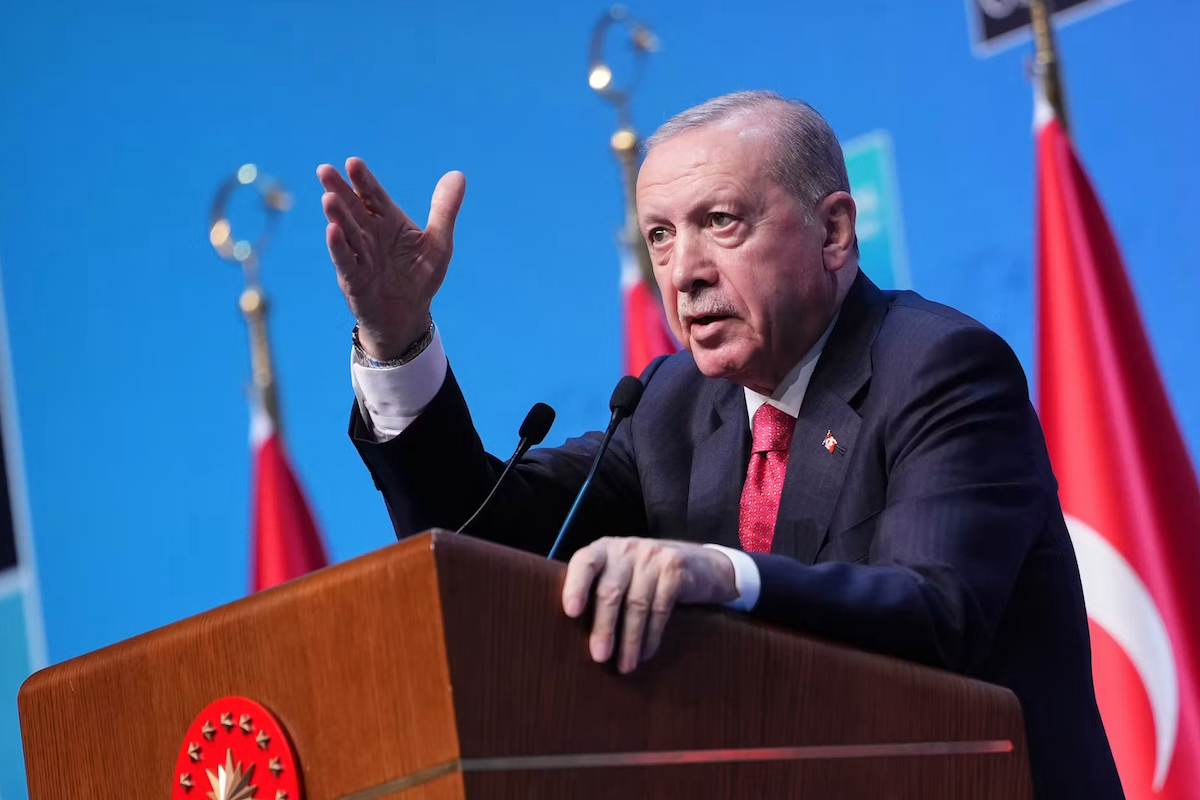
Just two months after hosting the NATO summit in a move designed to cement Turkey’s status as a cornerstone of transatlantic security, President Recep Tayyip Erdogan has announced plans to pursue full membership in the Shanghai Cooperation Organisation (SCO), a China- and Russia-led bloc often framed as a counterweight to NATO, even dubbed by some a “rogue NATO” that challenges Western-led international order.
This seemingly contradictory policy shift has reignited longstanding speculation: is Turkey gradually abandoning its Western alignment to pivot toward the East? But this debate rests on an outdated assumption of a rigidly divided world of competing, monolithic blocs. In reality, today’s global landscape is defined by overlapping, often conflicting international orders, each with its own institutional frameworks, norms, and claims to global authority. Far from signaling a full pivot, Turkey’s latest move is a deliberate assertion of strategic autonomy, as it navigates across these overlapping systems to advance its own interests.
The post-Cold War vision of a single, unified global order centered on Western institutions is becoming increasingly unsustainable. NATO now coexists alongside emerging power coalitions and region- or issue-specific partnerships that do not answer to Western leadership. While these orders overlap, they are rarely fully compatible, with competing norms and political visions that open space for middle powers to engage with multiple blocs without submitting fully to any single one’s authority.
Turkey has walked this line for decades: it has retained its deep roots in NATO (a member since 1952) and maintains extensive economic ties to the European Union, where it remains a formal candidate for membership. At the same time, it has steadily deepened diplomatic, economic, and strategic connections to Russia and China, and has been an SCO dialogue partner since 2012. It has also carved out a larger independent role for itself across the Middle East, Africa, the Caucasus, and Central Asia.
Critics often dismiss this approach as inconsistent or opportunistically tactical, but as Spyros A. Sofos, assistant professor in global humanities at Simon Fraser University, argues in his new book *Turkey, Geopolitics, and the Age of Populist World-Making*, Turkey’s flexible diplomacy reflects a deliberate broader goal: expanding its freedom of action by preventing any single alliance from locking in its international role.
Erdogan frames Turkey not as a peripheral state trapped between rival blocs, but as an independent regional power capable of shaping the contours of the global system itself. This approach extends his domestic populist political strategy onto the international stage. Just as he has positioned the Turkish people as a group long silenced by entrenched domestic elites, he frames Turkey as a nation denied its rightful global status by Western-dominated international hierarchies. Sofos terms this approach “populist world-making”: a framework that recasts global politics as a struggle between historical hegemons that have long controlled the international order, and states whose agency and rightful status have been systemically marginalized.
For Erdogan, full SCO membership is not intended to replace Turkey’s NATO membership. Instead, it adds another diplomatic and economic arena where Turkey can pursue its interests without ceding exclusive influence to Western powers. In practice, this means Turkey engages in what can be described as “forum shopping”: it moves flexibly across institutions, coalitions, and diplomatic processes, crossing supposedly fixed bloc boundaries whenever doing so expands its influence or loosens external constraints on its policy.
The SCO membership bid is just the latest example of this longstanding strategy. In Libya, for instance, Turkey provided military backing to the UN-recognized national government, and openly criticized France and other NATO allies for supporting opposing factions. Yet at the same time, Turkey pursued a policy of what Sofos calls “competitive coexistence” with Russia, which backed the opposing side: Turkey toned down its rhetoric and avoided direct military confrontation with Russian forces operating in the country.
Turkish rivalry with France has also played out in the African Sahel, where Turkey expanded trade, development aid, and defense cooperation — including the sale of Turkish combat drones — by leveraging growing resentment among regional governments over France’s ongoing military presence and lingering post-colonial influence. In the Eastern Mediterranean, Turkey has aggressively challenged a French-backed cooperation agreement between Greece, Cyprus, and Israel over maritime jurisdiction and energy development, a deal Ankara views as deliberately exclusionary of Turkish interests.
Syria offers an even clearer illustration of Turkey’s commitment to flexible forum shopping. Like other NATO members, Turkey has opposed the regime of Bashar al-Assad. Yet it has worked alongside Russia and Iran through the exclusive Astana peace process, a framework independent of the Western-led Geneva talks, to manage competing interests and de-escalate armed conflict across northern Syria. Even though the three states supported opposing factions and held conflicting core objectives, they built a parallel diplomatic forum outside Western-led structures because it served each of their individual national interests.
Turkey’s complicated relationship with Russia follows the same playbook. Turkey publicly condemned Russia’s full-scale invasion of Ukraine, supplied lethal weapons to Kyiv’s armed forces, and enforced international agreements by closing the Turkish straits to Russian warships. Yet at the same time, Ankara refused to join Western-led sanctions on Moscow, and maintained close economic and diplomatic ties with the Kremlin. This flexible stance allowed Turkey to broker the landmark Black Sea Grain Initiative, a deal that enabled grain exports from Ukraine’s Black Sea ports and gave Ankara a high-profile diplomatic role that no rigidly aligned state could have claimed.
The message from Ankara is unambiguous: Turkey will not automatically align with NATO on every global issue. Instead, it leverages its membership in multiple overlapping blocs to preserve its strategic autonomy and prevent any single bloc from dictating its foreign policy choices.
That said, Turkey’s room for maneuver is not unlimited. Its economy remains heavily dependent on access to European markets and Western capital, and its core security architecture still relies on NATO collective defense commitments. Meanwhile, Russia, China, and Iran are partners in some policy arenas but direct competitors in others.
While forum shopping expands Turkey’s strategic autonomy, it also creates persistent friction, erodes trust among alliance partners, and carries the risk of overextending Turkish influence across too many regions. Sofos emphasizes that “populist world-making” is not a rigid grand strategy to rewrite the global order, but rather a political orientation: an effort to convert diplomatic flexibility into greater global status and recognition for Turkey.
At its core, Erdogan’s policy rejects the idea that external powers should define Turkey’s foreign policy choices. He is not seeking to exit the existing international order entirely; instead, he is pushing for a more prominent position within it, and global recognition of Turkey as a major power entitled to help shape the future of global governance.