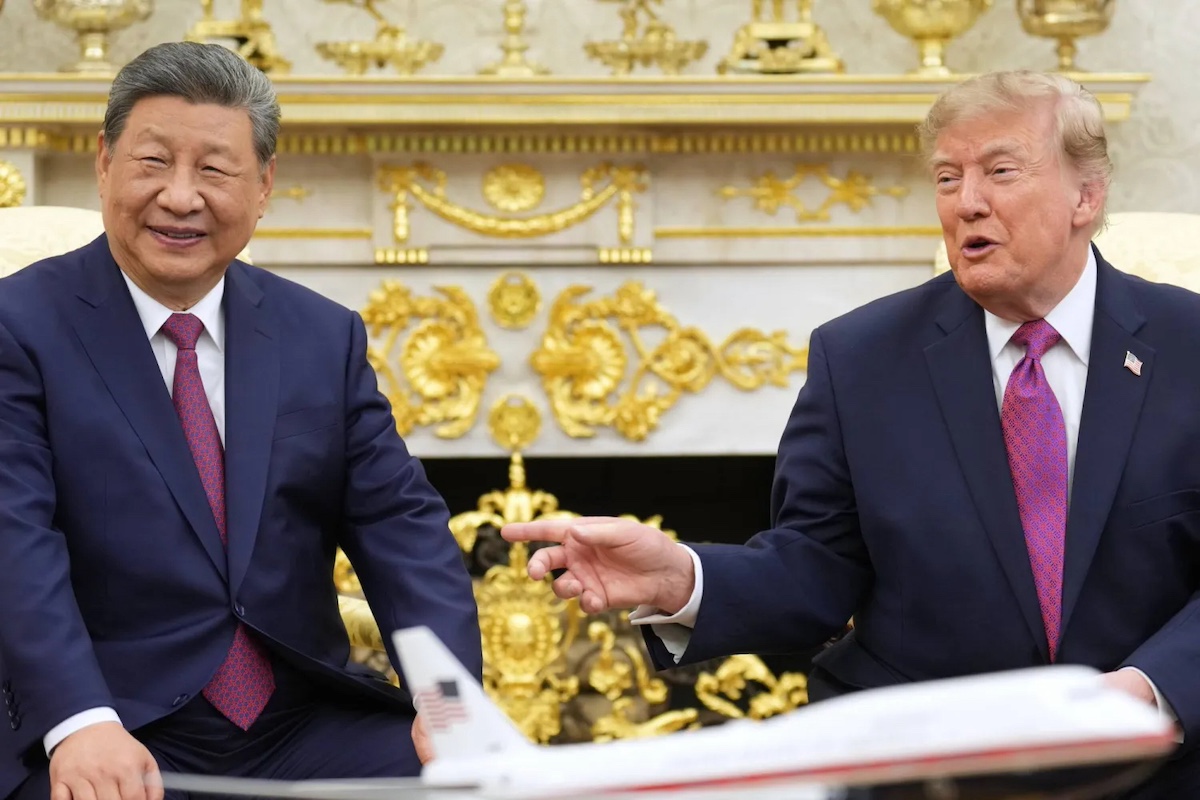
When Chinese President Xi Jinping touched down at Joint Base Andrews for his 2026 state visit to Washington, US President Donald Trump extended a rare, high-profile welcome, greeting the Chinese leader in person against a backdrop of full state pageantry: a red carpet procession, an official cannon salute, a curated state dinner, and a ceremonial bald eagle sculpture gifted to Xi. Even before the visit began, cross-partisan critics warned that the elaborate ceremony would legitimize what Washington has long framed as a strategic rival. But behind the ceremonial fanfare, a quiet, fundamental shift was unfolding in the trajectory of the world’s most consequential bilateral relationship.
Months earlier, at a summit in Beijing, the two leaders had already laid the conceptual groundwork for a new framework: a “constructive China-US relationship of strategic stability.” Each term in this new formula carries deliberate weight: “constructive” commits both sides to advancing shared positive priorities rather than merely managing confrontation; “strategic” anchors the relationship in long-term, leader-level statecraft rather than short-term political posturing; and “stability” sets clear guardrails to prevent uncontrolled escalation. During Xi’s Washington visit, this rhetorical framework moved from a conceptual agreement to a tangible working plan — marking a sharp break from the framing that shaped US-China relations from 2018 through the mid-2020s.
During Trump’s first presidential term, Washington launched a full-scale trade war against Beijing, imposed sweeping tariffs on hundreds of billions of dollars in Chinese goods, and enacted strict technology sanctions on leading Chinese firms including Huawei. The White House pushed multinational corporations to adopt the “China+1” strategy, which required moving manufacturing capacity out of China to build alternative supply bases in Vietnam, India, or Mexico, and positioned full economic decoupling as the end goal.
In response to this pressure over nearly a decade, Beijing systematically diversified its trade partnerships across Southeast Asia, Latin America, and Africa. Data from the McKinsey Global Institute’s 2026 report on global trade flows shows that bilateral US-China trade dropped by roughly 30% in 2025 alone. But over the same period, China built out a comprehensive, strategically vital end-to-end supply chain, spanning from raw basic materials to cutting-edge advanced manufacturing equipment. Today, China is the only economy in the world that covers every single one of the 41 industrial categories and 666 sub-categories defined by United Nations industrial classification. It supplies advanced machinery, critical components, and core materials to manufacturing facilities across the globe, leading McKinsey to label China the “factory to the world’s factories” — a shift also documented by *The Wall Street Journal*.
Far from displacing China from global supply chains, the “China+1” strategy ultimately pushed China to move up the global value ladder. The alternative production hubs that Washington encouraged — India, Vietnam, and Mexico — have largely ended up functioning as final assembly points for Chinese components and intermediate goods. Today, the once-ubiquitous term “China+1” has all but disappeared from mainstream discourse in Washington. No senior administration official or leading American business executive uses the phrase anymore; Washington has effectively abandoned the policy framing.
This shift could not be more clearly illustrated than by the guest list at the Trump-Xi state dinner. Seated alongside the two heads of state at the head table were the chief executives of America’s largest technology firms: Apple’s Tim Cook, Nvidia’s Jensen Huang, AMD’s Lisa Su, and Tesla’s Elon Musk. All four leaders have openly acknowledged that China is irreplaceable to their businesses, both as the world’s largest consumer market for their products and as a core base of their global supply chains.
According to Apple’s vice president for Asia procurement and operations, the company’s first foldable smartphone, the iPhone Duo, was entirely developed, trial-produced, and assembled in China — not in India or Vietnam, as many had predicted would happen under decoupling pressure. Tesla, which once announced plans to phase out Chinese suppliers for vehicles built in its US factories, is now actively sourcing multiple components from Chinese suppliers for its Optimus humanoid robot, and has already finalized orders. For months, Jensen Huang has publicly argued that US chip export controls on China are backfiring and eroding American semiconductor competitiveness, while Lisa Su has reaffirmed AMD’s commitment to deepening its market and operational engagement in China.
The logic that guides large American tech firms also holds for smaller businesses. Last week, California-based battery startup EnerVenue announced it had launched full mass production at its new facility in Changzhou, China, after scrapping plans to build a $264 million factory in Kentucky. The company’s chief executive cited China’s unmatched skilled workforce and integrated supply chain ecosystem, echoing the “factory of factories” framing used by independent analysts. Chinese business outlets have also documented dozens of cases where American manufacturers that shifted orders to India or Southeast Asia to avoid US tariffs encountered widespread quality control issues and delivery delays, ultimately moving production back to their original Chinese suppliers.
During the formal toasts at the state dinner, both leaders grounded the new bilateral direction in shared history, with a particular focus on expanding people-to-people and business-to-business ties. Trump highlighted the long-standing foundation of commercial exchange and mutual respect between the two nations, emphasizing the enduring people-to-people connections that outlast political shifts. Xi recalled the early trade ties that formed shortly after American independence, the Hump Airlift operation that supported the Allied war effort against Japan during World War II, and the iconic Ping-Pong Diplomacy that paved the way for bilateral normalization decades ago. He also highlighted a small, symbolic people-to-people story: Ronald Sakolsky, an American teacher who donated $5,000 to support a Chinese woman’s desert reforestation project 20 years earlier, who had recently returned to see the full forest that his donation helped grow.
The most strategically significant remark of the visit came when Xi framed China’s pursuit of national rejuvenation and Trump’s “Make America Great Again” domestic agenda as initiatives that “can surely be mutually reinforcing.” This framing directly challenges the dominant narrative in Washington that the US-China relationship is doomed to the Thucydides Trap — the theory that a rising power and an established incumbent power will inevitably clash in war. Xi rejected this zero-sum premise, offering an alternative vision: two great powers pursuing national renewal do not have to collide, and can instead cooperate under a new framework for major power coexistence.
This shift in direction does not mean that long-standing rivalry and competition between the two powers have disappeared, or will fade in the near future. Just two months before the visit, in July 2026, the US Federal Communications Commission added foreign-made humanoid and industrial robots to its list of restricted covered technologies, a move that Beijing formally condemned. Existing US chip export controls on China remain fully in place, and official trade data shows that China’s exports of rare earth magnets to the US fell 21% in August 2026 to 512 tons, on track to hit their lowest annual level since 2021. Key flashpoints including the Taiwan issue, Iran’s nuclear program, and global artificial intelligence safety regulation will continue to test the new “constructive relationship of strategic stability” framework. Even so, both leaders have explicitly committed to upholding the guardrails that this new model provides.
Where the first Trump administration launched decoupling and the “China+1” strategy, the second Trump administration now recognizes China as an equal negotiating partner, a critical supplier that the US economy cannot easily replace, and the other half of the only G2 that shapes global outcomes.
The ceremonial events at Joint Base Andrews and the White House East Room will soon fade from front-page headlines. But the enduring takeaway from Xi’s 2026 state visit is clear: Washington has abandoned its public rhetoric of withdrawing from China, and corporate America never truly left in the first place.
This analysis is by Xin Wang, Professor of Chinese Studies and Director of Asian Studies at Baylor University.