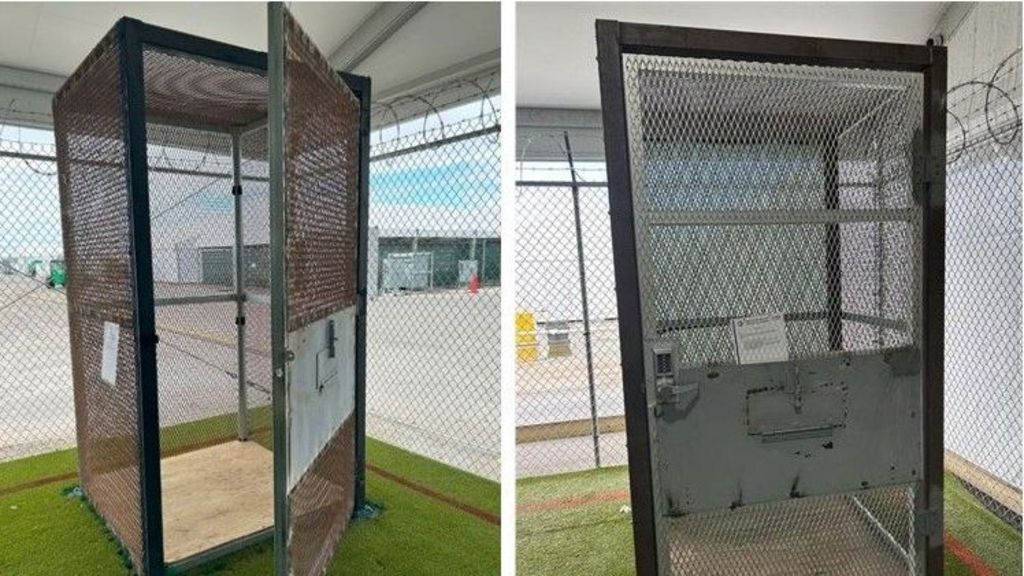
A damning new report from the U.S. Department of Homeland Security’s independent Office of the Inspector General (OIG) has pulled back the curtain on abusive and substandard conditions at Florida’s now-closed controversial immigrant detention site dubbed “Alligator Alcatraz,” confirming widespread violations of basic hygiene, safety and humane treatment standards.
Constructed in just eight days back in 2025 along Florida’s protected Everglades wetlands — a region infamous for its large population of wild alligators — the facility was launched via executive order from Florida Governor Ron DeSantis, with federal taxpayer funds covering all operational costs. Though the site was framed as a temporary overflow facility for migrant detention, it quickly gained national notoriety for its harsh conditions, even drawing a quip from former President Donald Trump, who toured the site in July 2025, that detained immigrants would need to “learn how to run away” from the area’s native alligators. Civil rights organizations immediately condemned the facility as fundamentally inhumane from its opening, and DeSantis announced its permanent closure in June 2026, reiterating that it was always intended to be a temporary operation.
The OIG, an independent oversight body within DHS whose current leader was appointed by Trump during his first presidential term, carried out an unannounced inspection of the site in January 2026, months before its closure. Its investigation uncovered a pattern of dangerous and noncompliant operations that deviate sharply from national detention standards.
One of the most alarming findings centers on the facility’s use of tiny 18-square-foot outdoor metal cages, which site administrators labeled “calming areas” for de-escalation and private time. Between the facility’s opening in July 2025 and the OIG inspection in January 2026, a total of 79 detained immigrants were held in these enclosures for periods ranging from a few minutes to nearly two hours, with at least one detention used as a disciplinary punishment. The OIG concluded that the use of such restrictive small cages is “unprecedented among detention facilities” across the United States, and explicitly dangerous. “The use of such restrictive spaces is highly unconventional and does not align with standards for humane treatment,” the report reads.
Beyond the improper use of metal cages, the inspection confirmed multiple failures to meet basic standards for healthcare, hygiene, food, safety and adequate living space. Detainees previously told the BBC they were denied necessary prescription medication and access to regular hygiene services, claims the OIG investigation validated. Inspectors documented that detainees were only permitted to shower three times per week, and shower facilities were heavily infested with small insects. Detainees also reported, and inspectors confirmed, a lack of access to reliably clean drinking water, with no way to properly sanitize the plastic drinking cups provided to them. The facility also failed to meet minimum space requirements, leaving detainees held in cramped housing units where they spent the vast majority of their time with no room to move.
In its official response included in the OIG report, DHS pushed blame for the facility’s operations onto Florida state officials, noting that state authorities held full control over day-to-day management of the site, even as the federal government covered operating costs. The BBC has reached out to DHS’s Immigration and Customs Enforcement (ICE) and Governor DeSantis for additional comment on the report’s findings, and has not yet received responses.