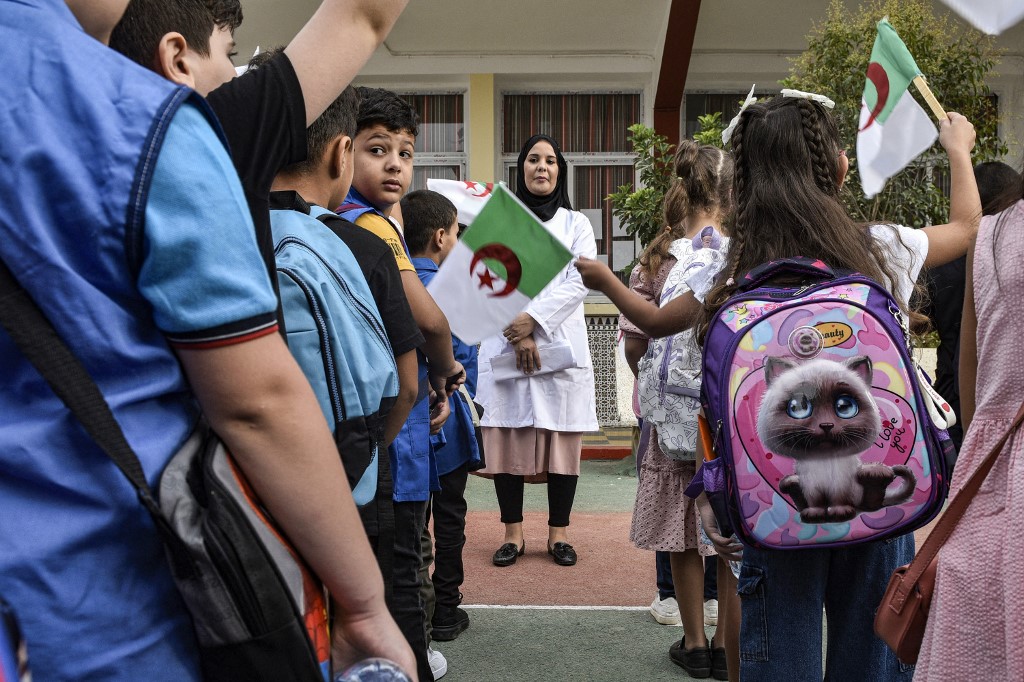
A seismic shift is reshaping Algeria’s national education system, as English moves to center stage as the first mandatory foreign language for primary school students – a change that comes at the expense of French, and has stirred fierce national debate over pedagogy, colonial legacy, and geopolitical alignment. For the 2024-2025 school year, the reform takes full effect: three years after English was first piloted in primary education, all third-grade pupils will now learn only English, with French instruction delayed until fourth grade, when it will be taught as a second foreign language alongside English.
This policy marks a break from a 61-year status quo. From Algeria’s independence from French colonial rule in 1962 through 2023, French held the position of the only foreign language taught to third-grade primary students. The current overhaul traces back to a directive from President Abdelmadjid Tebboune, who has framed the expansion of English as a strategic investment: he argues English is the global lingua franca of modern science, making early instruction critical for Algeria’s younger generations. The reform does not stop at primary school; secondary education will also see expanded English teaching hours and a higher weighting for the subject in national end-of-cycle exams, though French instruction in high school remains unchanged for the moment.
The rollout of the reform has unfolded against a backdrop of institutional upheaval. Algeria’s largest teachers’ union, Cnapeste – which previously criticized the English expansion as a reckless, unprepared move citing a critical shortage of properly trained educators – was dissolved by state authorities last July over alleged violations of strike regulations. Union leaders reject the charges, framing the dissolution as an intentional effort to silence a vocal critic of government policy. With the main union body eliminated, no major teachers’ association has issued formal comment on the final implementation of the reform.
Opinions are deeply split among other stakeholders. The National Federation of Parents of Students Associations, which typically aligns with the education ministry’s policy agenda, has welcomed the change. The group argues that mastery of English opens doors to global science, technology, and improved higher education and employment opportunities for Algerian youth. But many parents share Cnapeste’s earlier concerns, questioning whether the government can deliver on the promise of quality English instruction.
Rachida Mahi, a 36-year-old Algiers-based engineer, is one skeptical parent. Her son is starting third grade this year, the first cohort to receive English-only instruction at that level, and she worries the rushed rollout will harm his academic progress. “How will the state manage to provide every school with qualified English teachers in sufficient numbers? Where does it plan to find them?” Mahi asked in an interview with Middle East Eye. Like many Algerians of her generation, Mahi learned French throughout her schooling and completed her engineering degree in French, speaking very little English – leaving her unable to support her son with his homework, a reality that leaves her panicked.
To understand the stakes of this language shift, one must look back at decades of linguistic policy in post-independence Algeria. Immediately after ending French colonial rule in 1962, the new government established Arabic as the sole national and official language, launching a gradual process of Arabization to erase colonial linguistic legacy. That policy reached its peak in 1991, when a law mandated the use of Arabic across all areas of public life and education. But Arabization never fully succeeded: while law and social sciences were transitioned to Arabic instruction at the university level, scientific fields including medicine and engineering remained French-led, due to a lack of Arabic-language teaching materials and a shortage of educators trained to teach these subjects in Arabic. Even today, most leading global academic research is only accessible in foreign languages, primarily French and English. In line with his primary school reform, Tebboune has already announced plans to phase out French and replace it with English in medical studies by 2025, framing the move as a “wise” step that will align Algerian higher education with global scientific standards, where English is the dominant working language.
Education and language specialists widely share concerns about the rushed implementation of the reform. Salah Derradji, a veteran language didactics specialist and former university rector, says he has long supported the gradual expansion of English across all education levels – but argues the current rollout lacks the deliberate planning the project requires. “This project must be carried out thoughtfully. And that is not the case today,” Derradji told Middle East Eye. He characterizes the reform as a political, rather than pedagogical, decision, noting that “You cannot train teachers in a few weeks and send them into classrooms. You first need qualified trainers,” adding that the government failed to hold broad consultation with academic specialists before moving forward.
Rabeh Sebaa, a retired professor of sociology and anthropology at the University of Oran, echoes this criticism, arguing simply that “Algeria does not have the means to teach English – or teach in English – whether in schools or universities.” Back in 2022, as the government prepared to introduce English in primary schools, it launched a high-profile recruitment drive to hire 60,000 new English teachers, targeting university graduates with degrees in English language, literature, and interpretation. But education unions immediately criticized the campaign, pointing out that most new hires lacked any formal pedagogical training and received only rushed, inadequate preparation before entering classrooms.
Hamid Hani, a 42-year-old parent from Bejaia, has seen the impact of underqualified hiring firsthand. His daughter is entering secondary school this year, and after two years of English instruction with an untrained young teacher, she still cannot speak English comfortably. “This teacher admitted to me during a parent-teacher meeting that she had to manage on her own to find teaching materials and organise her lessons,” Hani said. He accuses the government of gambling with children’s futures through “improvised measures” that put political goals ahead of quality education. Ahmed Tessa, an education specialist and author of a book on the status of French in Algerian schools, agrees, arguing that the reform “is an ideological rather than pedagogical decision.” He questions how quality instruction can be expected when new graduates are sent into classrooms without the minimum two years of initial pedagogical training required to teach effectively.
Beyond questions of implementation, the reform has reignited a decades-long national debate over the legacy of French colonialism and Algeria’s ongoing relationship with France. The push to downgrade French comes at a moment of already heightened diplomatic tensions between Algiers and Paris, which escalated in 2024 after French President Emmanuel Macron publicly endorsed Morocco’s claim to sovereignty over Western Sahara – a position that directly contradicts Algeria’s longstanding support for the Polisario Front’s push for an independent Sahrawi state.
Proponents of the reform frame the shift as a necessary assertion of national sovereignty and a break from colonial oppression. El Hachemi Djaaboub, a former minister from the Movement of Society for Peace (MSP), an Islamist-aligned party known for its criticism of French influence, has called the delay of French instruction an act of national sovereignty, and accused critics like Tessa of advancing foreign interests. Abderrazak Makri, former president of the MSP, has called for a complete break from French linguistic legacy: “We must put an end to France’s colonial legacy. Even President Macron speaks more English than French abroad. Today, English is the universal language; it is time for Algerians to adopt it and align themselves with great nations,” he said in 2022. This view resonates with a segment of the Algerian public, with social media discussions reflecting growing support for framing French as a colonial leftover that should be removed entirely from national education. In France, right-wing and far-right media have already seized on the reform, criticizing Algeria’s move as an intentional effort to erode French cultural and political influence in North Africa.
Critics of the reform, however, push back against the ideological framing, arguing that language policy should be separated from anti-colonial politics. A small number of Algerian political parties, including the Rally for Culture and Democracy and the Workers’ Party, oppose downgrading French, arguing that foreign language instruction should be complementary, not a tool for ideological conflict. Sebaa characterizes the push to eliminate French from education as “visceral, ideologically driven postures.” He notes that many proponents of the shift studied at English-language universities and view English as a neutral global language, while framing French exclusively as a symbol of colonial domination. But Sebaa, who has published research on Algerians’ historical relationship with French, challenges this narrative. He points out that at independence, less than 20% of Algerian children attended colonial schools, meaning the “francisation” of Algerian culture was far less pervasive than often claimed. For most Algerians who lived under colonial rule, French was not only a tool of oppression but also a path to social advancement and cultural expression: the mid-20th century saw the rise of a vibrant body of Algerian literature written in French, with iconic writer Kateb Yacine famously describing French as “a war booty” that Algerians had claimed as their own.
Critics warn that downgrading French will carry long-term harmful consequences for Algeria. Tessa argues that the move threatens to erode Algeria’s existing French-language cultural production and erase a key strand of the country’s collective memory that is expressed in French. He also warns that shifting away from French will distance Algeria from its neighboring geopolitical environment, which remains majority francophone, and break cultural and social ties between Algerian citizens and the millions of Algerian diaspora members and their descendants living primarily in France and French-speaking Quebec. Today, Algeria is the third-largest francophone country in the world by population, according to the International Organisation of La Francophonie, with an estimated 15.6 million Algerians – roughly one-third of the total population – speaking French.