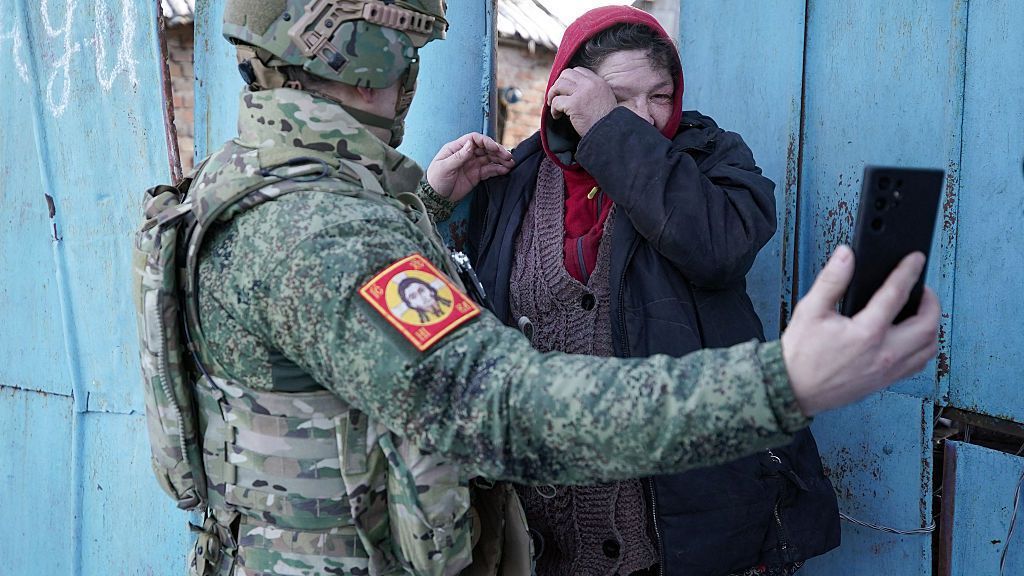
More than two years after Ukrainian forces pushed across the border into Russia’s Kursk region, dozens of local families are still grappling with unanswered questions, overwhelming grief, and growing resentment toward the Russian government over its failure to support efforts to locate their missing loved ones.
The 2024 incursion, which saw Ukrainian troops seize over 777 square kilometers of Russian territory over six days, was launched as a strategic maneuver to divert Russian military resources away from Kyiv’s frontline offensive operations. Within days, Ukrainian forces captured two key border checkpoints, took roughly 40 Russian prisoners, and struck a military convoy, holding control of the Sudzha district and surrounding areas for eight months. During that period, most mobile and internet connectivity across the occupied zone was completely cut off, leaving family members who had fled the fighting with no way to contact relatives who chose to stay behind.
For many residents who remained in the captured settlements, the choice to stay came after years of heavy messaging from Russian state media. Lyubov, a local woman whose 75-year-old mother stayed in the village of Darino, says she repeatedly begged her mother to evacuate, but state television propaganda convinced her the incursion would be over in days and everything would quickly return to normal. “State channels kept telling viewers everything was under control, that it would all be sorted out in two or three days,” Lyubov recalled. “My mother believed them, and she refused to leave.” Russian officials estimate around 2,000 civilians stayed in the settlements that fell under Ukrainian control.
As fighting dragged on and Russian forces launched counteroffensives to retake the territory by late autumn 2024, desperate family members stepped in to do what government agencies had not. A group of more than 100 relatives penned a joint letter to Russian President Vladimir Putin, Ukrainian President Volodymyr Zelenskyy, and the United Nations requesting a dedicated humanitarian corridor to evacuate trapped civilians, but no such corridor was ever established. Left with no official support, the families formed independent search groups, compiling their own lists of missing residents, cross-referencing names with footage published by Ukrainian media and the military, and documenting reported deaths and burial locations. By the time the collective list grew to nearly 1,000 names, it remained a purely volunteer effort.
Multiple requests for official help went unanswered. Lyubov says she reached out to both the International Committee of the Red Cross and the Kursk regional interior ministry with appeals for information about her mother, but never received a single response. In early 2025, Russia’s federal human rights commissioner released an official list of 517 reported missing Kursk residents, but the document was so riddled with errors that it mixed the names of missing people with the names of the relatives searching for them. Outraged families called the botched list a slap in the face to grieving loved ones, with one young woman who lost both parents posting online that the publication represented “the height of incompetence and a total lack of basic respect” for affected families.
After Russian forces retook Darino village in late 2024 – where officials confirm 90 percent of structures were destroyed in heavy fighting – they began evacuating surviving civilians and recovering the bodies of those who did not make it. An evacuee from Darino eventually reached out to Lyubov with devastating news: her mother had died several weeks earlier from an untreated head injury, one of multiple elderly residents who perished after being trapped in harsh wartime conditions. But for months, Lyubov still had no way to locate her mother’s remains, as officials repeatedly told her the area remained too dangerous to search for missing bodies.
Even volunteer recovery efforts have been left to self-fund. Yuri Tkachev, a local village council head who joined volunteer body recovery missions, says volunteers and private donations cover all costs for body bags, fuel, and transportation – authorities have provided no financial or logistical support. While regional officials held multiple meetings with the search group in the second half of 2025, relatives say the talks yielded no tangible change or support.
It was not until last October that Lyubov finally got an answer, during a trip to the regional capital Kursk. When she asked about unidentified bodies matching her mother’s description, a mortuary official pulled up a photo from April 2025. Lyubov immediately recognized her mother’s face and the old wool jumper she wore for gardening. Lyubov had submitted a DNA sample to authorities back in January to help identify remains, but officials told her the sample had been lost – meaning her mother’s body had gone unidentified in the mortuary for six months. Unable to bury her mother in the destroyed village of Darino, Lyubov had her cremated, and her ashes now sit on a shelf in Lyubov’s apartment in Belgorod, roughly 100 miles from her mother’s former home.
The BBC reached out to the Kursk regional governor’s office, Russia’s human rights commissioner, and the Russian Red Cross for comment on the families’ allegations, but none responded to requests. Ukrainian officials, including the command of Ukraine’s Territorial Defense Forces and Ukraine’s human rights commissioner, say all civilians evacuated from Kursk by Ukrainian forces have already been transferred back to Russian authorities.
For Lyubov, the loss of her mother has transformed her long-held faith in the Russian state into open resentment, a rare stance in a country where public criticism of the 2022 full-scale invasion of Ukraine is heavily suppressed. She still remembers a time when border life was peaceful: she would regularly cycle across the border into Ukraine to buy groceries, yarn, and ice cream, visiting with neighbors on both sides. “We went to see them, they came to see us,” she said. “And now not one of those villages exists any more.”
Local officials have publicly stated that more than 300 people remain unaccounted for in Kursk, but independent search organizers say the true number of missing civilians is almost certainly higher, with no centralized, accurate official database to confirm the full scale of the crisis.