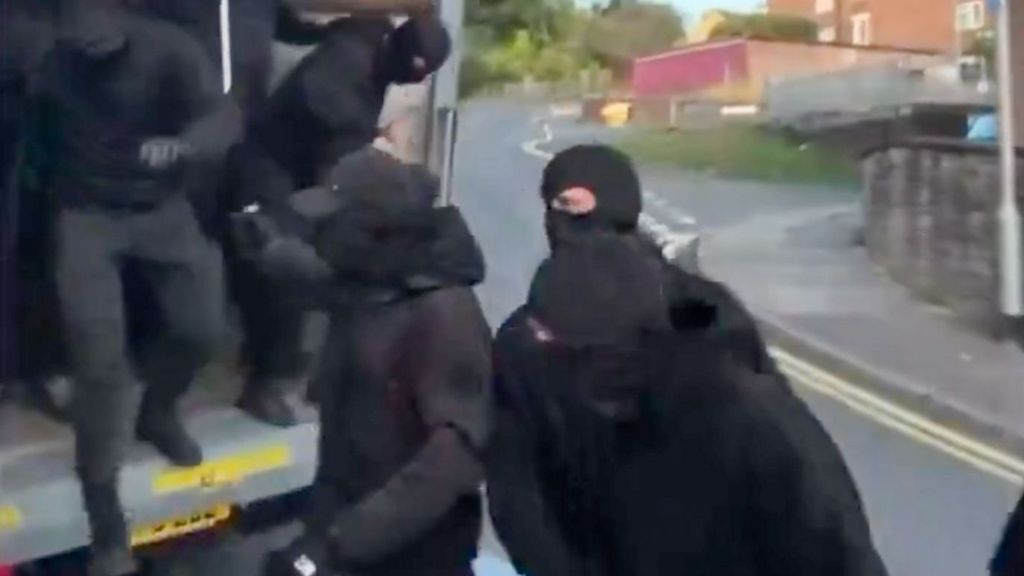
In early Saturday morning, a coordinated paramilitary-style anti-immigration protest near the Port of Dover sent shockwaves across British politics, marking the public debut of a newly formed far-right faction called Patriot Platform. The demonstration, organized by former convict turned far-right activist Danny Thomas (known to his supporters as Danny Tommo, introduced a radical new approach to far-right activism that differs sharply from the chaotic street violence of earlier movements like the English Defence League (EDL) once led by Tommy Robinson.
The operation unfolded with unusual precision. Dozens of predominantly male protesters, all clad in black clothing and paramilitary balaclavas, gathered under the cover of darkness the night before the protest in the quiet Kent village of Preston-next-Wingham. After leaving their vehicles scattered across the village hall car park and local recreation ground, the group boarded a small convoy of lorries that departed shortly after sunrise for Dover, where they joined at least two other waves of arriving activists.
Once assembled, the protesters formed rigid, serried ranks to block major roads surrounding the port, staring down passing motorists and responding police officers without engaging in open violence. Local resident Robin Burkhardt described the scene to the BBC, saying, “I seriously thought we’d been invaded by Russians.” After several hours of disruption, before law enforcement could fully mobilize to contain the demonstration, the group dispersed in an orderly fashion to Dover Priory railway station, leaving the area with estimates of total participation ranging between 200 and 500 people. Chants of “Stop the Boats” and “Christ is King” echoed through the protest, a clear signal of the group’s combined anti-immigration and Christian nationalist framing.
Just one day later, Thomas leveraged social media live streaming to organize a second, more spontaneous demonstration in his hometown of Portsmouth, where hundreds of activists attempted to block coaches transporting migrants who had crossed the English Channel illegally from northern France. The new tactics have already drawn a firm response from the UK government: UK Home Secretary Shabana Mahmood held an urgent meeting with senior police leadership just four days after the Dover protest, urging officers to fully use existing legal powers to ban face coverings at such events.
“These scenes have caused disruption for people and, given that people are dressed in black wearing balaclavas, there is a fear factor and obvious malign intent being communicated to our residents,” Mahmood told reporters after the meeting. “This makes it different from other protests, so we need to make sure we are learning lessons.”
Unlike earlier generations of British far-right activism, which often relied on spontaneous, violent street clashes, Patriot Platform has borrowed disruptive, attention-grabbing tactics from high-profile climate protest groups such as Just Stop Oil. At the same time, the movement draws ideological inspiration and financial support from the growing Christian nationalism movement in the United States, a departure from older far-right organizing models in the UK.
Thomas, who first publicly announced the creation of Patriot Platform on YouTube in June 2025 — just one month after the group’s website was registered, two days following the large-scale “Unite the Kingdom” anti-immigration march in London — explicitly designed the group to avoid the pitfalls of earlier far-right efforts that left dozens of activists jailed on charges of assault, violent disorder, and criminal damage. “Good men and women are now away from the fight stuck in jail cells,” Thomas explained in one early video. “We need to be a bit smarter… We are looking for the strong, the able, the ones that are willing to do things a bit different.”
William Allchorn, a far-right movement expert at Anglia Ruskin University, notes that what sets Patriot Platform apart from competing far-right factions is the unprecedented level of coordination and scale of its direct action. “There hasn’t [previously] been co-ordinated mass activism with hundreds of people descending and trying to take matters, as it were, into their own hands,” Allchorn explained.
Anti-racism advocacy group Hope Not Hate has warned that the new group poses a growing threat to public cohesion. The organization’s CEO Nick Lowles pointed out that Thomas has been open about his ultimate goal: “to create a ‘patriotic army that is able to take control of the United Kingdom’”, describing the Dover protest as nothing more than an intimidatory publicity stunt that disrupted life for an entire town.
Patriot Platform enters a crowded far-right political landscape in the UK, where it competes for support with established factions including Tommy Robinson’s personal network, Paul Golding’s Britain First, Turning Point UK, and neo-Nazi group Patriotic Alternative. While Robinson, a one-time mentor to Thomas, has publicly endorsed the new group, Thomas has had public, acrimonious splits from other far-right figures, including Raise the Colours founder Ryan Bridge, against whom he once made violent threats.
A notable feature of Patriot Platform’s platform is its explicit focus on building a working-class voting bloc to influence mainstream right-wing politics in the next UK general election, rather than limiting itself to street protest alone. Thomas has stated that he does not currently back any existing political party, and will publicly endorse whichever right-wing party adopts the group’s anti-immigration policy agenda after the bloc is formalized. While it remains unclear whether he will back Reform UK, Thomas has publicly criticized Reform leader Nigel Farage for calling the Dover protest “disgusting”, noting that his new bloc could shift its support to minor right-wing parties such as Restore Britain, which has already expressed public support for the Dover protesters.
Thomas, who served two years in prison for a 2016 knifepoint kidnapping linked to a drug-related debt dispute in Portsmouth, has rebranded himself as a born-again Christian in recent years, a shift that aligns with his movement’s alignment with U.S.-style Christian nationalism. His public messages are frequently laced with religious language, and he uses a prominent American Christian crowdfunding platform to raise funds for the group, which has already raised roughly £9,000 in a single month — well exceeding its £5,000 monthly target to cover operational costs including transport, equipment, and a media studio. Experts note that the framing of the UK as a uniquely Christian nation also serves to cast Muslim immigrants as unwelcome outsiders, a core ideological tenet of the group.
Local church authorities have distanced themselves from Thomas after he was photographed attending services at a south London parish earlier this year. “While we welcome people of various political and ideological perspectives, we remain committed to the inclusion of all people, and the focus of worship will always be the person of Christ, who is for everyone,” the local diocese said in a statement.
As of yet, the long-term trajectory of Patriot Platform remains unclear, even to far-right observers. Allchorn notes that many new far-right groups emerge without clear concrete policy goals or long-term strategies, developing these only later as they grow. What is certain, however, is that the group’s disciplined, media-savvy new tactics and transatlantic ideological and financial links mark a significant shift in British far-right activism that authorities and mainstream political parties are already moving to address.