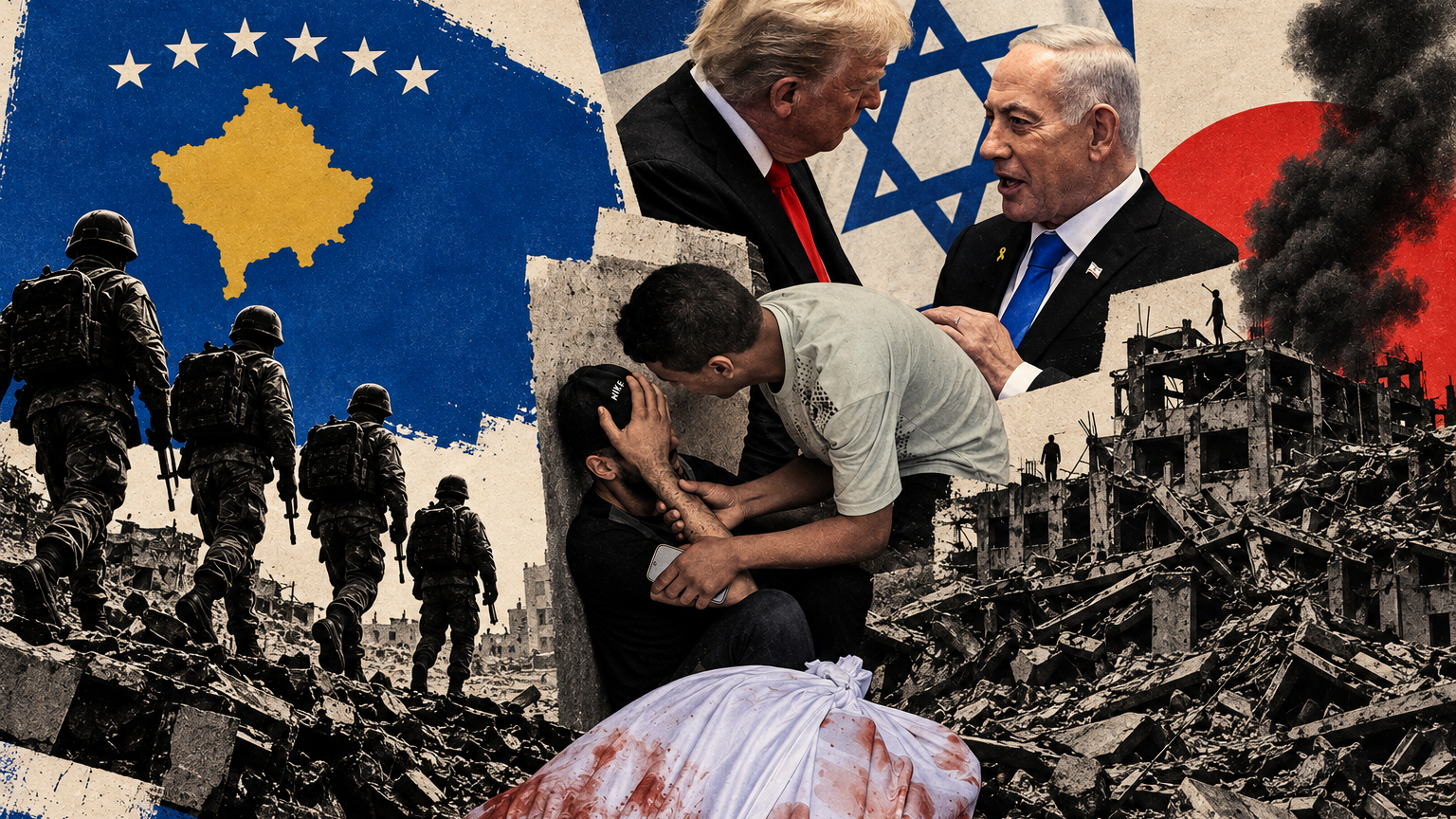
On Monday, following Israel’s formal approval, Kosovo officially became the latest member of former U.S. President Donald Trump’s divisive Board of Peace and its accompanying International Stabilisation Force (ISF) for Gaza, a move that has ignited sharp debate over geopolitics, human rights, and legal accountability. The signing ceremony, which saw ISF commander Major General Jasper Jeffers and Kosovo Security Force chief Lieutenant General Bashkim Jashari formalize the accession on September 7, 2026, was framed by the Board of Peace as a historic milestone. In a public statement posted to X, the organization emphasized the move demonstrates Kosovo’s unwavering commitment to the ISF mission and alignment with the core strategic goals laid out in Trump’s 20-Point Peace Plan.
The Board of Peace also revealed that Kosovo deployed military personnel to the region as early as this past spring, months before the official signing, a deployment that was never disclosed to the public ahead of the announcement. According to the statement, Kosovar troops have already taken on leading roles in logistics planning and civil affairs coordination, in addition to carrying out unexploded ordnance clearance operations on the ground in Gaza.
The decision has proven deeply divisive within Kosovo, a majority-Muslim nation where widespread public sympathy for Palestinians amid the ongoing humanitarian catastrophe in Gaza has already spurred large-scale pro-Palestine protests across the country. Despite this widespread public opposition, Kosovo’s ruling political leadership has aligned itself with the Trump administration’s pro-Israel demands, a choice that analysts attribute to a mix of ideological alignment and geopolitical pressure.
In comments made back in March, Kosovo’s left-leaning Prime Minister Albin Kurti defended his government’s participation, drawing a parallel to the 1999 NATO intervention in Kosovo. “We are ready to participate and help the people of Gaza, because we ourselves have been and are beneficiaries of international forces since 1999,” Kurti said. That 1999 intervention, led by U.S. forces, involved two and a half months of airstrikes against Serbia to halt the ethnic cleansing campaign targeting Kosovo’s ethnic Albanian population. While Kurti’s framing is designed to win over a domestic audience that broadly condemns the violence in Gaza, conflict experts say the comparison is deeply flawed.
Brunilda Pali, assistant professor of conflict dynamics and resolution at the University of Amsterdam’s Department of Political Science, called the parallel fundamentally unconvincing in an interview with Middle East Eye. “The international intervention in Kosovo followed a genocidal war in which the international community had identified a grave humanitarian catastrophe,” Pali explained. “Gaza presents a fundamentally different problem,” she added, noting that “as a main supporter of Israel’s genocide in Gaza, the U.S. is not at all credible as a peacekeeper.”
This contrast is underscored by ongoing international legal proceedings against Israel: much like Serbia faced global scrutiny for its actions in Kosovo, Israel is currently facing a genocide case at the International Court of Justice (ICJ) over its military campaign in Gaza. In 2024, the ICJ — a judicial body Kosovo has repeatedly relied on to solidify its own claims to sovereignty — ruled that Israel’s longstanding occupation of the West Bank and East Jerusalem violates international law. The International Criminal Court has also gone further, issuing arrest warrants for Israeli Prime Minister Benjamin Netanyahu and former defense minister Yoav Gallant on charges of war crimes and crimes against humanity committed in Gaza.
Pali warned that Kosovo’s participation in the ISF carries tangible risks for both the Balkan nation’s government and its deployed troops. Unlike the 1999 intervention in Kosovo, Israel holds full veto power over all entry into Gaza and all participation in the ISF. “Participation could expose both Kosovar soldiers and the Kosovo government to significant legal and reputational risks, particularly if the international deployment were to facilitate forced displacement, consolidate Israeli control over Gaza, or otherwise contribute to internationally wrongful conduct,” Pali said. She also pointed out that Kosovar political leaders have largely ignored explicit public plans from Israeli officials to ethnically cleanse Gaza of its Palestinian population and replace it with Jewish-only settlements.
While Kosovo’s ethnic Albanian population welcomed international forces in 1999 as protectors from violence, experts emphasize the U.S.- and Israeli-backed ISF serves an entirely different purpose in Gaza. “By participating in the ISF, Kosovo is effectively asking Palestinians to accept an international security architecture in which one of the principal parties responsible for the genocide in Gaza, which is the U.S., retains substantial influence over the security environment, while the Palestinian population has limited control over the institution determining its political future,” Pali explained.
The Board of Peace itself has already been widely condemned by global and Palestinian rights bodies. Eight independent United Nations experts have labeled the initiative an “illegal and illegitimate manoeuvre by powerful states driven by nostalgia and avarice.” The experts argue the board directly violates the Palestinian people’s fundamental right to self-determination and amounts to a modern colonial administration. Leading Palestinian human rights group Al-Haq has echoed that criticism, describing the Board of Peace and the ISF as a “blueprint for the indefinite alien occupation and de facto annexation of large parts of Gaza.”
Shpend Kursani, a lecturer in international relations at the University of Tartu’s Johan Skytte Institute of Political Studies in Estonia, noted that Kosovo, alongside Albania and Morocco, was deliberately selected for the initiative as a handpicked group of majority-Muslim nations that had already secured full Israeli approval. The inclusion of these countries, Kursani explained, is intended to “sugarcoat” the deployment, framing it to Gaza’s population as a helping hand from fellow Muslim-majority states. Crucially, Kursani emphasized that the entire initiative is a private project with no legitimate international standing. “This is Trump’s private initiative. The Board of Peace has no international standing whatsoever,” Kursani said. “It is viewed as Trump’s private initiative, actually almost like a parallel initiative to the United Nations efforts and its main mission of peacekeeping.”
For Kosovo, which has still not secured full United Nations membership due to longstanding opposition from China and Russia, the geopolitical pressures of aligning with the second Trump presidency have left the small Balkan nation with limited room to maneuver. With no other major regional allies to rely on, and a large U.S. military base — Camp Bondsteel, the largest U.S. base in the Balkans, currently hosting around 1,000 U.S. troops — hosted on its soil, Kosovo’s leaders see alignment with U.S. policy as the only way to protect their own hard-won sovereignty against Serb revanchism. The U.S. force is widely viewed as the only meaningful bulwark against attempts by Serbia to reclaim control over the territory.
Sidita Kushi, assistant professor of politics at U.S.-based Mount Holyoke College, explained that Kosovo’s leadership is prioritizing its alliance with Washington in hopes of shoring up its own security and sovereign status by backing Trump administration foreign policy priorities. But Kushi also noted that even full alignment offers no long-term guarantee of favorable treatment from the Trump White House, pointing to Trump’s erratic approach to global relations, including threats to invade Greenland and revisit the United Kingdom’s claim to the Falklands. Trump has already threatened to upend European security by withdrawing U.S. troops from Germany over Berlin’s reluctance to back the U.S.-Israeli campaign against Iran.
“With few other natural allies in the region, both Kosovo and Albania are stuck between a rock and a hard place, and their political elites are choosing to follow perceived geopolitical interests and the status quo over undeniable human rights considerations,” Kushi added. For Kosovo, the cost of that choice may yet prove steep, as experts warn of growing legal and reputational damage from its involvement in a widely condemned initiative.