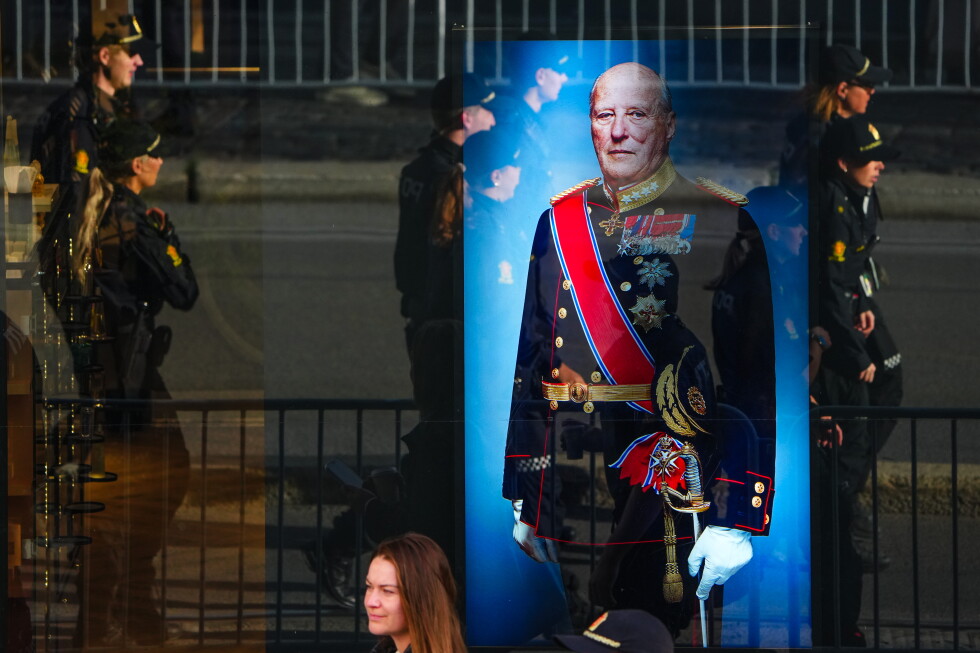
OSLO, Norway — On Wednesday, Norway gathered to lay to rest one of its most beloved modern monarchs, King Harald V, in a state funeral drawing royalty, heads of state, and senior officials from across the globe. The ceremony capped a week of national mourning for the 89-year-old ruler, who died on August 28 and left behind a 35-year legacy of institutional modernization that cemented the monarchy’s place in Norwegian public life.
King Harald, who stood as Europe’s oldest serving monarch at the time of his death, broke with a growing trend among older European royals by declining to abdicate the throne during his lifetime. Just days after his passing, his son Haakon VIII immediately succeeded to the crown and took a formal oath of allegiance to Norway’s constitution in a ceremony held in parliament last week, securing a smooth transition of constitutional power.
In the hours leading up to Wednesday’s funeral service, preparations unfolded across central Oslo in a display of solemn military pageantry. Norwegian soldiers, standard-bearers carrying the national flag, and a military marching band formed up along a broad city boulevard adorned with Norwegian flags, stepping in time to steady drumbeats and the rhythmic clatter of horses’ hooves. Additional troops were posted outside the Royal Palace, where thousands of well-wishers had already turned out to lay flowers in tribute, creating a dense, vibrant floral memorial to the late king.
Across the country, Norwegians organized to make the historic event accessible to all members of the public. Public broadcaster NRK confirmed that hundreds of churches, public libraries, cultural centers, and municipal government buildings had installed large public screens to broadcast the funeral ceremony for those unable to travel to Oslo. Mass crowds converged on the capital for the service, prompting local authorities to close the entire downtown area to motor vehicles and electric scooters; police also issued public guidance banning bicycles, umbrellas, and sharp objects from the event area for security reasons.
In the days leading up to the funeral, more than 46,000 Norwegians queued for hours to pay their respects as the king’s coffin lay in state in the Royal Palace chapel. Over the weekend, wait times to pass the casket stretched to seven hours at their peak, a testament to the widespread affection and respect Norwegians held for their long-serving monarch.
The guest list for Wednesday’s ceremony reflected the deep family and diplomatic ties the Norwegian royal house maintains with royal and state institutions across the globe. Attending dignitaries included reigning monarchs from Sweden, Denmark, Spain, the Netherlands, Belgium, and Jordan, alongside heir to the British throne Prince William and Japan’s Crown Prince Akishino. Multiple European presidents also joined the service, with Ukrainian President Volodymyr Zelenskyy in attendance — a visit that included a pre-funeral meeting with Norwegian Prime Minister Jonas Gahr Støre on Tuesday to discuss ongoing developments in the war in Ukraine. The United States was represented by Allison Hooker, Under Secretary of State for Political Affairs.
The formal funeral service inside Oslo Cathedral will open with a nationwide minute of silence, followed by eulogies delivered by Norway’s parliament speaker and prime minister. A multifaith candle-lighting ceremony, featuring representatives from religious communities across the country, will also be held as part of the service.
While the Norwegian government has not designated the funeral as an official national holiday, it has encouraged individual schools and employers to permit students and staff to watch the proceedings, with guidance that all noisy public activity should be paused for the duration of the ceremony.
Following the cathedral service, King Harald’s coffin will be carried in a formal procession to the royal chapel at Akershus Castle, the centuries-old resting place of the late king’s royal ancestors. After a private ceremony for the Norwegian royal family, joined by visiting foreign dignitaries and senior Norwegian government officials, the coffin will be interred in the castle’s royal crypt.
Norway’s monarchy traces its unbroken lineage back to King Harald Fairhair, who unified the country in the 9th century. When Norway regained full independence from Sweden in 1905, a national referendum saw three-quarters of voters endorse the restoration of the monarchy as the country’s constitutional form of head of state. Today, the Norwegian royal family maintains close blood ties to most other European royal houses: both King Harald and his successor King Haakon are direct descendants of Britain’s Queen Victoria, sharing that lineage with King Charles III of the United Kingdom and King Felipe VI of Spain.
While the modern Norwegian monarchy holds a largely ceremonial role, with full governing power vested in the country’s elected parliament and government, the institution remains a key soft power asset, helping to promote Norway’s global profile as one of the world’s wealthiest and most stable Scandinavian nations.