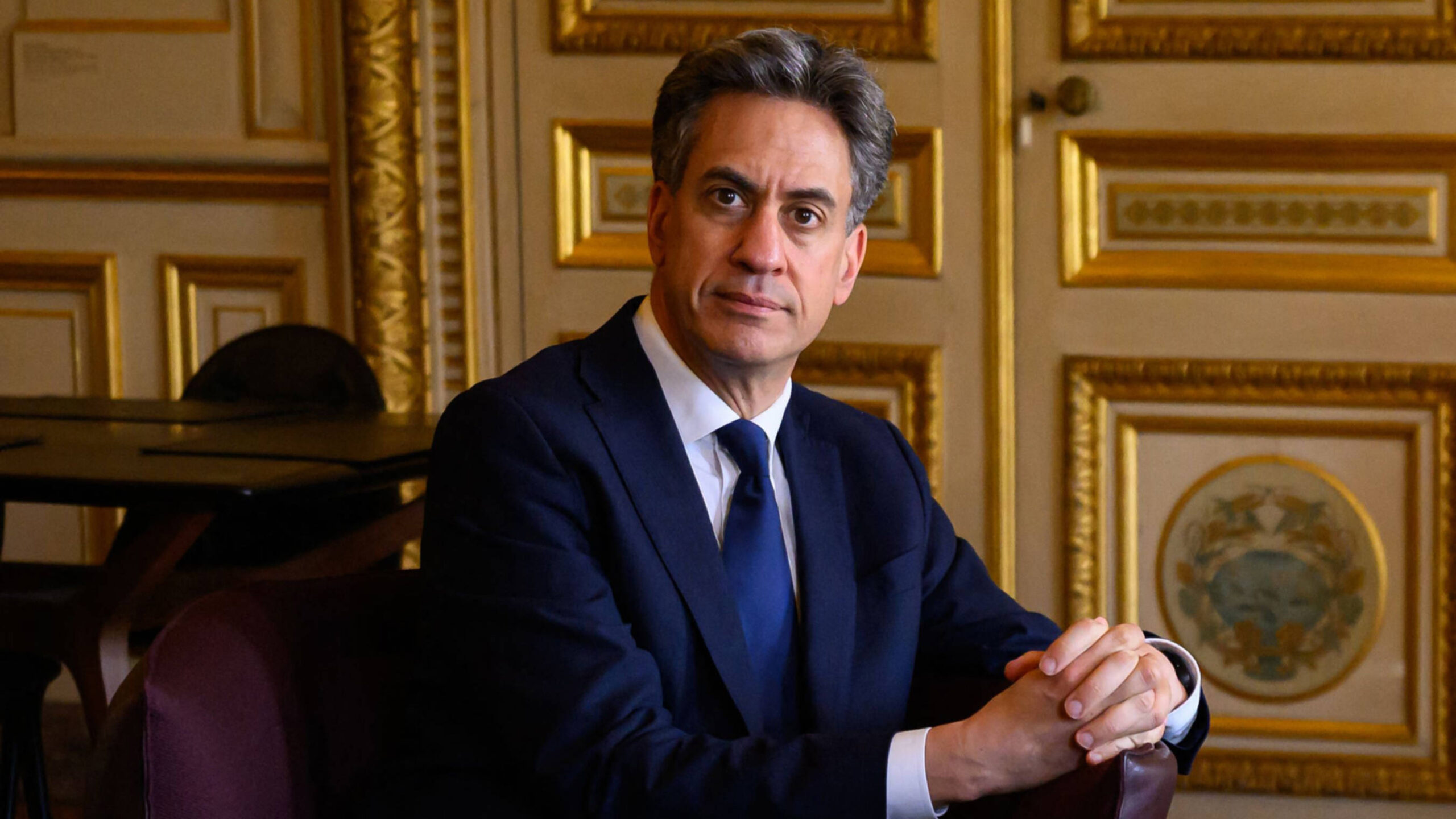
Over recent weeks, no British foreign secretary in modern memory has faced a more intense wave of criticism than Ed Miliband, after he unveiled plans for punitive measures targeting Israeli settlements to halt escalating settler violence and preserve the fading possibility of an independent Palestinian state. The controversial policy, set to be officially announced Tuesday, will introduce a full ban on trade with Israeli settlements built illegally in occupied Palestinian territory, bringing UK policy into alignment with the International Court of Justice’s landmark July 2024 advisory opinion that deemed the Israeli occupation of Palestinian lands illegal, according to senior Whitehall sources.
The backlash against Miliband has come from two overlapping fronts. On one side, pro-Palestinian campaigners have argued the long-awaited measure is far too incremental, dismissing it as largely symbolic. They have expressed particular frustration that the Labour government has refused to label Israel’s actions in Gaza as genocide, end all UK arms sales to Israel, or impose personal sanctions on Israeli Prime Minister Benjamin Netanyahu. On the other, the response from Washington, Jerusalem and domestic political opponents has been exceptionally harsh, marked by unprecedented personal attacks and explicit threats.
In an extraordinary break from standard diplomatic protocol, U.S. Ambassador to Israel Mike Huckabee took to social media platform X over the weekend to accuse the British government of rampant antisemitism, writing: “The Brits have lost it. The Jew hate of their government knows no boundaries and knows no facts.” The attack carries extra weight: Huckabee is not Jewish, while Miliband comes from an ethnic Jewish background. Netanyahu himself drew widespread condemnation last month when he labeled the UK the “Islamic Republic of Britain,” and Israeli Foreign Minister Gideon Saar issued a direct threat last week: “If Britain acts against Israel, Israel will act against Britain.” Yair Netanyahu, the prime minister’s son, escalated tensions further by claiming the Falkland Islands, a British overseas territory, rightfully belongs to Argentina – a claim that was echoed by U.S. President Donald Trump, who suggested he would not side with the UK if Argentina invaded the islands.
Domestically, the centre-right Conservative opposition, amplified by right-aligned British media, has joined the chorus of criticism. The *Sunday Telegraph* gave prominent front-page coverage to an interview with Conservative shadow foreign secretary Tom Tugendhat, who openly sided with Israel against his own country’s sitting government, repeating Israeli warnings that the new sanctions could put British national security at risk. Conservative Friends of Israel, a prominent pro-Israel advocacy group, went further, accusing Miliband of orchestrating “a morally indefensible move that further singles out and demonises the world’s only Jewish state and a close ally.”
Yet just two months into his tenure as foreign secretary, Miliband has shown uncharacteristic resolve in the face of this multi-pronged assault. No British foreign secretary in the 21st century has successfully defied simultaneous pressure from both the White House and the Israeli government, and Miliband’s rejection of long-standing British foreign policy orthodoxy – even amid fierce pushback from major domestic media outlets – represents a sharp break from decades of precedent. During his first address to parliament as foreign secretary last Tuesday, he pledged a “comprehensive reset” of UK policy toward Israel, insisting that Britain “will not acquiesce in the destruction of the two-state solution.” He reassured pro-Palestinian MPs from Labour, the Greens and the Scottish National Party who had pressed for action against settlement expansion in the occupied West Bank that they would not have to wait long for concrete action.
Well-informed sources speaking to Middle East Eye confirm that within the new Burnham government, Miliband has been the primary internal driving force behind the policy he will announce this week. He has also adopted unflinchingly blunt language when describing the humanitarian catastrophe unfolding in Gaza: “I just came out of this meeting talking about Gaza to people who’ve been there and are there on the ground, and frankly it was horrific what is unfolding.” Last week, he emphasized that “we as a UK government, as the prime minister has said, have got to act and act more decisively than we have.” Observers note that this forceful public anguish sets Miliband apart from his two immediate predecessors as Labour foreign secretary, David Lammy and Yvette Cooper, who both received identical high-level briefings on Gaza’s humanitarian crisis but chose not to speak out with the same urgency. This moral clarity has also tied Miliband’s political credibility to the policy: backing down in the face of future U.S. or Israeli pressure would open him to immediate charges of hypocrisy.
The push for a settlement trade ban comes at a pivotal moment for the Israeli-Palestinian conflict. Israel’s new E1 settlement project east of Jerusalem is on track to split the occupied West Bank into two disconnected segments, a development that would permanently eliminate any possibility of a contiguous, viable Palestinian state. For that reason, the planned British ban carries profound geopolitical significance. As Ben Jamal, former director of the Palestine Solidarity Campaign, noted recently: “Such a ban has been a core demand of the Palestine solidarity movement for many years, as a key basic step towards ending UK complicity with Israel’s violations of international law.” Early indicators already suggest the policy could have immediate impact: unconfirmed reports have emerged that Netanyahu has already ordered the removal of unauthorized settler outposts in response to Britain’s proposed move.
If implemented fully, the ban will fulfill the UK’s legal obligation under the 2024 ICJ advisory opinion, which required all UN member states to take active measures to end the illegal occupation. For the ban to deliver on its stated goals, it will need to cover both goods and services, prohibit all new investment in settlement-based businesses, and include robust enforcement mechanisms to ensure compliance. While a handful of other European nations – including Ireland, Spain and Belgium – have already introduced similar restrictions, Whitehall sources confirm the UK’s upcoming sanctions will be significantly stronger than existing European measures.
Though the ban has already triggered anger from the Netanyahu government and the Trump administration, it could also serve as a defining diplomatic moment for Andy Burnham’s new government, establishing the UK as a major power willing to act independently of U.S. policy in the Middle East. And if the early reports of Netanyahu ordering outpost removals are confirmed, it would prove that tough, principled diplomacy can deliver tangible results nearly immediately.
Critics of Miliband have repeatedly claimed he is acting to appease British Muslim voters, but public polling directly undermines this narrative. In fact, Miliband’s policy aligns closely with broad-based British public opinion: only 16% of UK adults oppose a ban on goods from illegal Israeli settlements. This broad public support explains why more than 140 backbench Labour MPs have publicly called for a full trade ban, and earlier polling of Labour Party members found that 87% back the measure. This widespread backing means Miliband is politically secure, and crucially, he retains the full backing of Downing Street. Even so, Labour insiders stress that Miliband’s support for the policy stems from deep-held personal conviction, not just political calculation.
Miliband’s record on Palestine stretches back more than a decade. When he served as Labour leader in opposition during the 2014 Israeli bombing of Gaza that killed 1,600 Palestinian civilians – including 550 children – Miliband sharply criticized the Conservative-Liberal Democrat coalition government’s refusal to condemn the action, at a time when only six Israeli civilians were killed. He accused then-Prime Minister David Cameron of taking the wrong position and condemned his “inexplicable silence” on “the killing of innocent Palestinian civilians caused by Israel’s military action.” That same year, he became one of the first major British party leaders to back unilateral recognition of Palestinian statehood, a position the Conservatives rejected. More recently, sources confirm Miliband was a leading voice in cabinet pushing former Prime Minister Keir Starmer to formally recognize Palestinian statehood, a step Starmer finally took last September. Earlier this year, Miliband and Home Secretary Shabana Mahmood privately lobbied Starmer to refuse backing for the joint U.S.-Israeli strikes on Iran in February.
The current policy shift marks a dramatic break from the recent trajectory of British foreign policy. The previous Conservative government led by Rishi Sunak openly rejected international law on the issue in late 2023 and early 2024, publicly mocking the ICJ’s ruling on the genocide case brought against Israel by South Africa, while then-Foreign Secretary David Cameron privately lobbied the International Criminal Court’s chief prosecutor to abandon plans for arrest warrants for senior Israeli ministers. Under Starmer, the two previous Labour foreign secretaries only introduced half-measures: a partial, not full, arms embargo, while intelligence sharing from surveillance flights over Gaza continued throughout Israel’s military campaign. When Lammy publicly stated that Israel had broken international law, Downing Street quickly walked back the comment, and the government only issued non-binding advice against investment in settlements, rather than a formal ban.
Moving forward, Burnham and Miliband face a clear choice. Weakening the planned sanctions to appease the Trump administration would signal that no substantive change has occurred, and the UK will continue the largely pro-Israel approach of the Starmer government. But if they move forward with a full, enforced ban as planned, they will have demonstrated that Britain is finally ready to pursue an independent foreign policy that prioritizes international law and human rights over great power pressure.