BERLIN – A seismic shift in German regional politics has left Chancellor Friedrich Merz mired in mounting political pressure, after the far-right Alternative for Germany (AfD) delivered a crushing defeat to Merz’s center-right Christian Democratic Union (CDU) in Sunday’s Saxony-Anhalt state election, bringing the extremist-leaning party to the cusp of leading Germany’s first far-right state administration since the end of the Nazi era.
The outcome caps a dramatic surge for the AfD, which is classified as an extremist organization by Germany’s domestic intelligence service in multiple parts of the country. In the election held in the economically struggling eastern state, the party captured 43.8% of the popular vote – more than doubling its 2019 result – falling just a single digit of the 50% threshold needed to form an absolute majority on its own. By contrast, the CDU, which had held power in Saxony-Anhalt for 24 consecutive years, saw its support cut nearly in half, finishing with just 17.2% of the vote and 15 parliamentary seats.
While the contest is formally limited to state-level governance, its national and international ripple effects are already reshaping European politics. When Merz took office as chancellor, he made weakening the AfD’s growing influence a core campaign promise; Sunday’s result exposes that pledge as unfulfilled, leaving the chancellor politically weakened at a moment when Europe faces cascading crises, including Russia’s ongoing full-scale invasion of Ukraine, a suspected Russian sabotage campaign targeting NATO infrastructure, and tense trade and diplomatic negotiations with the U.S. administration under Donald Trump.
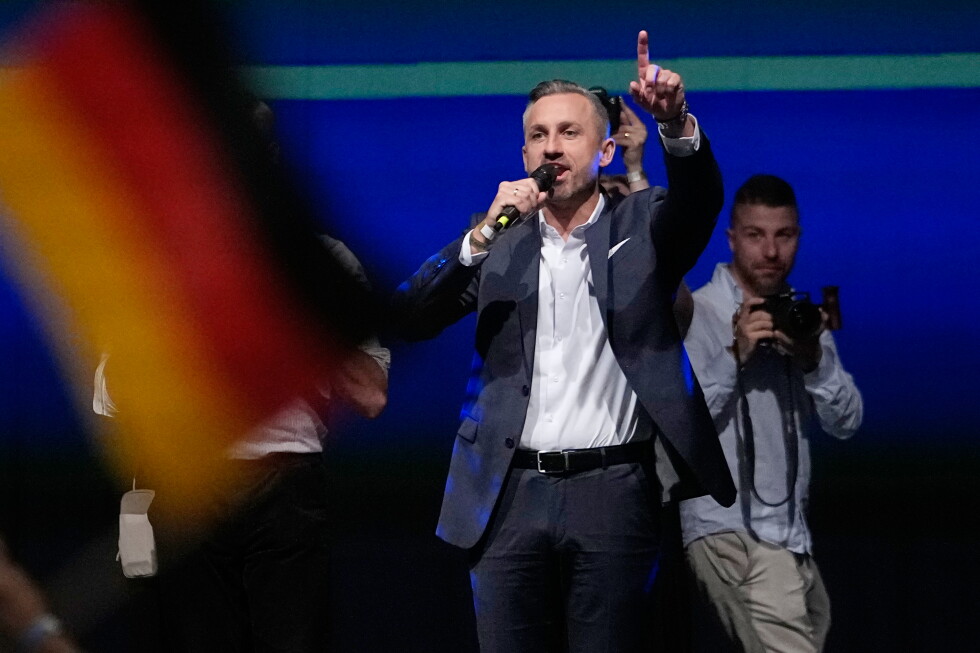
Coalition negotiations are already poised to be fraught and protracted, with the AfD on the brink of a historic milestone that would mark the farthest advance for a far-right party in modern German politics. The AfD’s lead gubernatorial candidate, Ulrich Siegmund, has made clear he intends to deliver on the mandate voters delivered. “Very clearly, we want voters finally to get after the election what they voted for,” Siegmund told German public broadcaster ZDF on Sunday night. “Over 44% voted for political change … and that must be implemented after the election.”
Siegmund has ruled out leading a minority government, leaving two plausible pathways for the AfD to claim power. The most likely route is a coalition with the hard-left BSW party, which shares the AfD’s pro-Russia policy stance and hardline opposition to immigration, despite disagreements on other domestic issues. On Monday, BSW’s lead candidate Thomas Schulze reaffirmed his party’s openness to supporting an AfD-led government. The alternative – a broad anti-AfD coalition uniting the CDU, Social Democrats, Greens, Left Party and BSW – would require five disparate parties to align on a governing agenda, a arrangement that political analysts across Germany call extremely unlikely and unworkable. Even if an anti-AfD bloc holds together, the AfD could secure a majority by luring just three defecting lawmakers from other parties, a risk that looms over negotiations. Regardless of the outcome, talks are expected to stretch on for weeks.
Rooted in anti-immigration and pro-Russia policy, the AfD has long been the largest opposition party in Germany’s federal parliament, with its strongest support in the former East Germany, where economic stagnation and discontent with mainstream national politics has fueled its rise. Widespread public frustration with the current federal government’s failure to reverse Germany’s sluggish economic growth has created fertile ground for the AfD’s gains, and analysts widely expect the Saxony-Anhalt result to energize the party’s campaigning in other upcoming state elections later this month.
Despite Saxony-Anhalt’s small size – it is home to just 2.1 million residents – the election drew outsized global attention. Unlike many other European nations, post-WWII Germany has never seen a far-right populist party lead a state, national, or major municipal government, and the legacy of Nazi rule means far-right political movements face uniquely intense scrutiny both domestically and abroad.
Reactions to the result have split sharply across global political lines. Tech billionaire Elon Musk congratulated the AfD on its victory with a “Well done!” post on his social platform X, prompting an immediate thank-you from Siegmund, who extended an invitation for investment: “If we take on responsibility here, I would very much welcome the opportunity for strong and constructive cooperation. Germany would then once again be a place worth investing in. Best regards from Saxony-Anhalt!”
U.S. President Donald Trump shared an election projection screenshot on his Truth Social platform without additional comment. Russian presidential envoy Kirill Dmitriev celebrated the outcome on X, calling it a “historic win for the pragmatic AfD that will put migration under control,” adding that “AfD will restore Germany and Europe by leading the commons-sense approach that migrant-friendly, warmongering Biden-think EU politicians tried to eradicate.”
Leaders of other European far-right parties also offered congratulations. Santiago Abascal, leader of Spain’s Vox party, wrote that “Congratulations to Alice Weidel and Ulrich Siegmund on this spectacular result, which offers great hope for Germany and Europe.” André Ventura, head of Portugal’s Chega party, added that “Germans, too, are increasingly opening their eyes to illegal and uncontrolled immigration, corruption, and the erosion of our freedom and identity. Congratulations!”
Not all international leaders welcomed the result. Polish Prime Minister Donald Tusk issued a sharp rebuke Monday morning, writing on X that “In Poland, only idiots or traitors could rejoice the AfD triumph in Germany.”
Official results confirmed that turnout hit a surprisingly high 77.8%, with the AfD drawing significant support from voters who stayed home in the previous regional election. Completing the seat count, the center-left Social Democrats won 9.3% of the vote, the Greens 8.9% and the Left Party 8.6%, each taking eight seats. BSW captured 5.3% of the vote and five seats. Merz is scheduled to address the public later Monday following closed-door meetings with his party and federal government leadership.