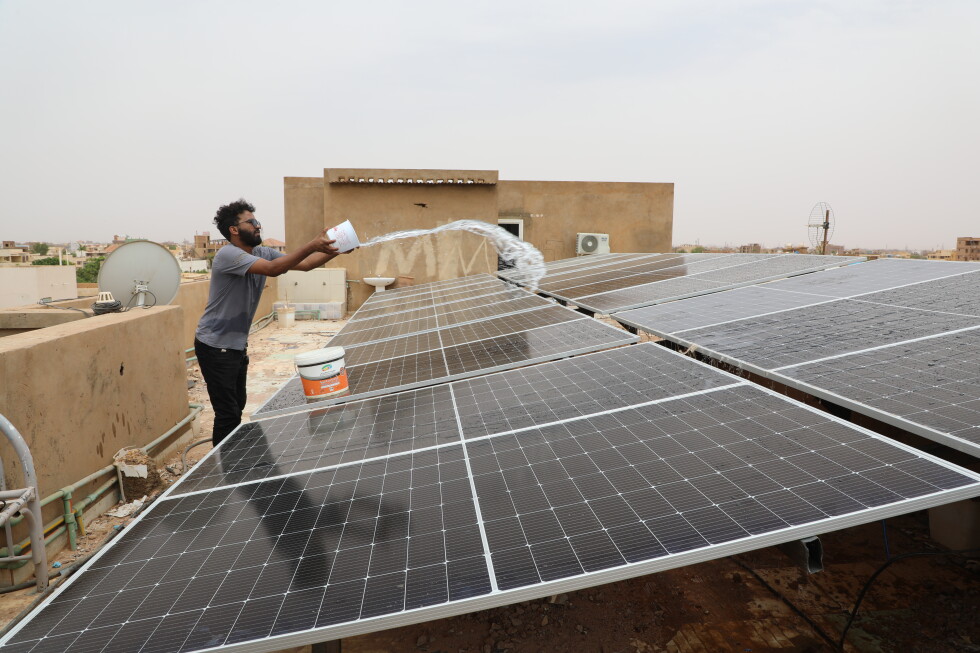
One year into Sudan’s brutal civil conflict between the national military and the Rapid Support Forces (RSF), the country’s already fragile national electricity infrastructure has collapsed, pushing millions of ordinary Sudanese into a desperate struggle for reliable power that has forced many to turn to costly solar energy systems — and left low-income and vulnerable households facing catastrophic consequences.
Across Omdurman, the largest city adjacent to war-battered capital Khartoum, 31-year-old housewife Randa al-Mansour is among the relatively fortunate: with remittance support from her husband working in Saudi Arabia, she was able to install rooftop solar panels to power her home through near-constant blackouts that have become the new normal. Even for her, however, daily life remains an unrelenting challenge. “We are suffering big time,” al-Mansour told the Associated Press. When her three children arrive at school each morning, there is often no power to run classrooms, forcing them to return home — where the grid is also down. With summer temperatures climbing to extreme highs, studying or even resting without reliable cooling becomes a grueling test.
Since the conflict erupted in April 2023, the human cost of the fighting has been staggering: official counts record at least 59,000 people killed, with aid organizations warning the true death toll is far higher, and some 13 million Sudanese have been displaced from their homes. Beyond the direct violence, the war has gutted critical public infrastructure, and the national electricity grid has suffered some of the worst damage. The United Nations Development Program estimates total damage to Sudan’s power network at $3 billion, a staggering sum for a country already crippled by economic collapse and war.
As grid power becomes more unreliable, solar energy has emerged as the only viable alternative for many families. In recent months, billboards advertising solar panels, storage batteries, and power inverters have proliferated across Khartoum and surrounding urban centers as demand for off-grid power surges. But the high cost of systems puts this lifeline out of reach for millions. Mohey Eddin Abu-Bark, owner of a Khartoum-based solar installation business, explained that a standard 10-kilowatt system large enough to power a typical household costs close to $5,000 — a sum that is completely unattainable for low-income Sudanese families grappling with hyperinflation and lost incomes.
For vulnerable households that rely on electricity for life-saving medical care, the lack of power has deadly consequences. Manahel Madany, a 43-year-old diabetic civil servant living in Omdurman, requires consistent refrigeration for her insulin, but cannot afford to install a solar system to power her fridge. “Every three to four days, I am forced to throw away all my insulin stock after it goes bad due to heat and power outages,” she said. Madany and her family, who share a small two-bedroom home, are also forced to sleep in their courtyard each night to escape the deadly indoor heat that builds up when fans cannot run during extended blackouts.
The crisis extends beyond households to critical health care facilities. Madany notes that even many local pharmacies cannot afford solar power for refrigerated medication storage, leading to widespread shortages of life-saving drugs across the country. The Sudan Doctors’ Network, which monitors health access across conflict zones, has warned that ongoing blackouts threaten the lives of thousands of hospital patients, particularly those with chronic conditions like kidney disease that require constant, electricity-dependent care.
Official data paints a bleak picture of the scale of the crisis. The World Bank estimates that at least 30 percent of Sudan’s total population has no access to electricity at all, with poor rural communities bearing the worst of the deprivation. Even in major urban centers that were previously connected to the national grid, conditions have deteriorated sharply in recent months: two senior electricity department officials, speaking to the AP on condition of anonymity because they are not authorized to speak to media, confirmed that daily blackouts now last up to 16 hours in most parts of the country.
Total national electricity production has plummeted from 4,400 megawatts before the war to just 1,100 megawatts today, the officials reported. Multiple major power plants have been damaged or destroyed by drone attacks carried out by the RSF, and the sector has suffered a catastrophic brain drain: nearly half of Sudan’s most experienced power engineers and technicians have fled the country since the conflict began in 2023, according to a local labor union survey cited by the officials.
Ironically, Sudan has one of the highest potentials for utility-scale and residential solar energy generation in the world, with annual sunshine hours exceeding 4,000, according to United Nations estimates. But widespread adoption of solar energy remains out of reach for most Sudanese: all major solar system components must be imported, and the Sudanese pound has collapsed in value since the war began, making upfront costs even more prohibitive for families and businesses alike.