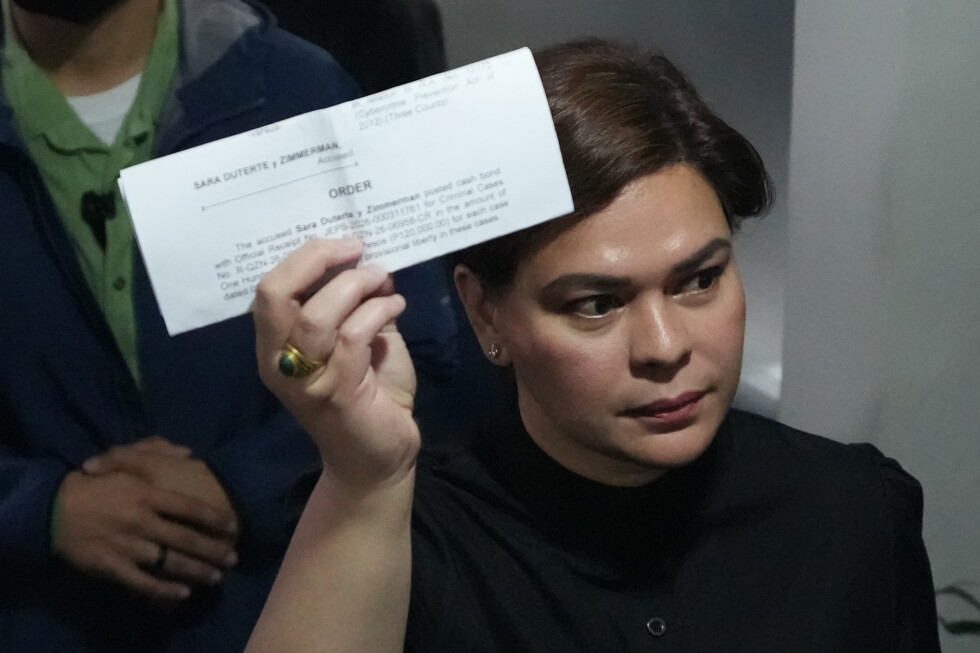
In a dramatic development escalating one of the Philippines’ most high-stakes political conflicts, Vice President Sara Duterte has posted bail following the issuance of an arrest warrant on Friday over charges that she plotted to assassinate President Ferdinand Marcos Jr. and two other political allies. The 48-year-old vice president, who has repeatedly denied all allegations against her, turned herself in at the Quezon City Regional Trial Court in Metro Manila on Saturday, emerging from the courthouse in a black ensemble to greet throngs of cheering supporters who packed the surrounding streets.
As supporters chanted her name, Duterte stopped to comfort emotional backers, including embracing one woman who openly sobbed at the scene. She displayed the court document that formally lifted the arrest warrant after she posted bail, noting that her legal team had instructed her to keep the official order on her person at all times. In a candid remark to reporters, Duterte asked journalists to surround her as she walked to her vehicle, saying she did not feel secure amid what she called ongoing harassment from law enforcement.
“If possible please go with me, because I do not feel safe with all these police personnel who are harassing those at my home, harassing me since 2023,” Duterte told reporters. “What does this administration really want to do with me?”
Paul Lawrence Lim, one of Duterte’s lead attorneys, confirmed that court officials collected Duterte’s fingerprints before she processed bail totaling 360,000 Philippine pesos, equivalent to roughly $5,740, to cover three counts of grave threats. He reaffirmed that his client has no intention of avoiding legal process and will vigorously challenge the charges through all available legal channels.
The criminal case stems from incendiary comments Duterte allegedly made during an online news conference earlier in 2024, when she reportedly stated she would arrange the assassination of Marcos, First Lady Liza Marcos, and then-House Speaker Martin Romualdez if she was killed amid their deepening political rift. Duterte insisted at the time her warning was not a joke, though later walked back the remarks to clarify she was only voicing fears for her own personal safety, not issuing a direct threat against the president. The comment sparked an immediate criminal investigation and raised national security alarm across the country.
The conflict between Duterte and Marcos marks a stunning collapse of a once-powerful political alliance that brought both leaders to power in the 2022 national elections. The pair, who ran as a unified ticket, combined the influence of two of the Philippines’ most dominant political dynasties: Marcos is the son of former authoritarian president Ferdinand Marcos Sr., who ruled the country for more than two decades including a 14-year period of martial law, while Duterte is the daughter of former hardline president Rodrigo Duterte, Marcos’ immediate predecessor.
That alliance has fractured dramatically over multiple issues in recent years. In a major point of contention, the Marcos administration allowed former president Rodrigo Duterte to be taken into custody by the International Criminal Court in 2025. The former president is currently detained in The Hague, where he is set to go on trial in late November on charges of crimes against humanity linked to his brutal anti-drug crackdown that left thousands of mostly low-income suspects dead. Rodrigo Duterte has denied authorizing extrajudicial killings, though he openly threatened suspects with death during his time in office. Sara Duterte has repeatedly condemned the Marcos administration for turning her father over to an international court, which she argues has no legal jurisdiction over the Philippines.
The two leaders also hold starkly contrasting positions on key geopolitical issues. Marcos has expanded the Philippines’ longstanding defense partnership with the United States, the country’s treaty ally, as his administration pushes back against growing Chinese assertiveness in the contested South China Sea. Sara Duterte, by contrast, has faced widespread criticism for refusing to condemn Chinese aggressive actions against Filipino coast guard personnel and fishermen in the disputed waters, including recent incidents where Chinese vessels used high-powered water cannons to block Filipino craft.
The grave threats charges are not the only legal battle Duterte currently faces. In May, the Marcos-dominated House of Representatives voted by an overwhelming majority to impeach Duterte on three additional allegations: unexplained personal wealth, misuse of confidential state funds, and the controversial threats made during the online news conference. The Philippine Senate, convening as an impeachment court, launched the televised impeachment trial in July. A conviction on the current grave threats charges would carry severe political consequences, permanently barring Duterte from holding public office and eliminating her potential bid for the presidency in the 2028 election, when Marcos’ current six-year term concludes.