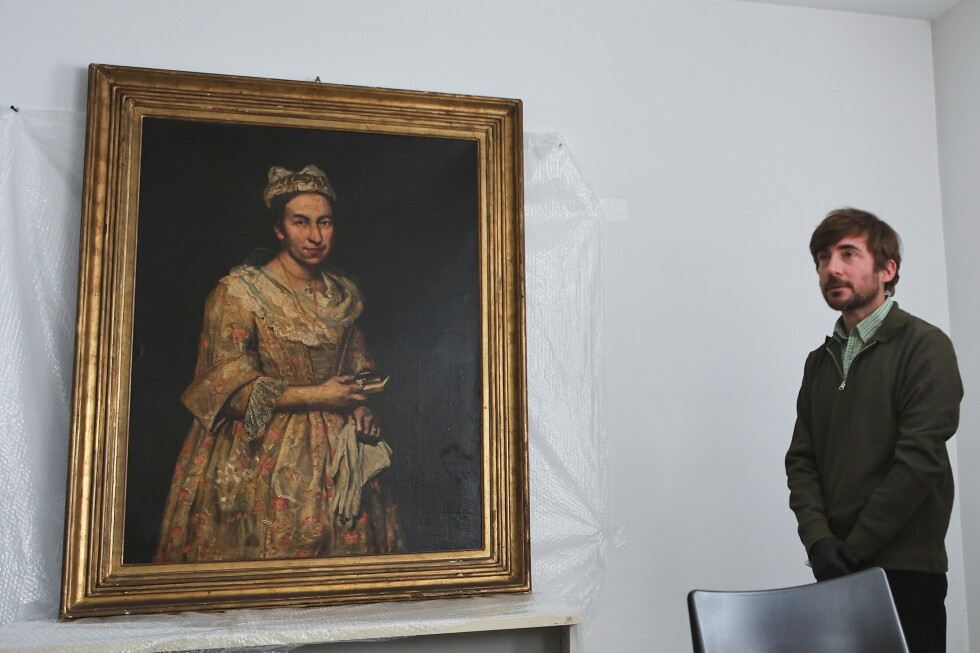
BUENOS AIRES, Argentina — A decades-long battle for the restitution of a World War II-looted Italian portrait has reached a pivotal resolution, after an Argentine court greenlit a landmark agreement that will see the artwork returned to the sole surviving heir of its original Jewish owner. The deal comes after the daughter of a fugitive high-ranking Nazi official agreed to surrender all ownership claims to the piece in exchange for avoiding criminal prosecution.
The 18th-century work, long known as *Portrait of a Lady*, was part of the massive, world-renowned collection assembled by Jacques Goudstikker, a leading Dutch-Jewish art dealer operating in pre-war Europe. When Nazi Germany invaded the Netherlands in 1940, Goudstikker fled Amsterdam with his family, but died in a shipwreck shortly after his escape. His entire collection — numbering more than 1,100 works by masters including Rembrandt and Vermeer — was seized and sold under extreme duress, with a large portion falling into the hands of Nazi leader Hermann Göring, Hitler’s infamous right-hand man who amassed one of the largest stolen art collections of the war.
The portrait in question ended up in the hands of Friedrich Kadgien, a top Nazi financial official who served as Göring’s adviser on confiscated property sales, foreign currency, and precious metals. Kadgien evaded justice for his Nazi-era crimes after Germany’s defeat, fleeing first to Switzerland before settling in Argentina, where he died in 1978 without ever facing arrest or charges. The painting passed to his daughter, Patricia Kadgien, who lived with her husband Juan Carlos Cortegoso in the coastal Argentine city of Mar del Plata.
The modern legal saga that led to the portrait’s recovery began in August 2025, when Dutch journalists investigating Kadgien’s post-war escape spotted the artwork hanging above a green velvet couch in an online real estate listing for the couple’s rustic Mar del Plata home. Within hours of the Rotterdam-based newspaper Algemeen Dagblad publishing its discovery, the listing was taken down. Argentine police launched multiple raids on Kadgien and her sister’s Mar del Plata properties, but failed to locate the painting. More than a week later, Kadgien’s legal team turned the artwork over to authorities. Last year, the couple was formally charged with aggravated cover-up, accused of deliberately hiding the looted painting while knowing Argentine and international investigators were actively searching for it.
Under the terms of the court-approved deal, obtained by the Associated Press, Kadgien and Cortegoso have relinquished all legal claims to the portrait and consented to its transfer to Goudstikker’s heir, Marei von Saher, a Connecticut resident who has spent decades working to recover her family’s stolen art. In exchange, the pair avoid a public criminal trial, and will instead serve two years of court-supervised probation. As part of the agreement, they will also make charitable donations to a local Mar del Plata hospital, and are required to notify authorities of any changes to their residence during the supervision period.
For decades prior to its recovery, the portrait was formally attributed to Italian Baroque painter Giuseppe Vittore Ghislandi, matching the attribution listed in Goudstikker’s original pre-war collection records; it was even exhibited under Ghislandi’s name in Amsterdam before the Nazi invasion. However, a court-ordered forensic analysis by Argentina’s National Academy of Fine Arts reattributed the work to another 18th-century Italian master, Giacomo Antonio Melchiorre Ceruti. Independent experts have since authenticated the piece as part of Goudstikker’s original collection, and valued it at approximately €250,000 (equivalent to $290,000 U.S.).
In a nod to the years-long investigation in Argentina, von Saher has agreed to allow the portrait to be exhibited in the country before it is transferred to her custody. During the 2025 raids on Kadgien family properties, police also seized two additional 19th-century paintings, along with a collection of prints and engravings. Argentine authorities have confirmed they are still conducting provenance investigations into these additional works to determine if any were also looted during the Nazi era.
Associated Press writer Isabel DeBre contributed reporting from Buenos Aires.