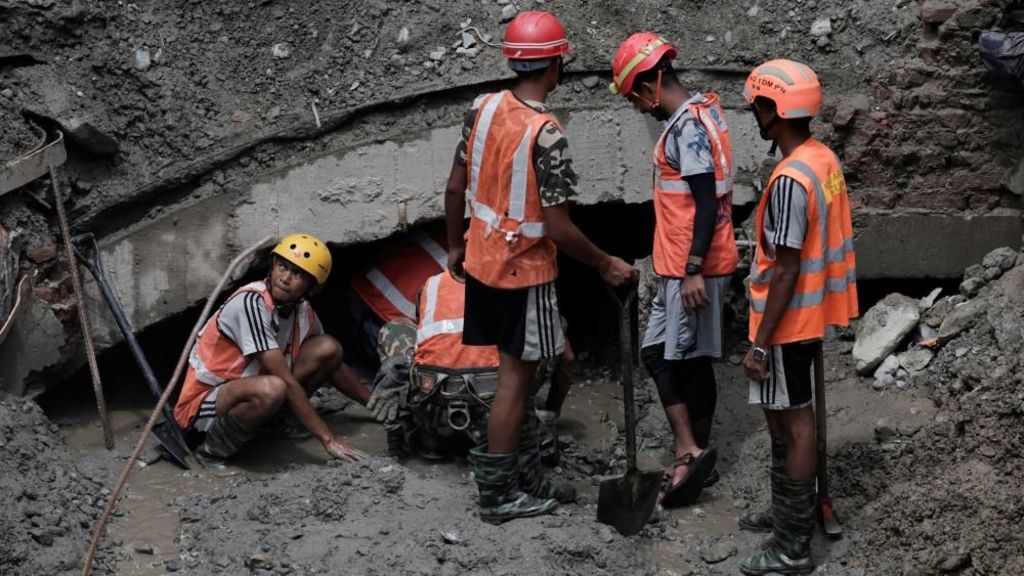
Last week, catastrophic flash floods along the Nepal-Tibet border left more than 1,300 people dead and devastated multiple hydropower infrastructure projects, including the Trishuli 3A Hydropower Station, where a construction tunnel was completely buried under mud, rock and flood debris. In what a senior international tunnelling expert has called a succession of overlapping miracles, two workers trapped inside the blocked tunnel were pulled alive by rescue teams in the early hours of Friday, with an intensive search now underway for dozens more still missing deep in the mountain.
Arnold Dix, president of the International Tunnelling and Underground Space Association, who has served as a lead advisor to Nepalese hydropower authorities on the unprecedented rescue operation, shared a detailed account of the extraordinary challenges his team faced from the very start of the mission.
Unlike any rescue Dix has worked on in his decades-long career, the first major hurdle was simply locating the tunnel’s entrance. The flash flood and accompanying avalanche of debris completely rearranged the mountain landscape, moving the original entrance from its position up the hillside to a spot completely buried underground. “I’ve never known a rescue operation where you had to look for an entrance of a tunnel that was previously up the hill, that was now underground. You can imagine the enormity of the avalanche, it completely buried the entrance,” Dix explained.
To pinpoint the entrance’s approximate location, Dix and his team combined a range of tools: conventional engineering methods, decades-old topographic maps, post-disaster satellite imagery, aerial helicopter footage, and even visible surface markers like standing power poles, to triangulate the most probable position and begin digging. Against steep odds, their approach worked, and they uncovered the buried entrance – but an entirely new set of obstacles stood between rescuers and the trapped workers.
The entire tunnel passage was choked solid with mud and boulders, some as large as passenger cars. To clear the massive blockage, teams were forced to use controlled explosives – a dangerous measure never used in standard tunnel rescue scenarios, due to the extreme risk of collapsing the tunnel or harming trapped survivors. Dix praised the Nepalese army for its exceptional precision in executing the blasts, which successfully cleared debris without destabilizing the remaining tunnel structure.
Rescuers also discovered the tunnel was still filled with standing floodwater. To address this hazard, Nepalese crews used excavators and heavy pumping equipment to carve a network of drainage trenches running from the interior of the tunnel all the way out to the adjacent river, draining excess water to create safe working conditions.
In the final stage of the approach to the detected survivors, teams dug a narrow human-sized access passage through the debris along the top of the original tunnel. Dix noted this strategic choice had two key benefits: it leveraged the original tunnel’s intact roof as the roof of the new passage, cutting down on digging time and reducing collapse risk, while also mitigating the ongoing threat of secondary flooding inside the tunnel.
In the pre-dawn hours of Friday, rescuers detected faint sounds coming from deep in the passage. After calling out to confirm the presence of survivors, they received a faint reply of “okay” from two trapped men. Within minutes, workers pulled out Sanjaya Shah and Kabir Maharjan, both alive.
Despite this breakthrough, the rescue mission is far from complete. Dozens of workers are still believed to be trapped inside the tunnel, and teams have so far only cleared roughly 60 meters of debris from the entrance. Another 150 meters of digging remains before crews can reach the main hydropower station complex deep inside the mountain.
Rescuers hold cautious optimism that flood debris never reached the main station complex. If debris did penetrate the station, it would bring severe complications: any survivors there could have been injured by rock and mud flows, or the area could be fully flooded.
Dix added that rescue teams still face life-threatening risks as they push deeper into the mountain. Crews could unexpectedly encounter standing water that could trap or drown tunnellers, and the threat of a second flash flood upstream means water could surge into the tunnel from behind the rescue team, leaving crews surrounded by water on both sides.
Even so, Friday’s successful rescue has renewed the entire team’s determination and hope that more survivors can be found. The first successful extraction confirmed that the team’s untested approach to the unprecedented disaster was correct, Dix said, giving the entire operation a jolt of renewed energy. “It’s a big relief, that we are on the right track. And it gives us renewed energy that our thinking on how to conduct the rescue works… we have never done something like this before.”
Teams are now advancing toward what Dix calls the “Goldilocks zone,” the upper level of the hydropower station complex, where open dry space makes it the most likely area for survivors to have held out. Refusing to end the operation after the first successful rescue, Dix said the team is committed to pushing forward: “We got two people out. If we were playing at a casino, some might say it’s time to walk away, but we say game on, time to take on the house.”