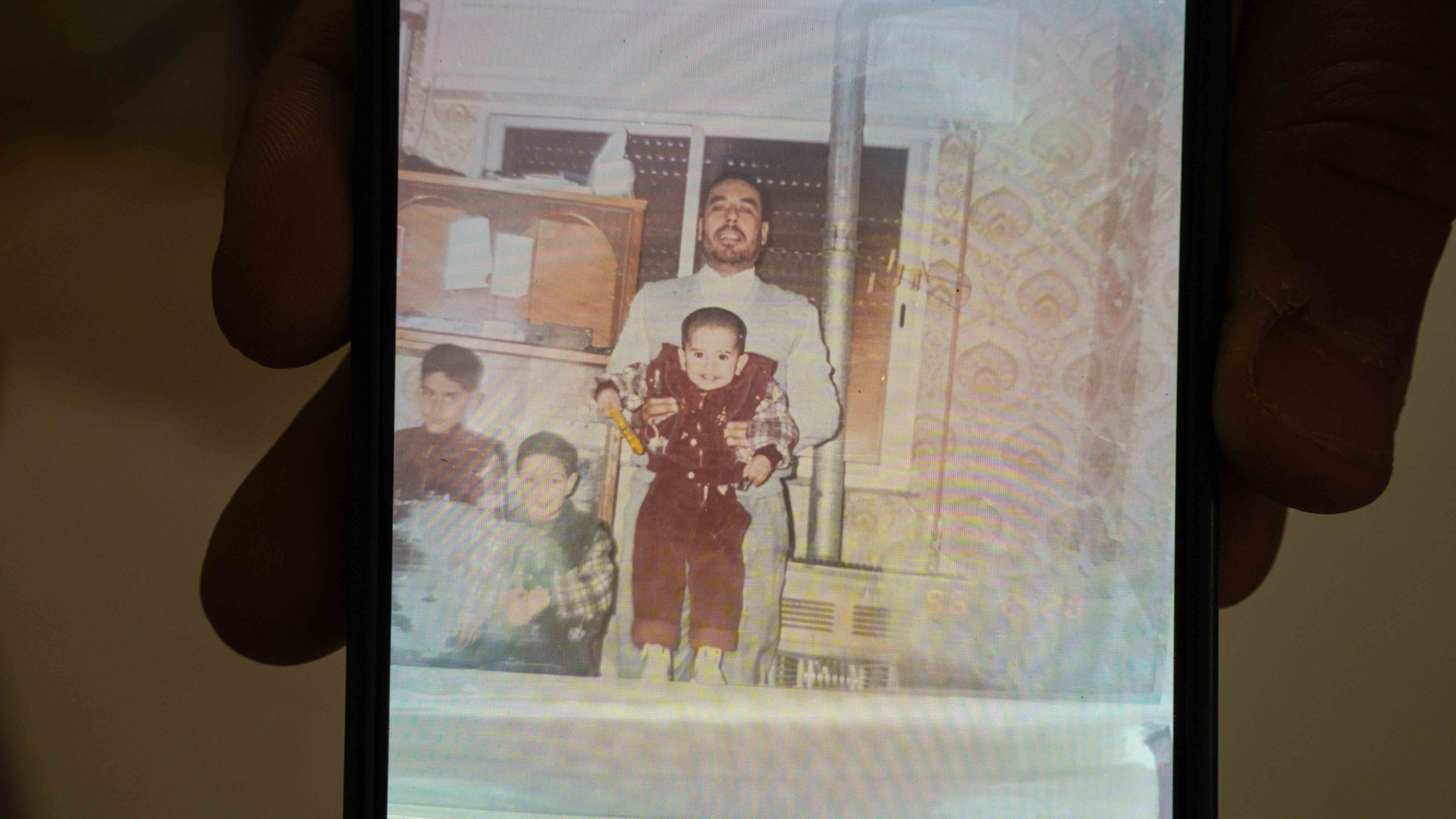
Eleven months after Syrian security forces seized 71-year-old Adel al-Natour, a co-founder of the Palestinian armed faction Palestinian Islamic Jihad (PIJ), the elderly Palestinian refugee remains in arbitrary detention with no formal charges, no access to legal representation, and limited contact with his family, his relatives have confirmed in an exclusive interview with Middle East Eye.
Natour was taken into custody from his family home in a Damascus suburb on September 18 last year. What makes his detention particularly striking is that Natour officially cut all ties with PIJ nearly 30 years ago, back in 1995, after growing disillusioned with the group’s leadership and external influence. According to his family, only four supervised visits have been permitted since his arrest. When they finally saw him four months into his detention, they discovered he had lost 20 kilograms due to poor conditions behind bars.
“Our entire immediate family is internally displaced in Gaza, living in tents after the recent war, and he was completely cut off from all news – he didn’t even know the conflict had ended,” said Israa al-Natour, Adel’s daughter and a public sector employee. For months, the family stayed silent amid repeated promises from Syrian security officials that Natour would be imminently released. Authorities initially claimed he was detained to protect him from unspecified threats to his life, offering no further details about the grounds for his arrest. That silence broke this weekend, when security officials notified the family that Natour would be deported from Syria within 10 days.
A lifelong Palestinian political activist, Natour was born in 1955 to a poor refugee family in the Rafah refugee camp in the Gaza Strip. He helped found PIJ in 1981 as a movement opposing Israeli occupation, but his activism has already led to decades of displacement and repeated detentions across the Middle East. Shortly after co-founding the group, he was detained without trial by Israeli authorities, then deported first to Egypt, then to Greece, before finding temporary refuge in Algeria. He was allowed to return to Gaza in 1986, only to be deported again ahead of the First Intifada. A third return in 1990 led to another expulsion, this time with a permanent ban on re-entering Gaza, forcing him to settle first in Libya before moving to Syria with his family in 1992.
In 1995, Natour formally left PIJ, stepping away from all political and armed activity in protest of growing Iranian interference in the faction. “He believed Iran only funded PIJ as a tool to pressure Israel, not out of genuine commitment to the Palestinian cause,” Israa explained. “He also came to the conclusion that armed resistance only led to endless Palestinian deaths, without advancing the goal of ending occupation.”
Natour’s history of detention in Syria predates the current government: he was arrested by the former Assad government in 2008 and held for three months in the notorious Palestine Branch prison before being released. When the 2011 Syrian revolution broke out, Natour opened his home in Damascus’ Yarmouk Camp to hide opposition activists, and advocated fiercely for Palestinian factions to remain neutral in Syria’s internal conflict. When fighting broke out in Yarmouk in 2012, he fled the camp, earning a reputation as a neutral humanitarian advocate who provided aid to displaced people regardless of their political alignment. “People called him the Godfather of Yarmouk Camp,” Israa said. “He trusted everyone, even when it put him in danger.”
Today, Natour’s family is fighting to overturn the deportation order, but their efforts have hit a dead end. Because no formal charges have ever been filed against Natour, courts and lawyers have refused to take up his case. As Palestinian refugees holding only Syrian residency, not citizenship, the family says deportation would leave them stateless. Most countries routinely deny entry visas to Palestinians, and all of the family’s travel documents were seized during the original raid on their home. The family has explored seeking temporary entry to Malaysia, which allows Palestinian tourists to enter without a visa, but they have no guarantee Natour would be granted residency there, leaving him at risk of displacement yet again.
“Given the option, my father would rather remain in prison than be deported,” Israa said. “Our lives, our work, everything is here – Syria is our second home.”
Human rights groups have condemned Natour’s detention as unlawful, framing it as part of a broader pattern of arbitrary detentions under Syria’s new interim government led by President Ahmed al-Sharaa, which seized power in December 2024. “Even if he had broken a Syrian law, even if he is not a citizen, he is entitled to due process: a fair trial, the right to know the charges against him, the right to legal representation, and protection from torture and enforced disappearance,” said Bassam Alahmad, executive director of Syrians for Truth and Justice. His organization has documented nearly two dozen cases of enforced disappearance and more than 12 deaths under torture in custody since the new administration took power.
Natour’s son Muamen warned that the deportation would set a dangerous precedent for the hundreds of thousands of Palestinian refugees who have made Syria their home for decades. “My father wanted to help build a new, free Syria after the fall of Assad,” he said. “But justice was supposed to be one of the core goals of the revolution. Oppression and forced disappearances have no place here.”
As of publication, Middle East Eye had reached out to the Syrian Ministry of Interior for comment on the case but had not received a response.