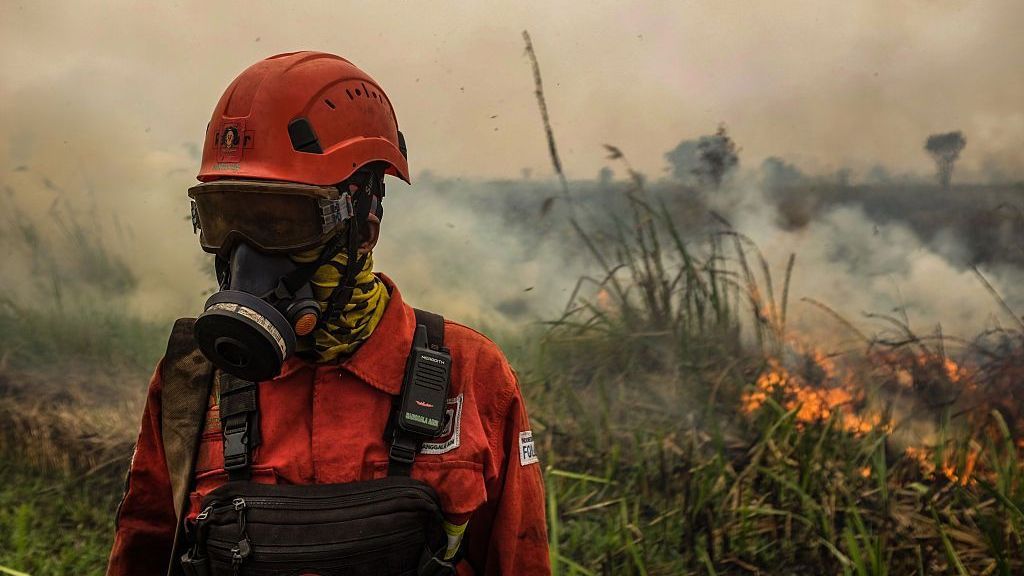
A growing public health and environmental emergency is unfolding across Southeast Asia, as months of uncontrolled wildfires in Indonesia have spawned a thick blanket of toxic haze that has drifted across national borders, endangering millions of people and threatening massive carbon emissions from vulnerable ecosystems.
Weeks after the first blazes ignited across Sumatra and Indonesian Borneo in mid-July, the smog now covers large swathes of Indonesia and has spread to neighboring Malaysia, Singapore, and the Philippines. In the hardest-hit areas, pollution levels have surpassed 15 times the maximum safe limit set by the World Health Organization, pushing air quality into the “acutely unhealthy” range that threatens even healthy adults, not just vulnerable groups.
For local residents, the daily reality of living under the haze is grim. Nineteen-year-old teaching assistant Rizma Nur Fatimah, who works at a school in Banjarbaru, South Kalimantan, described visibility so poor that “you couldn’t even see your own feet” inside her classroom. Even sealed indoor spaces offer little protection: “Even inside the house, with everything closed, the haze still got in,” she said. Having grown up with annual haze events, Fatimah noted that this year’s crisis is far worse than previous seasons, leaving local communities resigned to chronic poor air quality. Twenty-three-year-old mother Misbah, from nearby Pengayuan village, said her three-year-old daughter has already developed persistent cough, sore throat, and runny nose from prolonged exposure to the smog.
The health impacts are being felt hundreds of kilometers away, too. On the Philippine island province of Palawan, residents and medical workers report widespread respiratory and allergic symptoms linked to the drifting smoke. “We are now experiencing mild headaches,” said local physician Dr Precious Bañas-Melad. “My cousin who isn’t allergic to anything started developing allergies. My husband is the first one who had itchy eyes and throat.” Across the border in Malaysia, national health authorities have recorded sharp increases in asthma and conjunctivitis cases as air quality declines across the country.
Between July and August alone, Indonesia’s Ministry of Health confirmed more than 50,000 cases of respiratory infections directly linked to the land and forest fires, with children under five accounting for over 12,000 of those cases.
While this year’s extreme severity is being driven by a Super El Niño event that has worsened drought conditions across the region, experts emphasize that the recurring crisis is deeply rooted in decades of human-caused land use change. The pattern dates back to the Suharto era, when vast areas of ancient rainforest and carbon-rich peatland in Kalimantan were cleared for logging, industrial agriculture, and large-scale infrastructure projects. Today, environmental groups, researchers, and official government investigations have repeatedly documented that many commercial operators use fire as a low-cost method to clear large tracts of land for industrial plantations.
Unlike small-scale, community-managed traditional burning practices that are tightly controlled, large-scale clearing fires are far harder to contain and create far greater harm to both public health and the environment. Drained peatlands, industrial timber estates, and oil palm plantations create landscapes that are far more vulnerable to burning, and blazes often reoccur in the same degraded areas year after year.
What makes this year’s fires on Indonesian Borneo particularly alarming is that they are tearing through one of the world’s largest tropical peatland ecosystems. These unique landscapes act as massive natural carbon sinks: under normal waterlogged conditions, decomposition is slowed, allowing carbon to accumulate underground for thousands of years. But when drained and burned, these same carbon stores turn into what researchers call carbon “bombs,” releasing thousands of years of stored carbon into the atmosphere in just weeks or months, worsening the climate change that drives extreme drought and El Niño events in a dangerous feedback loop.
“Peatlands are incredibly effective carbon stores because their waterlogged conditions slow decomposition, allowing carbon to accumulate underground for thousands of years,” explained Dr Nisa Novita, a peatland researcher at Indonesian conservation NGO Yayasan Konservasi Alam Nusantara. “But this also means they can become a ‘carbon bomb’ when they are drained or burned, because that carbon can be rapidly released into the atmosphere.”
As the Super El Niño event continues to intensify through the coming months, experts warn the worst may still be ahead. Forest fire forensics expert Professor Bambang Hero Saharjo, from Institut Pertanian Bogor University, noted that in 2025, without an El Niño event, Indonesian wildfires burned roughly 359,000 hectares of land. This year, he projects the burned area could reach 11 million hectares, putting the 2026 season on par with the devastating 1997-1998 wildfires, one of the worst on record for Indonesia.
Indonesia’s Forestry Minister Raja Juli Antoni confirmed this week that the fight to contain the blazes is now entering its most critical phase. “Our problems are not over. September is the peak of El Niño,” he said. “September is the main fight for us.”