Fresh off attending the Shanghai Cooperation Organization (SCO) summit hosted in Kyrgyzstan, Turkish President Recep Tayyip Erdogan issued a clear diplomatic reassurance Wednesday: Turkey’s push to strengthen economic and political ties with Eastern powers will not come at the cost of its relationship with the Western bloc. In on-the-record remarks to reporters traveling aboard his presidential aircraft en route back to Istanbul, Erdogan pushed back against speculation that Turkey’s ambition to gain full membership in the growing Eurasian security and economic bloc signals a strategic turn away from the West.
“Turkey’s membership perspective in the organization does not mean a break from a bloc or turning our backs on the West,” the president emphasized, directly addressing widespread geopolitical analysis that frames Turkey’s deepening engagement with the SCO as a shift in its longstanding foreign policy alignment.
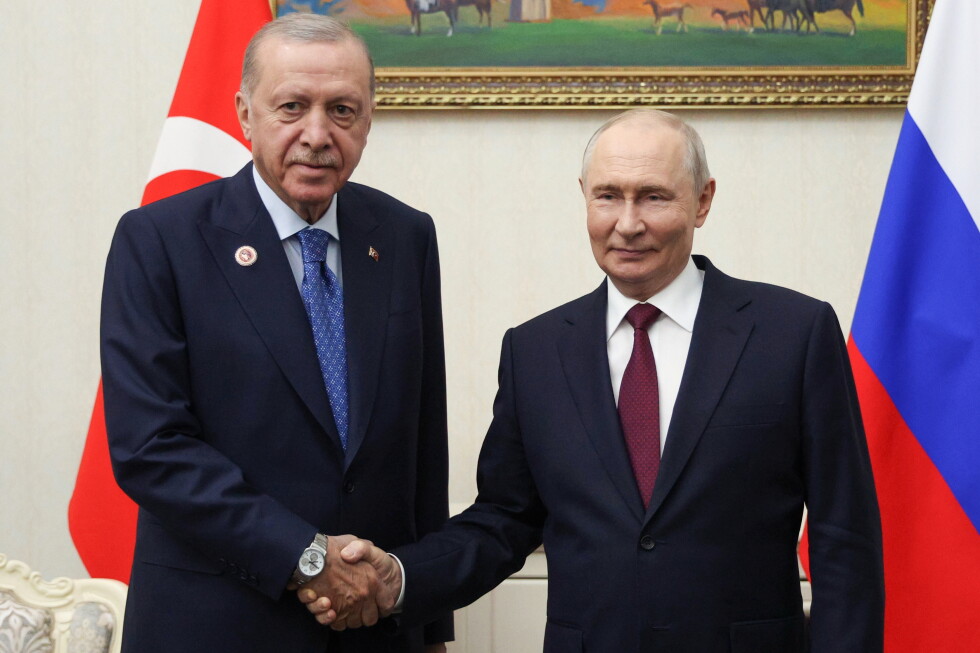
The three-day summit in Kyrgyzstan’s Cholpon-Ata provided a high-profile stage for Erdogan to hold a closed-door bilateral meeting with Russian President Vladimir Putin, where the pair advanced talks on expanded nuclear energy collaboration between the two nations. Beyond energy cooperation, the two leaders aligned on their shared top priority for the ongoing war in Ukraine: an urgent end to hostilities through peaceful negotiation. Since the full-scale Russian invasion began in February 2022, Turkey has carved out a unique diplomatic niche, maintaining open, constructive ties with both Moscow and Kyiv while positioning itself as a key neutral mediator for global and regional security.
A core focal point of Erdogan and Putin’s discussion was maritime security in the Black Sea, a strategic waterway where civilian commercial shipping has faced a sharp rise in attacks since Russia exited the landmark Black Sea Grain Initiative last year. Erdogan stressed that the ongoing instability threatens to reignite a global food security crisis, echoing warnings from global food security bodies that new disruptions to grain shipments from major exporter Ukraine would hit vulnerable populations in low-income regions hardest.
“There is a need for a mechanism that will permanently ensure the safety of commercial maritime transport in the Black Sea,” Erdogan said. The president added that a durable security framework would be “beneficial” to prevent a “resurgence of the grain crisis” that pushed millions of food-insecure people deeper into hunger in 2022 and 2023.
It was Turkey that led the 2022 brokering of the original grain deal, alongside the United Nations, which unlocked Ukrainian Black Sea ports to allow export of millions of tons of grain and sunflower oil, while also removing barriers to Russian exports of food and fertilizer. The agreement, which proved critical to stabilizing global food prices and preventing widespread hunger across Africa, the Middle East and South Asia, collapsed in July 2023 when Russia withdrew from the pact over unmet demands related to its own agricultural exports.
Founded in 2001 as a Eurasian security and cooperation bloc, the SCO currently counts 10 full member states: Russia, China, India, Iran, Kazakhstan, Kyrgyzstan, Tajikistan, Uzbekistan, Pakistan and Belarus. The expanding bloc has increasingly been framed by geopolitical analysts as a counterweight to U.S.-led global institutional frameworks, though its core policy priorities and collective action mechanisms remain relatively undefined to date. Erdogan reaffirmed Wednesday that Ankara remains fully committed to its long-held goal of attaining full SCO membership, as Turkey continues to pursue a multi-directional foreign policy that balances longstanding ties to NATO and the European Union with growing economic and security partnerships across Eurasia.