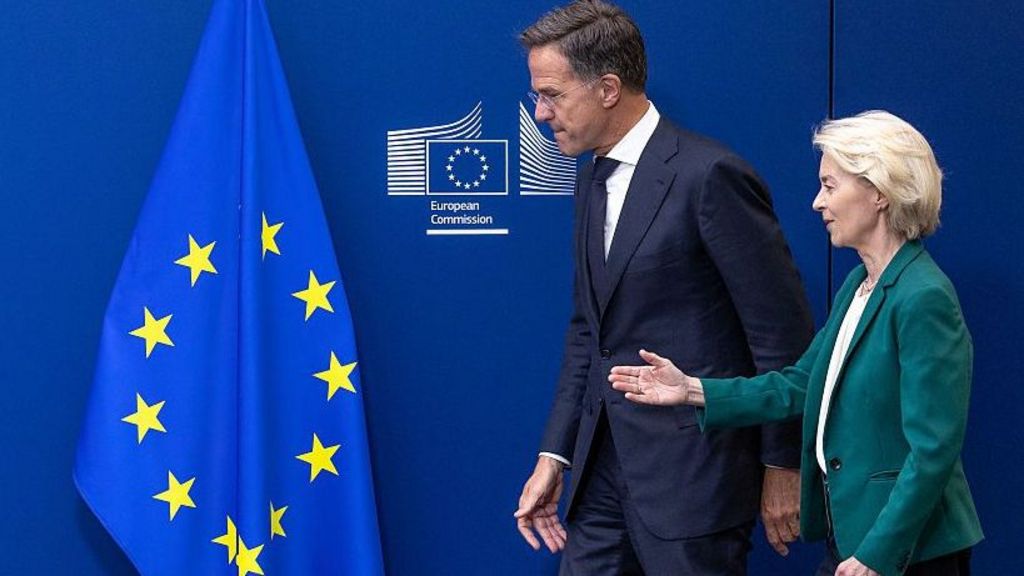
In a sharp rebuke of escalating Russian hostile activity on European territory, European Commission President Ursula von der Leyen and NATO Secretary General Mark Rutte have formally accused Moscow of growing increasingly reckless, vowing a unified, robust response to what leaders frame as a dangerous new phase of hybrid aggression.
The confrontation was triggered by last month’s attempted drone attack at Leipzig/Halle Airport, a critical NATO logistics hub that regularly hosts Ukrainian military transport aircraft. On Tuesday, the German government confirmed that weeks of police investigations and intelligence assessments conclusively tied the incident to Russia. Three drones were recovered in and around the airport: one was safely defused by a bomb disposal robot, a second collided with a cargo plane, and a third was discovered 10 days after the 4 August incident. German Interior Ministry officials note that the drones’ design, components, explosives, and triggering mechanisms match the signature of other proven Russian hybrid operations across Europe. Authorities have also identified two suspects linked to the plot: a Belarusian national holding a Russian passport who entered Germany on a tourist visa, and a dual Latvian-Russian citizen who flew into Berlin before departing two days ahead of the attempted attack. Moscow has forcefully denied all accusations, claiming Berlin has presented no concrete evidence to support its claims.
In its first formal response to the proven attack, Germany has announced it will shutter the Russian consulate in Bonn and close the Russian House, a prominent cultural institution in Berlin that German security agencies have long suspected of operating as an unregistered Kremlin propaganda hub. The Kremlin has hit back sharply: Russian Foreign Ministry officials have pledged a “mirror-image” retaliatory measure, while President Vladimir Putin condemned Berlin’s actions as a “serious mistake” that directly contradicts the interests of the German people. When asked whether Moscow could cut full diplomatic ties with Berlin, Russian Deputy Foreign Minister Alexander Grushko acknowledged the possibility remained on the table, but said Moscow would give diplomatic channels a chance to de-escalate first. Some German political critics have argued Berlin’s current response is overly restrained, but German officials note they are prioritizing building a coordinated multilateral response alongside European and transatlantic allies, which could include expanded EU-wide sanctions and tighter entry restrictions for Russian travelers across the 27-nation bloc.
Speaking alongside Rutte in Brussels, von der Leyen emphasized the unprecedented nature of the incident: “Leipzig marks a new escalation on European Union soil directly attributed to Russia. We have to step up and that means being ready to respond to Russia’s recklessness faster and better.” She added that the Leipzig attack is not an isolated event, but part of a growing pattern of increasingly dangerous Russian hostile actions targeting European critical infrastructure, including repeated drone incursions and sabotage attempts. Rutte echoed the condemnation, affirming that the entire 32-member NATO alliance – including the United States – stands in full solidarity with Germany. He noted that alliance members have seen a steady rise in direct malign activity on NATO territory, ranging from arson attacks on factories manufacturing defense equipment for Ukraine to the confirmed hybrid plot in Leipzig.
As EU and NATO leaders met in Brussels, EU foreign ministers gathered in Wicklow, Ireland, to discuss further collective measures. French Foreign Minister Jean-Noël Barrot announced that European-level action could be targeting Russia’s shadow fleet of oil and cargo vessels that operates to evade existing EU sanctions. Barrot, alongside his counterparts from Belgium and the Netherlands, has already summoned the Russian ambassador in their respective capitals to formally protest the Leipzig attack. Lithuania’s Foreign Minister Kestutis Budrys pointed out a worrying trend: Moscow has calculated that it faces no meaningful political cost for its repeated hybrid operations against European allies, encouraging further escalation.
In a separate development that adds to heightened security tensions, Germany reported multiple suspected sabotage incidents across the country in just 24 hours, including two separate attacks on electrical substations – one in eastern Germany and a second near Cologne in western Germany. While authorities have not yet attributed these attacks to any actor, Herbert Reul, Interior Minister for the state of North Rhine-Westphalia, confirmed the attack on power lines in Bergheim was deliberate, stating that the perpetrators “attacked the entire country.” Reul added that investigators are probing two leading hypotheses: foreign state-directed sabotage and attack by domestic left-wing extremist groups.
Von der Leyen outlined the next steps for the bloc, noting that existing sanctions have already constrained Russia’s war capacity, but EU foreign ministers are currently negotiating new measures to “cut deeper into Russia’s war chest.” The EU has already approved a €90 billion loan package to support Ukraine’s government and military operations, and von der Leyen confirmed that Kyiv has requested additional billions in funding to acquire PAC-3 air defense missiles to protect civilian infrastructure from Russian missile and drone attacks. She also revealed that work is already underway on a joint European-Ukrainian anti-ballistic missile defense initiative, codenamed Project Freyja. Closing her statement, von der Leyen reaffirmed the unwavering commitment of the EU and NATO to supporting Ukraine: “Europe and NATO will not just maintain pressure on Moscow, we will increase it, and we will not stop – not until Russia stops bombing and killing innocent people in Ukraine.”