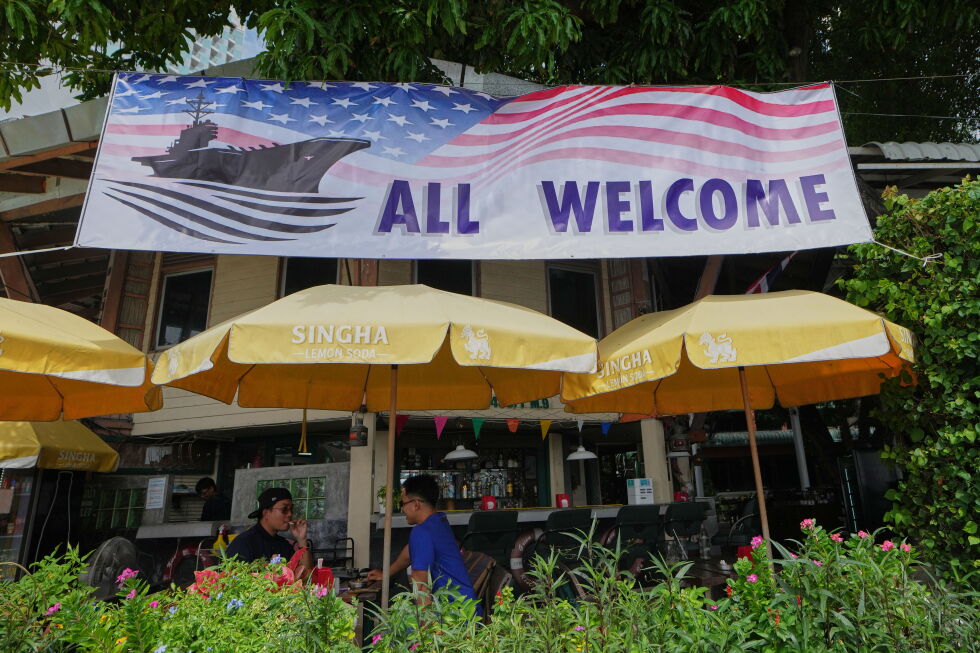
Decades after it rose from a quiet fishing village to an infamous global hub for sex tourism during the Vietnam War, Thailand’s sun-soaked coastal resort city of Pattaya is gearing up to welcome around 5,000 sailors and Marines from the USS Abraham Lincoln strike group, who are seeking much-needed rest and recreation after a lengthy, high-tension deployment in the Middle East.
The upcoming shore leave continues a decades-long tradition of U.S. military personnel visiting the city, located just 100 kilometers southeast of Bangkok. Long before this port call, millions of civilian tourists and thousands of service members have traveled to Pattaya annually, many for joint land and sea military exercises conducted alongside the Royal Thai Armed Forces. Most U.S. Navy vessels dock at nearby deep-water ports, including Laem Chabang Port and Sattahip Royal Thai Navy Base, both of which are less than an hour’s drive from the city’s central tourist districts. While social media has already been flooded with old jokes and jabs about sailors seeking the city’s historic adult entertainment, recent visitors and local development efforts tell a different story: a decades-long rebranding that has gradually pushed the city’s seedy reputation into the background in favor of family-friendly attractions.
Local economies have long benefited from the shore leave tradition, with service members’ off-base spending injecting millions of baht into local businesses ranging from restaurants to retail shops each year. Beyond economic activity, U.S. military visits often include structured community outreach initiatives, such as providing free specialized medical care to rural villagers near the city and completing volunteer work at local orphanages. To mitigate potential disruptions during large groups of sailors’ onshore liberty, the U.S. Navy deploys specialized Shore Patrol teams that work alongside Thai law enforcement to de-escalate conflicts and address any misconduct. All service members are reminded before leaving their ships that while Thailand’s formal ban on prostitution is rarely enforced, purchasing sex remains a criminal offense under Article 134 of the U.S. Uniform Code of Military Justice, punishable under U.S. military law.
Pattaya’s deep ties to U.S. military visits date all the way back to the Vietnam War era, when as many as 50,000 American service members were stationed across Thailand to support air operations over Indochina. U.S. military bases were spread across the country, and each drew a thriving nightlife industry around its perimeter. Pattaya’s prime location — close to both the Sattahip naval base and U-Tapao airfield, which hosted U.S. Air Force B-52 bombers — made it an ideal rest stop for off-duty troops. As author Elizabeth Becker notes in *Overbooked: The Exploding Business of Travel and Tourism*, what was once a quiet fishing community was quickly transformed into a raunchy seaside playground for visiting GIs.
A 1966 Thai law regulating entertainment venues created a legal gray area that allowed the sex trade to operate semi-openly in bars and massage parlors, despite a 1960 national law that formally criminalized prostitution. This framework allowed the industry to grow rapidly, with thousands of young workers from Thailand’s impoverished northeastern Isan region migrating to Pattaya to earn wages far higher than what they could make farming back home, sending much of their earnings back to extended family. While sex work remains a cultural taboo in Thailand, it has quietly existed in Thai society for centuries, with a large domestic market that has long outstripped the more visible trade for foreign tourists.
After U.S. military forces withdrew from Thailand in 1976, Pattaya was well-positioned to transition to a civilian tourist destination. Its existing infrastructure of entertainment venues, beautiful beaches, and relative proximity to Bangkok made it a popular stop for the growing global package tour industry, which boomed as low-cost air travel made international vacations accessible to more people. Sex tourism became a deeply entrenched part of the city’s identity and global reputation through the final decades of the 20th century.
The 1990s brought another major shift to Pattaya after the collapse of the Soviet Union in 1991. A new wave of Russian tourists began visiting the city, taking advantage of a 30-day visa-free agreement and direct charter flights from Russian provincial cities to U-Tapao’s newly expanded civilian airport. Local businesses quickly adapted, adding Cyrillic signage and Russian-language services to cater to the new market. Along with legitimate tourists, the city’s permissive regulatory environment and relaxed law enforcement attracted transnational criminal groups and fugitives from across the globe, including Russian and Eastern European gangs, Western European organized crime networks, and outlaw motorcycle gangs involved in drug trafficking from Australia.
In the 21st century, Pattaya has made a concerted push to rebrand itself as a mainstream, family-friendly tourist destination, and the effort has seen measurable success. New attractions including a Cartoon Network-themed water park, the sprawling Nong Nooch Tropical Botanical Garden, the 100-meter-tall all-wood Sanctuary of Truth Museum, dozens of championship golf courses, and new luxury residential resorts and shopping malls have drawn millions of Thai tourists and visitors from other East and Southeast Asian countries. The city still retains echoes of its past: Walking Street, the historic heart of Pattaya’s adult nightlife district, still operates for visitors seeking that side of the city. But for many modern travelers, the new, more diverse Pattaya has fully overshadowed its old reputation.