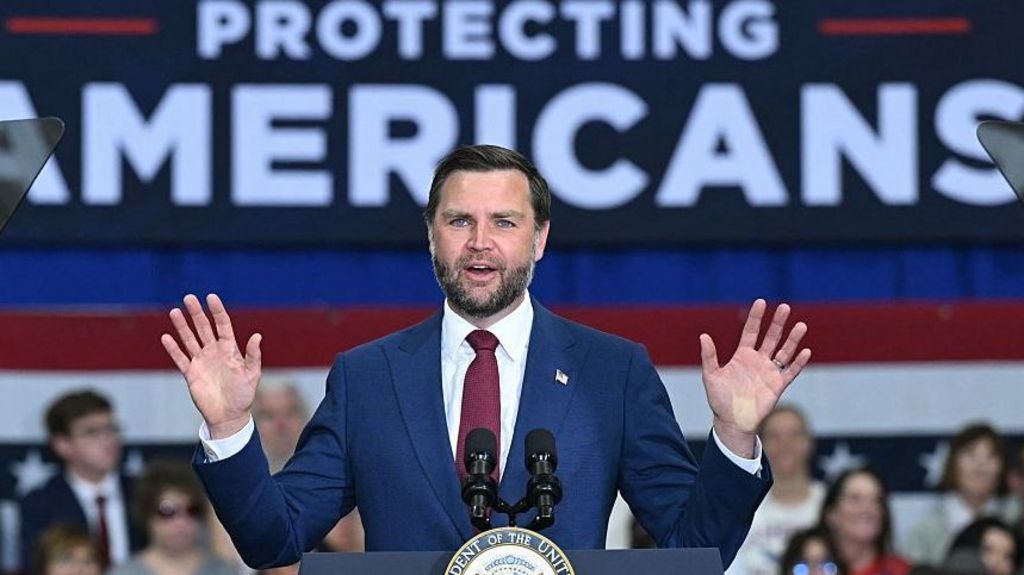
A heated Michigan Senate campaign has devolved into raw personal confrontation this week, after U.S. Vice President JD Vance delivered a blistering attack on Democratic candidate Abdul El-Sayed at a campaign rally for Republican nominee Mike Rogers in suburban Detroit Monday night. Vance, a close ally of former President Donald Trump, labeled the 41-year-old Muslim candidate “a very, very evil” person seeking to “destroy” the United States, framing El-Sayed as a divisive extremist who represents a dangerous rising force in American politics.
The vice president’s tirade came after El-Sayed made controversial remarks about Vance’s family, specifically suggesting that Vance’s late grandfather would not accept Usha Vance, the Hindu Second Lady and Vance’s wife. Addressing that comment directly, Vance issued a sharp public warning: “keep my wife’s name the hell out of your mouth.”
Vance also sought to tie El-Sayed to far-left streamer Hasan Piker, who once claimed the U.S. “deserved” the 9/11 terrorist attacks. El-Sayed appeared alongside Piker during his primary campaign, but has repeatedly denied sharing Piker’s views and publicly distanced himself from the 9/11 comment. Undeterred, Vance repeated unsubstantiated insinuations that El-Sayed sympathizes with terrorists and aligns with anti-American ideology, claiming the candidate sided with attackers over victims of a shooting at a Detroit-area synagogue.
Within hours, El-Sayed pushed back forcefully against Vance’s accusations during an interview with CNN, turning the “evil” label back on the Trump administration’s policy agenda. He argued that the real harm facing American communities comes from what he called the Trump White House’s unethical policy choices: “Evil is ripping healthcare away from working people in exchange for tax breaks for billionaires. Evil is making people pay more for groceries and gas while pushing for trade wars and actual war. Evil is dividing people for your own gain. Evil is selling out your morals for a little bit of power.”
El-Sayed also moved to clarify his earlier comments about Usha Vance, explaining that his remarks were never intended as a personal attack. Instead, he said, they were meant to illustrate what he frames as Vance’s core political belief: that some people are inherently “more American than others” based on their identity or background.
The contest between El-Sayed and Rogers, a long-time former law enforcement official and seasoned political figure, has already become one of the most closely watched races of the 2026 midterm elections. Michigan is a critical battleground state: it went to Joe Biden in the 2020 presidential election, and flipped back to Donald Trump in 2024, making this Senate seat a key target for both major parties as they fight for control of the upper chamber.
A recent poll released by Michigan-based research firm Epic-MRA shows the race remains tight, with El-Sayed holding only a narrow four-point lead over his Republican opponent ahead of the general election. The rapid escalation of personal hostility between the candidates has underscored the deep polarization that continues to shape competitive electoral contests across the U.S. ahead of 2026’s voting.