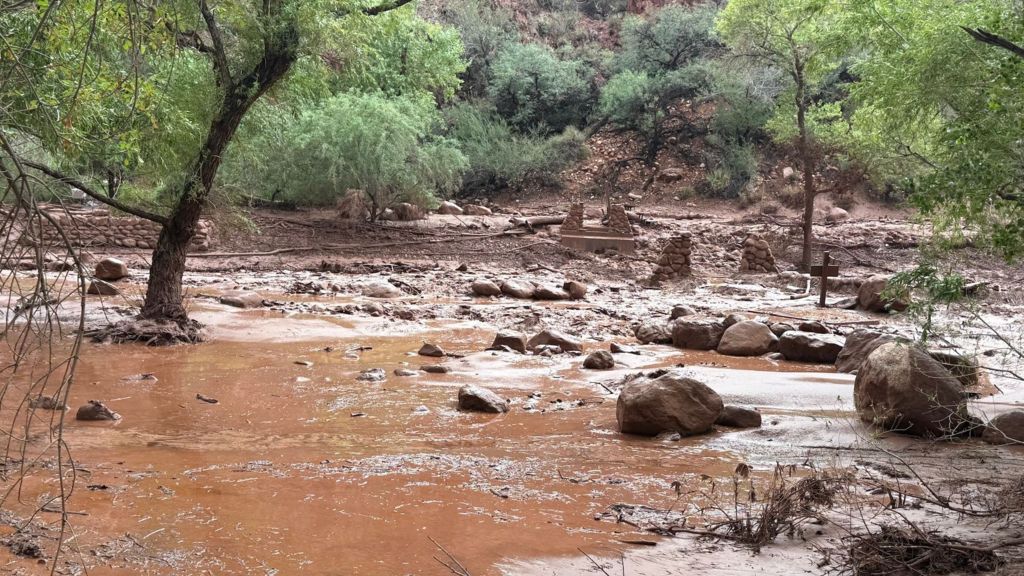
A brutal flash flood that swept through popular hiking trails at Arizona’s Grand Canyon over the weekend has left two people dead and only one hiker still missing, according to updates from the U.S. National Park Service (NPS). What began as an ordinary Saturday on one of the nation’s most visited natural landmarks quickly turned deadly when the sudden flood hit, destroying critical infrastructure and stranding dozens of visitors in low-lying areas.
The disaster unfolded around 14:30 local time on Saturday, when intense monsoon rains triggered what the NPS describes as significant flooding in Bright Angel Canyon, the location of the park’s most popular hiking route. Floodwaters surged downstream, sweeping away footbridges, dislodging massive boulders, and cutting off access to popular campgrounds and outposts including Phantom Ranch, the area hardest hit by the disaster. By the time emergency crews arrived, at least two adult males had been killed; the NPS has confirmed one of the victims as a 46-year-old man whose body was recovered near Crystal Rapids along the Colorado River, and officials have declined to release further identifying details at this time.
When the flood first struck, 30 hikers and visitors were initially unaccounted for. But incident commander Dave Black told reporters at a Monday press briefing that NPS rangers and emergency response crews have worked tirelessly around the clock to locate those missing, reducing the number of unaccounted-for people to just one. “We’ve had a very busy couple of days,” Black noted, praising his teams for their extraordinary efforts to get the rapidly unfolding crisis under control.
Rescue operations centered on airlifting stranded visitors from Phantom Ranch, with 45 people evacuated by air on Saturday alone. An additional 37 people were lifted to safety by Sunday afternoon. Search crews will resume their hunt for the final missing person on Tuesday morning, focusing on the stretch of trail between Phantom Ranch and Cottonwood Manzanita. The search is complicated by a new forecast for further heavy rain overnight Monday into Tuesday, which brings an elevated risk of additional flash flooding in the already vulnerable area.
Nikki Baggs, a 41-year-old hiker who was airlifted from the canyon along with two friends, described the chaotic moments when the flood hit to the BBC. “The whole thing was terrifying,” she said. “It was a beautiful day and then people were screaming, running.”
Preliminary infrastructure assessments released Monday show nearly all footbridges spanning Bright Angel Creek were destroyed in the flood. The NPS has instituted a full closure of Phantom Ranch, Bright Angel Campground, the entire North Kaibab Trail to Phantom Ranch, Black Bridge, Silver Bridge and the adjacent stretch of the Colorado River. Additionally, roughly 40% of the Transcanyon Waterline, which supplies drinking water to park visitors and approximately 2,500 local residents, has been damaged or destroyed, creating a major ongoing challenge for park operations.
The Grand Canyon draws roughly 5 million visitors every year, making it one of the most popular national parks in the United States, and the Bright Angel trail is its most frequently hiked route. This flooding is tied to the annual North American monsoon season that brings frequent heavy storms to the Southwestern U.S. This time of year, a shift in wind patterns pulls warm, moisture-heavy air north from the Gulf of California and tropical Pacific, which collides with the region’s mountainous terrain to trigger sudden, intense storms. These monsoon storms are notoriously difficult to predict accurately, meaning they can strike with little to no warning. Compounding the risk, the region’s typically parched ground cannot absorb heavy rainfall quickly, so even strong downpours almost immediately spawn dangerous flash floods, while frequent lightning from the storms also increases the threat of wildfires across the Southwest.