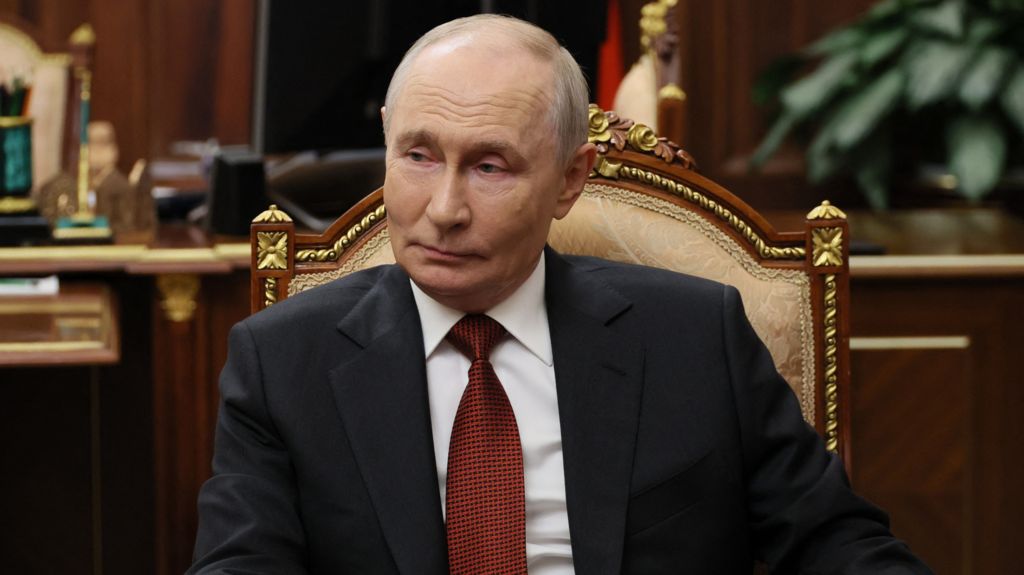
Senior anonymous Western officials have shared their latest assessment of Russian President Vladimir Putin’s strategic intentions amid soaring tensions over the Ukraine conflict, concluding that Putin’s primary goal remains avoiding direct military confrontation with the NATO alliance — even as his government ramps up aggressive rhetoric targeting the United Kingdom and other Western backers of Kyiv.
Recent public speculation has framed this week’s high-profile visit of CIA Director John Ratcliffe to Moscow as a mission centered on delivering a stark warning: that any attack on a NATO member state would trigger severe consequences. But Western officials push back on that framing, noting that recent threatening statements from Moscow — including hints that British military personnel and weapons manufacturing facilities could become legitimate targets — are far from unprecedented. Instead, they argue, these verbal barrages align perfectly with long-standing Russian military doctrine designed to test Western unity and erode public support for continued aid to Ukraine.
Beyond external pressure tactics, officials say the heated rhetoric also mirrors growing domestic strains on Putin’s regime. Months of grinding, costly progress in Ukraine, paired with increasingly frequent Ukrainian long-range strikes that hit targets deep inside Russian territory, have piled unrelenting pressure on the Kremlin leader.
Putin and his senior aides have repeatedly dismissed claims that Russia plans to attack NATO members as baseless fearmongering, a framing that has found acceptance from U.S. President Donald Trump, who stated publicly this week that he is convinced Putin will never launch an attack on NATO sovereign territory. This stands in sharp contrast to the period just before Russia’s 2022 full-scale invasion of Ukraine, when Putin repeatedly gave public assurances he had no plans to attack his neighbor even as U.S. intelligence documented large-scale military preparations underway along the border.
While direct military confrontation is not seen as imminent, Western officials warn that Russia will continue to ramp up so-called hybrid activities that fall below the threshold of open war. These tactics include cyberattacks against critical infrastructure, covert sabotage operations, and targeted assassination attempts on European soil, all designed to fracture Western resolve and force a reduction in military and political support for Kyiv. Officials also emphasize a key underrecognized risk: this gradual escalation of hybrid action increases the chance of a strategic miscalculation that could accidentally spiral into full-scale military conflict between Russia and NATO.
In recent weeks, a series of unexplained drone incidents across multiple NATO member states have deepened these concerns. Earlier this month, an explosive-laden drone crashed on the runway of Leipzig Airport in Germany, a critical logistics hub that handles much of the Western military equipment bound for Ukraine. While no conclusive evidence has linked the incident directly to the Kremlin, and Russia has repeatedly denied any involvement, this event is only the latest in a string of drone sightings over European military bases and major airports stretching back to 2024 — all of which Western intelligence agencies suspect are tied to Russian operatives.
The Leipzig incident prompted the head of France’s domestic intelligence agency to issue a stark warning, urging European governments to prepare for the possibility of more frequent, more violent direct hostile actions on European national soil. Despite these risks, one senior Western official stressed that NATO allies must maintain a measured posture: remaining alert to emerging threats without giving in to panic, while also avoiding the complacency that could leave vulnerabilities open to exploitation. The UK government has already reaffirmed its commitment to Ukraine, stating that recent Russian threats will not alter its policy of military and political support for Kyiv.
Western officials’ assessment also paints a detailed picture of the current state of the war in Ukraine, noting that the conflict has escalated noticeably in 2025, with both Russian and Ukrainian forces expanding their long-range strike campaigns against each other’s territory. Contrary to some speculation, officials say Putin has not softened his maximalist territorial goals for Ukraine, even as mounting frustrations build within Russian domestic circles.
The report notes that growing petrol shortages across Russia have started to erode public backing for the war, putting increasing political pressure on Putin. Still, officials emphasize that this pressure does not currently amount to an existential challenge to his hold on power. On the battlefield, Russia continues to make incremental territorial gains in the eastern Donbas region, but the advance comes at a devastating cost: Western intelligence estimates Russia is sustaining 6,000 more killed and wounded soldiers per month than it is able to recruit through existing enlistment channels. Despite this severe manpower shortage, officials say there is currently no indication that Putin will order a new wave of mass mobilization to replenish ranks, a move that could spark further domestic unrest.