A recent decision by the United States government to label UK-based pro-Palestine advocacy group Palestine Action as a transnational terrorist organization has triggered widespread alarm among campaigners, who warn the move will expose UK-linked activists to elevated risks of intrusive surveillance and potential exclusion from the global financial system.
The announcement came via an official statement published on the US Treasury Department’s website, which rolled out a new package of sanctions targeting what it calls “Violent Far-Left Terrorist Networks”. Alongside Palestine Action, the sanctions also target Masar Badil, a Palestinian movement pushing for a revolutionary alternative path to secure Palestinian rights and self-determination, as well as Italian tech collective Autistici/Inventati. The US claims the collective provides specialized digital infrastructure, tools and services to Antifa cells and other violent far-left extremist groups, including a designated foreign terrorist organization.
US officials emphasized that the designation complements the UK government’s 2024 decision to ban Palestine Action under domestic terrorism law, a ruling that is currently scheduled to face a legal challenge at the UK Supreme Court this November.
For activists directly connected to the group, the new sanctions have already created profound uncertainty and fear. Max Geller, a former Palestine Action member and US citizen who resides in the UK, told independent outlet Middle East Eye that he now faces deep anxiety over his financial security and ability to travel. “I have American bank accounts, I don’t know if I’m going to suddenly be de-banked or if every single one of my Paypal transactions with my friends are going to be scrutinised,” Geller said. With elderly parents based in the US, Geller added that the ban could even block family visits, noting “Suddenly going back home has become a very stressful and scary prospect. No one knows what this means yet. They don’t use these laws on American citizens, so no one really knows what it means for people like me.”
Huda Ammori, co-founder of Palestine Action, described the US economic sanctions as an additional layer of repression stacked on top of the UK’s domestic proscription, one that will make daily life far harder for hundreds of linked activists. “There is so much reliance in the Western world on these institutions that you don’t think about how intertwined they are with the US financial system until you’re at the opposite end of their repression,” Ammori told Middle East Eye. Beyond financial exclusion, Ammori warned the designation amplifies the risk of expanded surveillance through intelligence sharing arrangements between the US and UK governments. “It puts people at more of a risk. The US are known for trying to quash who they perceive as enemies of the American empire, and we are now firmly in their sights,” she said.
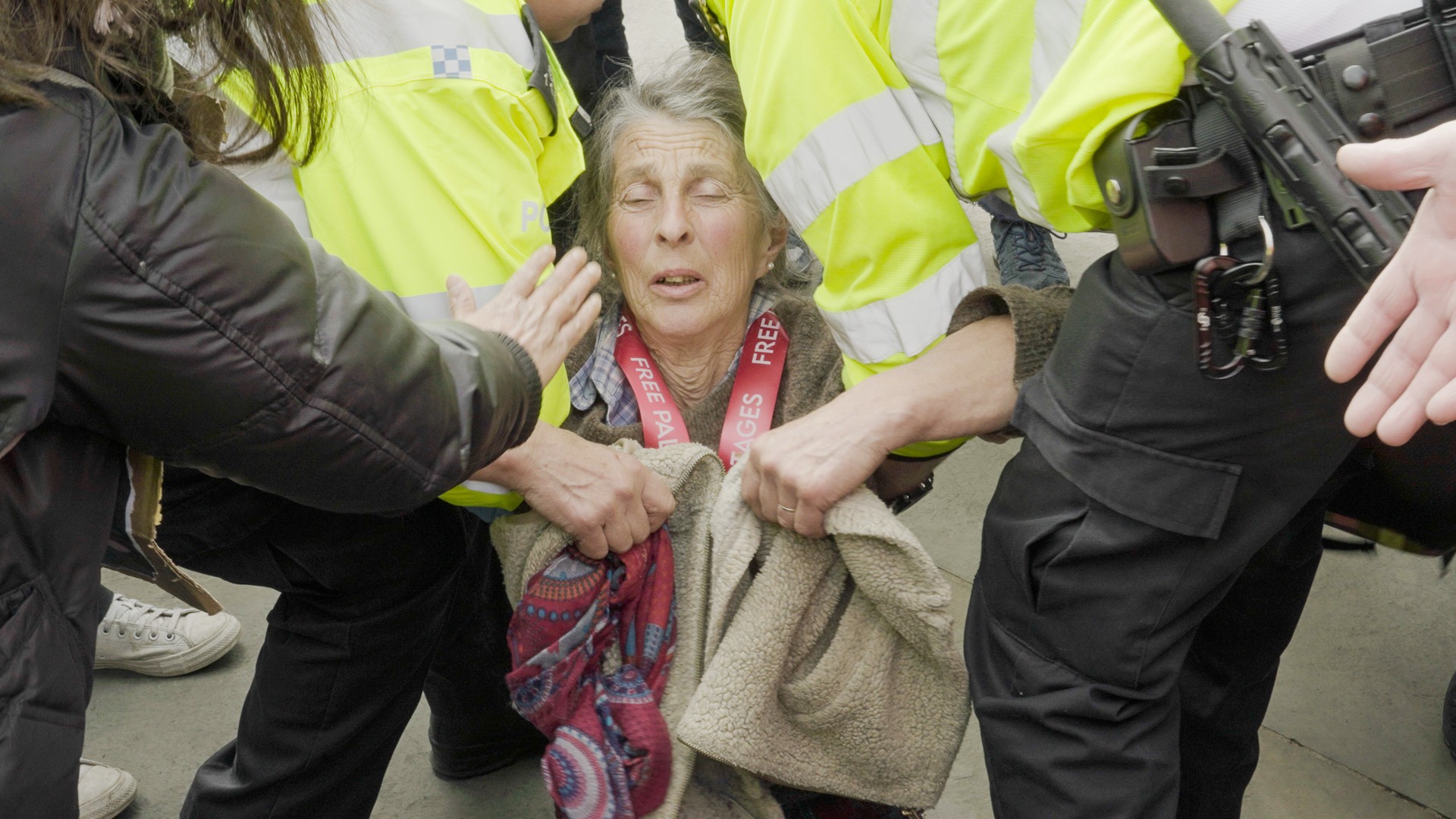
Legal and civil liberties campaigners say the far-reaching nature of the US sanctions puts thousands of UK-based supporters at risk of severe consequences. Tim Crosland, a former government lawyer and co-founder of London-based advocacy group Defend our Juries, pointed out that more than 2,700 people have already been arrested in the UK under the 2000 Terrorism Act for supporting Palestine Action. He questioned what the new US designation means for this group: “Are they now in danger of having their bank accounts closed and not being able to operate within the financial system?” Crosland noted that the sanctions already cut off financial access for high-profile critics, pointing to the case of UN Special Rapporteur for Palestine Francesca Albanese, who was sanctioned by the US during the Trump administration last year and has since been locked out of routine financial transactions after calling for the International Criminal Court to prosecute Israeli officials and US company executives accused of complicity in human rights abuses in Palestinian territories.
“Does that apply to people who’ve held up signs saying ‘I support Palestine Action’? Will the British government give the US the personal data of the people who’ve done that? Because they haven’t got the data unless somebody gives it to them,” Crosland added.
The US announcement came just days after new details emerged of a pending terrorism-connected case against seven Palestine Action activists accused of vandalizing former US president Donald Trump’s golf resort in Turnberry, Scotland. In March 2025, the activists are alleged to have broken into the property, dug up sections of the golf course and spray-painted “Gaza is not 4 sale” on the clubhouse. All seven face charges of malicious damage aggravated by a terrorist connection, a designation that can result in longer prison sentences and continued terrorist monitoring for decades after release.
Raza Husain KC, who represented Ammori in a judicial review of the UK’s proscription last November, noted that then UK Prime Minister Keir Starmer held two phone calls with Trump shortly after the incident, on March 10 and 30. Declassified UK reported that the British government has so far refused to confirm or deny whether the two leaders discussed Palestine Action during those conversations. Around the same time, Trump’s son Eric met with Scottish First Minister John Swinney, and a Freedom of Information disclosure showed Swinney “noted with concern the recent incident at the Trump Turnberry property, condemning the damage caused by vandalism and offered reassurance that the relevant authorities would continue to take the incident seriously”. Trump later took to his Truth Social platform to label the activists “terrorists” who had committed “serious damage” — language that echoed the wording of the UK’s 2000 Terrorism Act — and said they would “hopefully be treated harshly”. Ammori argued that the wording makes clear the proscription was discussed: “What emboldened him to use those words after speaking to Starmer? It must have been discussed.”
In recent months, British courts have already begun applying terrorist designations to Palestine Action activists convicted only of property damage, a move that legal experts call unprecedented in UK history. In June 2025, four Palestine Action defendants were sentenced as terrorists in connection with a 2024 raid on an Elbit Systems factory near Bristol. Crucially, the jurors that convicted them of general criminal charges were never informed that prosecutors would seek a terrorist designation, which was determined by the presiding judge during a separate sentencing hearing. This marked the first time British courts applied a terrorist label to direct action protesters who had not been convicted of terrorist offences or intentional violence. In a separate case, Judge Phillip Parry initially announced he would consider applying a terrorist connection to five activists who vandalized a Barclays Bank branch in Lancashire, but Judge Altham rejected the designation at a recent hearing, ruling the damage caused was not substantial enough to warrant the label.
The US designation of Palestine Action adds the group to the Specially Designated Global Terrorist (SDGT) list, a regime created just days after the 9/11 attacks in 2001 via then-President George W. Bush’s Executive Order 13224. The first target of the list was the Holy Land Foundation, the largest Muslim charity operating in the US at the time, which resulted in five Palestinian-American men being sentenced to between 15 and 65 years in prison on charges of funding Hamas-linked groups. Notably, no court ever presented evidence linking the men to violent activity.
In its official statement, the US Treasury Department claimed “The United States does not sanction persons for engaging in political speech or other constitutionally protected activities.” But Geller says the designation places Palestine Action in the same legal category as extremist groups like Boko Haram and al-Qaeda, and warns it signals a broader crackdown on dissent. “It seems to be a harbinger for where things are headed. A lot of people might soon find themselves in this position,” he said.
The US action aligns with a broader administration-wide push to crack down on left-wing activist groups under the framing of countering a global “resurgence of far-left political terrorism”. The latest sanctions build on a November 2024 executive order signed by Trump that designated the loose anti-fascist network Antifa as a domestic terrorist organization. In June 2025, a Texas court sentenced anti-ICE protesters accused of Antifa ties to up to 100 years in prison, a verdict widely seen as a test case for the national crackdown on left-wing activism. In July, US Secretary of State Marco Rubio hosted an international summit focused on countering what he called “a deliberate, ideologically motivated strategy to destabilize free societies by violently targeting our political and economic systems”.
Many campaigners have questioned the timing of the US announcement, which comes just weeks after the UK Supreme Court granted Ammori permission to challenge the British government’s proscription of Palestine Action. “Is the Trump administration worried that Palestine Action might prevail at the European Court of Human Rights or in the British Supreme Court?” Geller asked.
The designation also comes shortly after Spanish police arrested US citizen and left-wing humanitarian financier James “Fergie” Chambers at the request of US extradition authorities. Chambers has acknowledged participating in a Palestine Action protest and covering legal fees for some group members, and his lawyers confirm he has donated roughly $1 million to humanitarian projects in Gaza. Ammori revealed that the US submitted its indictment against Chambers on the exact same day the Treasury Department announced the Palestine Action sanctions. Geller argues the timing is no coincidence: “It feels like it’s truly only being done as a PR stunt to build a groundswell of public support for either extraditing Fergie or preempting another Palestine Action legal victory.”
Middle East Eye, which originally reported this story, provides independent coverage of the Middle East, North Africa and global affairs.