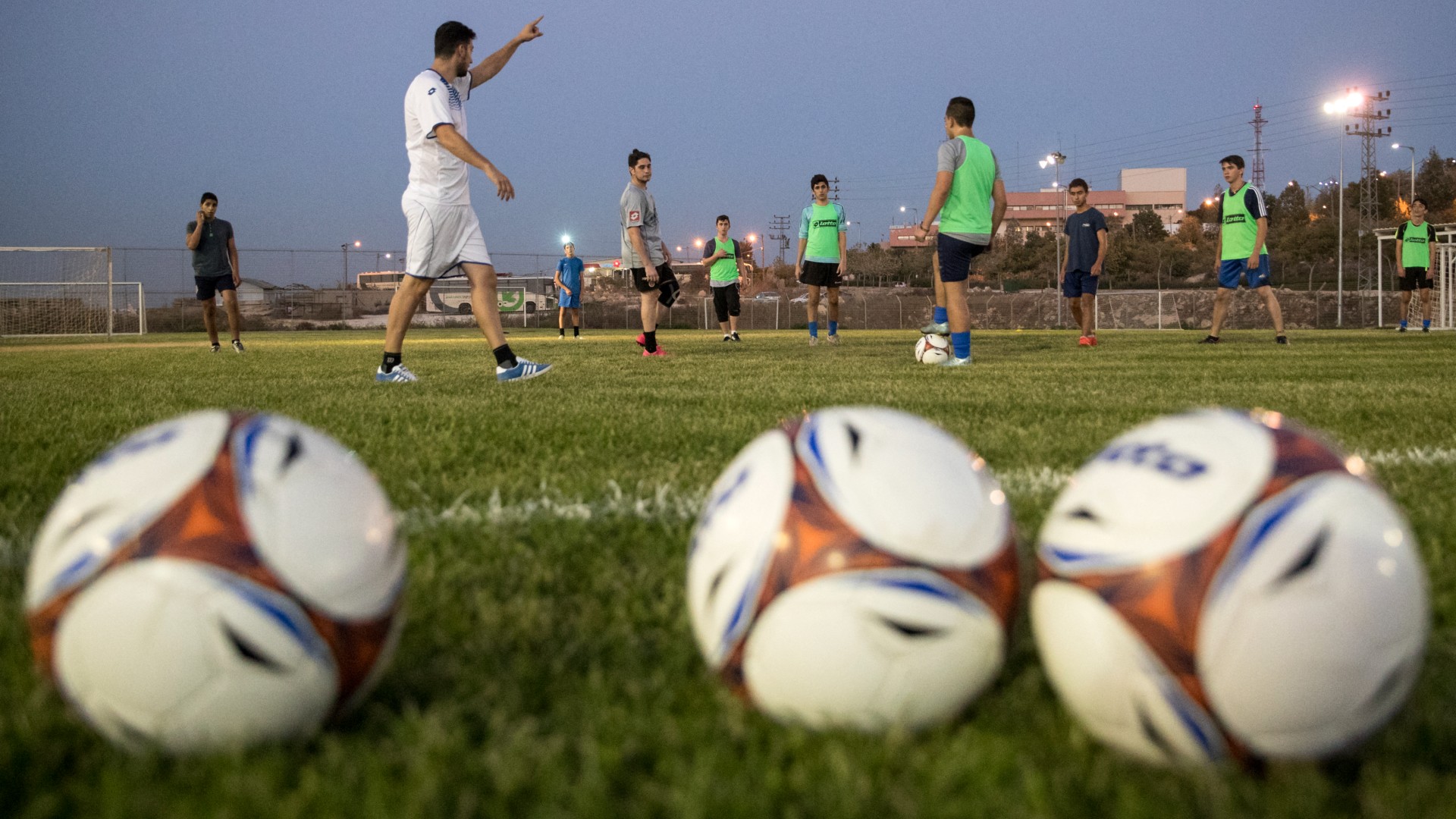
Since Israel launched its military campaign in Gaza in October 2023, football across the occupied West Bank has been pushed to the brink of collapse. Palestinian players face crippling barriers to even basic training and competition, while Israeli football clubs operating in illegal West Bank settlements continue to expand, train, and compete with open backing from global football governing bodies, a joint investigation by Arab Reporters for Investigative Journalism (ARIJ) and Bridges Investigations for Middle East Eye has revealed.
For Palestinian athletes like Mahdi al-Assi, a goalkeeper with the Palestinian national youth team, the journey to training has become a daily ordeal. Travel between Palestinian communities is blocked by a sprawling network of Israeli military checkpoints and sealed electronic gates, forcing players to leave hours early only to be turned away without explanation. Training sessions themselves are regularly disrupted by military raids and tear gas exposure. “More than once, I’ve set off three or four hours before training, only for them [Israeli soldiers] to turn us back at the checkpoint for no reason at all,” al-Assi told Middle East Eye.
The scale of destruction to Palestinian sporting infrastructure is staggering. Data from the Palestinian Football Association (PFA) confirms that 292 sports facilities across Gaza and the occupied West Bank have been partially or completely destroyed since the war began, and the entire Palestinian league has been suspended indefinitely. “It became too dangerous to keep the league going,” explained PFA vice-president Susan Shalabi. “There are more and more checkpoints, and towns are sealed off by electronic gates, trapping people inside. We can’t schedule the league; the gates could be shut at the time of a match, so it gets cancelled.” Deprived of official training opportunities, al-Assi has turned to a private coach to maintain his fitness – a choice that imposes extra financial strain, though he remains determined to keep playing in the hope of representing Palestine at the international level.
Just a few kilometers from al-Assi’s restricted training routine, a starkly different reality unfolds inside Israeli settlements built illegally on occupied Palestinian land. Clubs based in these settlements are actively expanding their facilities and competing fully in Israeli national competitions, with unwavering support from the Israel Football Association (IFA). In the settlement of Ariel, founded in 1978 on stolen Palestinian land near Salfit, local mayor Yair Shatbon launched a major multi-year development plan last year to upgrade local sports infrastructure, including a new stadium, additional football pitches, and a FIFA-standard artificial turf renovation for FC Ironi Ariel’s main pitch. Today, nine IFA-affiliated clubs operate across occupied West Bank settlements, with some directly based on seized Palestinian land and others leveraging settlement facilities.
Despite repeated complaints from the PFA and clear findings from human rights groups that settlements violate international law, global football bodies FIFA and UEFA have failed to take meaningful action, and continue to provide formal recognition and substantial funding to the IFA. The investigation found that FIFA’s own streaming platform, FIFA+, actively broadcasts and archives matches played by settlement clubs, including matches from the Har Homa settlement in occupied East Jerusalem that are featured on the platform’s Israel Youth League and IFA pages. This activity continues despite a 2016 Human Rights Watch report that criticized FIFA for funding matches in illegal settlements, noting that such activity violates the Fourth Geneva Convention, which prohibits an occupying power from transferring its own civilian population into occupied territory.
In March 2026, FIFA’s Disciplinary Committee dismissed a PFA complaint first submitted during the 2024 FIFA Congress, claiming it could not act due to “the unresolved legal status of the West Bank under public international law.” The committee only issued a token fine of 150,000 Swiss francs ($190,000) to the IFA for documented grave and systematic abuses, including discrimination, racism, and exclusion of Palestinians from sports infrastructure. Amnesty International’s head of Economic and Social Justice Steve Cockburn called the ruling a shameful failure to uphold international law and FIFA’s own rules. “FIFA had a clear opportunity to both defend the rights of Palestinians and uphold international law. But by taking this decision, it has shamefully chosen to abandon both,” he said, noting that the International Court of Justice has already ruled Israel’s occupation and settlements are unlawful under international law.
FIFA and UEFA’s financial support for the IFA has continued uninterrupted even after the outbreak of the 2023 Gaza war. A 2026 Amnesty report confirmed both bodies continue to transfer funds to the IFA, with UEFA’s 2024-2028 HatTrick development program allocating €17 million ($17.3 million) to the IFA – a 21% increase from the previous funding cycle. Even the UEFA Foundation for Children, chaired by UEFA president Aleksander Ceferin, provided €320,000 between 2020 and 2023 to a project run by an association registered in the Har Adar settlement, which hosted matches in settlements until 2025.
Illegal settlement sports infrastructure has also received substantial public funding from Israel’s national lottery Mifal HaPais, which is a member of European Lotteries and the World Lottery Association. Around 51% of Mifal HaPais profits go toward sports facility development, and the organization allocated 18.7 million shekels ($6.23 million) to build the Sababa Sports Centre in the Efrat settlement, including an Olympic-sized swimming pool. The organization’s board includes current and former leaders of Israeli municipal governments, settlement councils, and the ruling Likud Party, with no separation made between funding for communities inside Israel and those in illegal settlements.
The contrast between global football bodies’ treatment of Israeli settlements and Russia’s 2022 invasion of Ukraine has drawn widespread criticism of blatant double standards. Just months after FIFA and UEFA suspended all Russian clubs from international competition, European football institutions hosted a delegation from Beitar Ma’ale Adumim, a club based in the illegal Ma’ale Adumim settlement, including visits to La Liga headquarters and Atletico Madrid’s facilities. Former UN Special Rapporteur on human rights in the Palestinian territories Michael Lynk pointed out that there is no legal difference between the two situations, calling the construction of Israeli settlements a war crime under the Rome Statute and repeated UN resolutions. “There is no fundamental difference between Russia’s illegal invasion and Israel’s ongoing 58-year-long effort to occupy and annex the Palestinian territories,” he said.
Critics also reject the long-standing claim from global sporting bodies that sport should remain separate from politics. “Sport is big business. To say that sport is separate from politics flies in the face of what’s happened in sport over the last 45 years,” Lynk said. International football policy researcher James Dorsecy describes sport and politics as “inseparable twins,” while sport sociology scholar Mark Doidge notes that the neutrality invoked by FIFA and UEFA always benefits powerful actors: “Neutrality is never neutral. It always goes along with the powerful.”
As political pressure grows for action – with Irish parliament members passing a motion in June 2026 calling for Israel’s suspension from international sporting bodies – Israel continues to expand settlement infrastructure in the occupied West Bank. Earlier this year, the Israeli government approved a new corridor linking the Ma’ale Adumim settlement to East Jerusalem, an area home to three IFA-affiliated settlement clubs, a move aligned with Prime Minister Benjamin Netanyahu’s public rejection of any future Palestinian state. For Palestinian players like al-Assi, however, the fight to keep the game alive continues against all odds. “I try to train and I push myself, despite the circumstances,” he said. “They can’t easily stand in our way.”