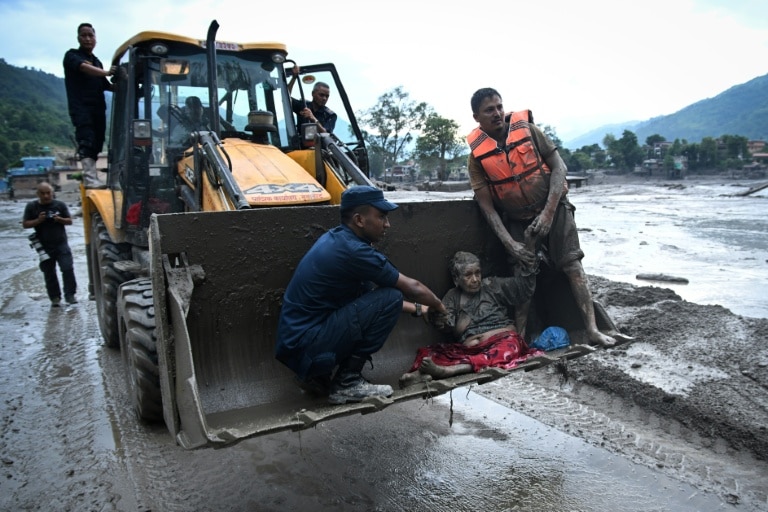
A catastrophic natural disaster along the Nepal-Tibet border has left at least 165 people dead and hundreds unaccounted for, after a collapsing glacier unleashed massive walls of floodwater and debris across both sides of the frontier. The disaster, which unfolded on Wednesday morning, has sparked an urgent international response, with aid organizations and governments around the world stepping in to support search and rescue operations.
While the full sequence of events is still being pieced together by geologists and disaster response teams, dramatic surveillance footage from the Chinese side of the border captured the raw force of the disaster: a towering surge of mud and water swept over a structures as residents fled for safety. On the Nepalese side of the border, fast-moving floodwaters slammed into settlements along the Bhote Koshi and Trishuli rivers, destroying homes, infrastructure and cutting off entire communities.
In the immediate aftermath of the event, initial descriptions varied: Nepalese officials first categorized it as a major flood, while Chinese authorities labeled it a catastrophic mudslide. The death toll has continued to climb in the days since the disaster: 162 fatalities have been confirmed in Nepal, with three more recorded in Tibet. As of Thursday, more than 350 people are officially listed as missing in Tibet, while Nepal reports 468 unaccounted-for tourists, 393 of whom hold foreign nationalities, alongside 93 missing Nepalese citizens. Foreign nationals missing span the globe, including citizens from India, Ukraine, Malaysia, the United Kingdom, South Africa and Australia, which has confirmed 34 of its residents are unaccounted for in the affected region.
Early theories about the cause of the disaster pointed to a small earthquake triggering a landslide that blocked a upstream river, creating a natural dam that eventually burst to release the catastrophic downstream surge. This initial hypothesis aligned with an early reading from the United States Geological Survey (USGS), which detected seismic activity in northern Tibet near the disaster zone. However, further analysis of seismic data from nearby monitoring stations, long-period wave readings and satellite imagery has revised that conclusion. USGS now confirms the seismic signal initially mistaken for an earthquake was actually the event itself: a large-scale glacial collapse and subsequent debris flow, with no tectonic earthquake involved.
The international community has moved quickly to offer support to response efforts. The United States has committed $500,000 in immediate emergency aid, while the International Federation of the Red Cross and Red Crescent Societies (IFRC) has released $1.4 million to fund on-the-ground assistance. David Fisher, head of IFRC Nepal, emphasized that reaching cut-off and affected communities is the top priority, with teams working to deliver support to people who have lost their homes, suffered injuries, or been isolated by the disaster. The European Union has activated its Copernicus satellite surveillance system to map damage and guide recovery teams, and stands ready to deploy additional support. The World Health Organization has already shipped emergency medical supplies to the region, and neighboring India has dispatched an initial 10 tonnes of humanitarian aid to support response efforts.