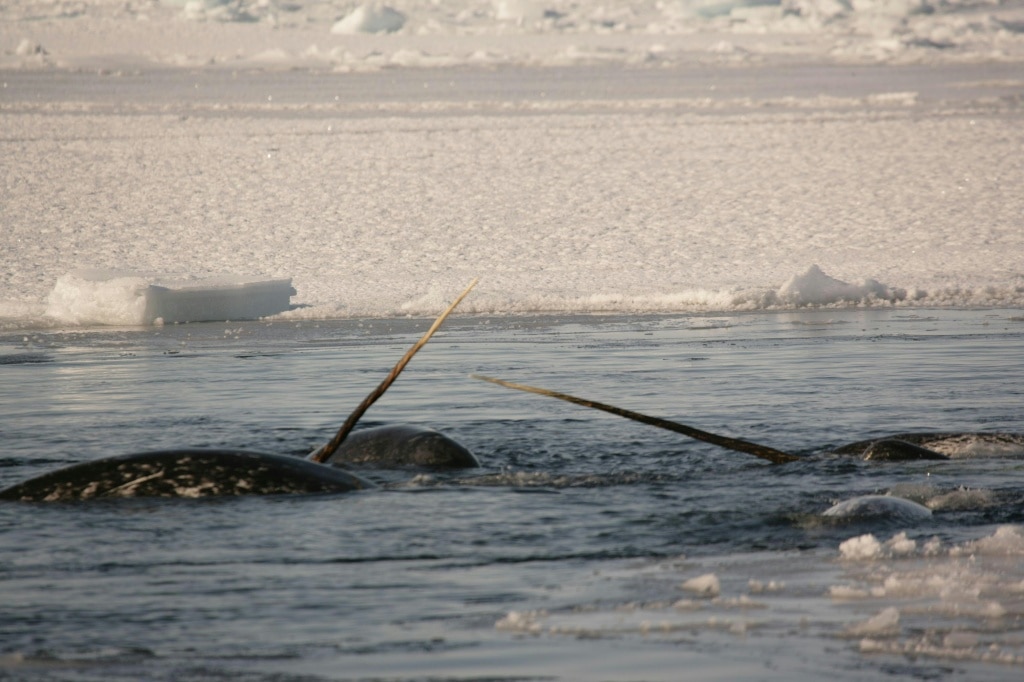
The global battle against climate change has gained an unexpected, tusked contributor: the Arctic narwhal, often nicknamed the “unicorns of the sea.” A groundbreaking study published Wednesday in *Science Advances* outlines how researchers turned these elusive deep-diving whales into citizen scientists of sorts, outfitting six individuals with custom satellite transmitters to collect data in one of the planet’s most inaccessible regions: remote East Greenland fjords.
Between 2017 and 2020, these non-traditional research partners gathered more than 2,000 high-quality measurements of ocean temperature and salinity. The data they collected has filled a critical gap in scientific understanding, revealing how masses of warm Atlantic water are pushing deep into East Greenland’s fjord systems and accelerating the melt of marine-terminating glaciers. This glacial melt does not stay confined to the Arctic: it carries wide-reaching consequences for global ocean circulation and weather patterns that impact communities across the Northern Hemisphere.
“We have used a completely novel technique,” explained Mads Peter Heide-Jorgensen, professor at the Greenland Institute of Natural Resources and lead author of the study, in an interview with AFP. Unlike traditional research methods that require scientists to brave the region’s harsh conditions, “we can sit at our warm offices and drink coffee while the data comes in,” he added.
### Global Climate Impacts at Stake
Meltwater from East Greenland’s glaciers flows into the coastal shelf and fjords before feeding into two major Arctic ocean currents. One of these, the East Greenland Current, acts as a foundational regulator for the Atlantic Meridional Overturning Circulation (AMOC)—a vast, planet-scale system of ocean currents that distributes heat across the globe. Climate researchers have warned that a complete collapse of the AMOC, which is increasingly likely as Arctic warming accelerates, could trigger severe winter cooling across Europe, plunging much of the continent into prolonged deep freezes and disrupting agricultural and economic activity.
Despite the urgency of understanding this process, studying the “Atlantification” of East Greenland waters has long been a major challenge. The region’s remote location, frigid temperatures, and thick year-round ice make traditional research dangerous, logistically complex, and prohibitively expensive. For decades, the only data available came from research ship crews that manually sampled water columns as they navigated open waters. In recent years, fixed electronic sensors have been deployed, but these are limited to summer months when ice cover retreats enough to allow installation. Icebreakers, the only vessels capable of navigating year-round ice, are rare and cost prohibitive to operate for extended research missions, and crews face constant risk from glacial calving events that release massive ice chunks capable of damaging or capsizing ships.
Narwhals, however, are perfectly adapted to this harsh environment, making them ideal research partners. These deep-diving mammals regularly descend to more than 1,500 meters below the ocean surface, allowing them to collect continuous data across entire water columns. The transmitters attached to their backs record temperature, salinity, depth, and geographic location, which researchers then use to calculate water density and distinguish between warm Atlantic-origin water and colder polar-origin water.
One of the study’s most striking findings was the detection of Atlantic-origin water deep beneath glaciers in the Scoresby Sound fjord complex, more than 350 kilometers inland from the open coast. This confirms that warm water is penetrating much farther into glacial systems than previously documented, explaining the faster-than-expected melt rates scientists have observed in the region in recent years.
### Reluctant But Invaluable Partners
While researchers have experimented with using other marine mammals including seals, beluga whales, and bowhead whales for data collection, narwhals offer a unique advantage: they exhibit strong site fidelity, returning to the same locations year after year. This allows scientists to collect consistent, repeated measurements over time, a core requirement for tracking long-term changes in ocean conditions.
The research team grew fond of their four-legged (well, flippered) collaborators, even naming individual narwhals after ancient Nordic deities including Freya and Balder—though the whales did not earn co-authorship on the paper. For their part, the narwhals are far from enthusiastic partners. “I wouldn’t say they enjoy interacting with humans,” Heide-Jorgensen noted, adding “they do it under protest.”
Capturing narwhals in nets and fitting the non-invasive tags takes roughly 20 minutes, a short stressful interruption after which the animals quickly return to their normal behavior. The tags are designed to detach from the whales’ skin naturally after several months, leaving the animals unharmed.
The study team emphasized that this successful partnership showcases how creative, unconventional approaches can revolutionize oceanographic research in regions that are nearly inaccessible to human scientists. Even as narwhals help us track the impacts of climate change, however, they are among the species most vulnerable to a warming Arctic. As Heide-Jorgensen pointed out, narwhals are ultimately “losers in the climate game”: rising ocean temperatures are shrinking their cold-water habitat, and climate projections indicate the species will be forced to shift their range hundreds of kilometers further north to survive in the coming decades.