Dolly Parton, the globally beloved country music icon whose name is synonymous with chart-topping hits and warm Southern charisma, leaves behind far more than a legendary entertainment career: a decades-long legacy of grassroots philanthropy that has transformed millions of lives across the United States and beyond. Though Parton passed away recently, her team’s request that fans honor her memory by donating to her signature initiative, the Imagination Library, ensures her work will continue lifting up communities for generations to come.
Born the fourth of 12 children in a cramped one-bedroom cabin in Tennessee’s Smoky Mountains, Parton grew up immersed in working-class poverty. Her father, Robert Lee Parton, a hardworking tobacco farmer, was unable to read or write—a barrier that the young Dolly watched prevent him from achieving all his dreams. That experience would shape the core of her charitable work for the rest of her life. “He was the smartest man I have ever known but I know in my heart his inability to read probably kept him from fulfilling all of his dreams,” Parton once wrote. In 1988, she turned that motivation into action, founding the Dollywood Foundation to expand access to life-changing educational opportunities for children.
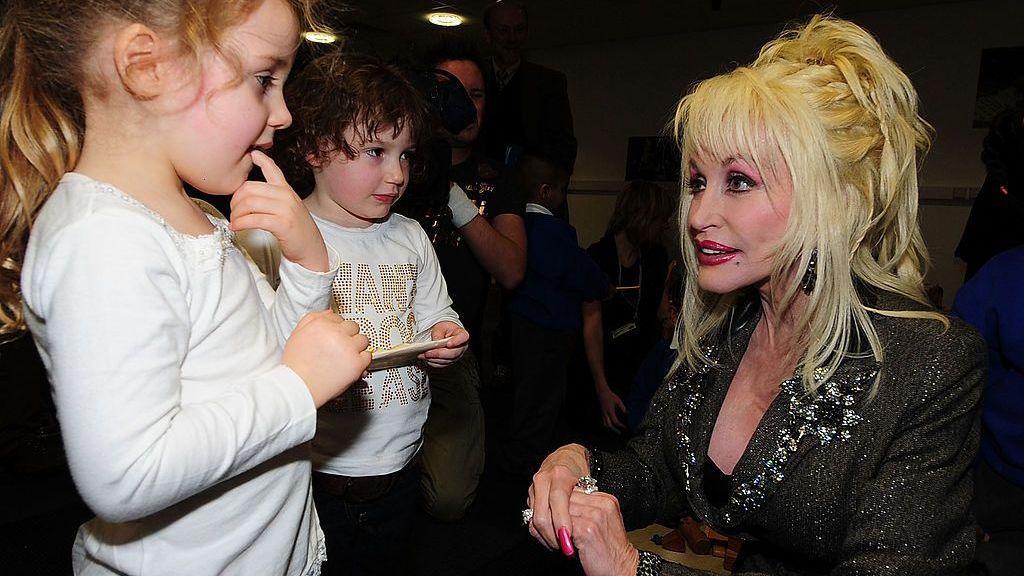
Seven years later, in 1995, the foundation launched the Imagination Library, Parton’s most far-reaching philanthropic project. Designed to foster early literacy, the program mails a free, personalized book every month to every child under the age of five, starting from birth. What began as a small local initiative limited to Sevier County, Parton’s hometown, quickly expanded across the U.S., then crossed borders to reach Canada, the United Kingdom, Ireland, and Australia. To date, the program has distributed more than 332.4 million free books, putting a personalized, owned book into the hands of children who have never had a book of their own before. “They get this little book with their little name on it in the mail, and they feel special… they know that somebody out there is thinking of them,” Parton explained of the program’s quiet power.
The Imagination Library has earned widespread praise from educators, authors, and community leaders around the world. Scottish councillor Lee Mills, a lifelong Parton fan who brought the program to Dundee after his election, noted: “Dolly’s legacy will last with every page turned of a children’s book. I will do my utmost best to ensure that this is delivered to every child in Scotland.” For British author Selina Brown, whose children’s book *My Rice is Best* was selected for distribution, the program does more than boost literacy—it advances critical representation in children’s publishing. “For my book in particular, the protagonist is black. It helps with representation, it helps with real life situations and having a book that speaks directly to you and speaks to a different world is important,” Brown told the BBC.
Early literacy was far from Parton’s only educational focus. In the early 1990s, she launched an innovative high school graduation incentive program in Sevier County: every 12- to 14-year-old student who stayed in school to graduate would receive $500, with a peer buddy system to keep students accountable. Though Parton joked the initiative was a “bribe,” it delivered transformative results: the county’s high school dropout rate plummeted from 35% to just 6%, according to foundation data. More recently, in 2022, Parton extended educational support to adult learners, announcing that all Dollywood employees—seasonal, part-time, and full-time alike—would have 100% of their college tuition and textbook costs covered if they chose to pursue further education. The foundation also runs an annual scholarship program that awards $15,000 to five graduating high school seniors pursuing personal and professional dreams.
Beyond education, Parton’s giving extended to medical research, disaster relief, and wildlife conservation. When the COVID-19 pandemic shut down the world in 2020, Parton donated $1 million to Vanderbilt University Medical Center in Nashville, funding early-stage research that was critical to the development of the Moderna COVID-19 vaccine, which ultimately reached 95% efficacy against severe disease. To encourage vaccine uptake, she even reworked the lyrics to her iconic hit *Jolene*, famously singing, “vaccine, vaccine, vaccine, vaccine, I’m begging of you, please don’t hesitate,” before sharing a video of herself receiving the injection. This contribution was just one of many major gifts to medical causes: a 2007 benefit concert raised $1 million for a new Sevier County hospital and cancer center that includes the Dolly Parton Center for Women’s Services; in 2017, after her niece received leukemia treatment at Nashville’s Monroe Carell Jr. Children’s Hospital, she donated $1 million to the facility, followed by a second $1 million gift years later to fund pediatric infectious disease research. Earlier this year, East Tennessee Children’s Hospital announced it would be renamed the Dolly Parton Children’s Hospital in recognition of her decades-long partnership and support.
When disaster struck her home state, Parton was always one of the first to step up. After a devastating 2016 wildfire destroyed hundreds of homes in Sevier County, she organized a star-studded telethon that raised more than $13 million, then pledged $1,000 a month for six months to nearly 900 displaced families. When Middle Tennessee suffered catastrophic flooding in 2021, she helped raise $700,000 to support affected residents. She has also partnered with the American Eagle Foundation to host the world’s largest sanctuary for non-releasable bald eagles at her Dollywood amusement park. The sanctuary’s breeding and rehabilitation work contributed to the recovery of the species, which was removed from the U.S. endangered species list in 2007.
Throughout her life, Parton earned widespread recognition for her generosity, including the 2022 Carnegie Medal of Philanthropy, which honored her as “one of the entertainment world’s most generous philanthropists.” For Parton, giving was not just a public gesture—it was a core part of who she was. “I’m kind of addicted to the feeling of giving,” she once said. “Knowing that I’m doing something good for someone else.” She often spoke of her hope that her work would outlive her, writing that her father, who inspired the Imagination Library, was prouder of that initiative than he ever was of her entertainment career. When announcing her death, her team echoed that vision, asking fans to forgo sending flowers and instead donate to the Imagination Library to carry her work forward. “When I’m done, I can rest in peace knowing I’ve done my best,” Parton once said. “I hope that when my time comes, I’ll leave something behind that others can use to lift themselves up.” That vision, it seems, is already secured.