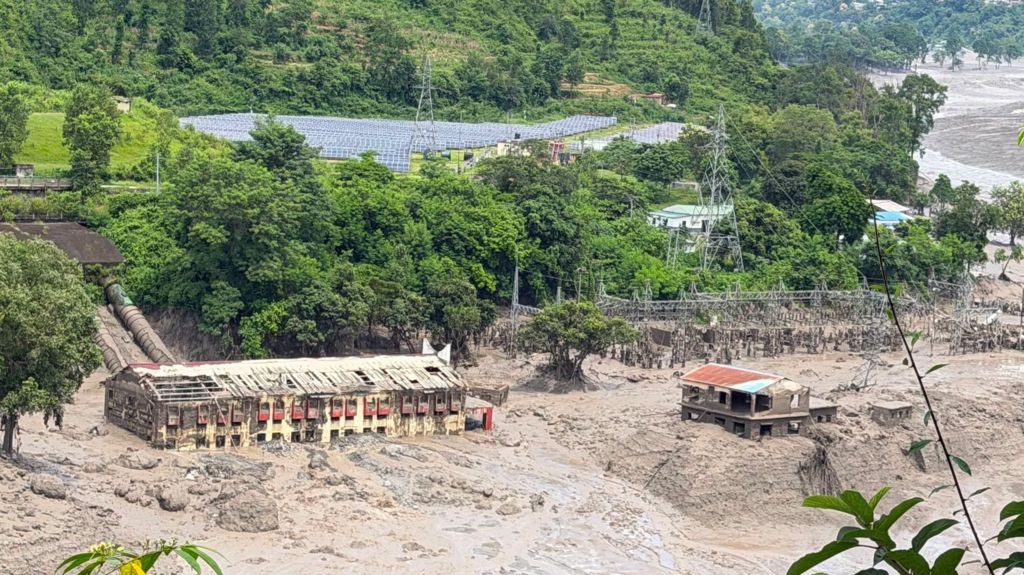
A catastrophic flash flood that swept through remote districts of northern Nepal early Wednesday has left entire communities submerged, critical infrastructure destroyed, and dozens of people unaccounted for, with emergency officials warning the final casualty toll could be severe.
The disaster struck Rasuwa district, a mountainous border region located roughly 60 miles north of Nepal’s capital Kathmandu that shares a frontier with China’s Tibet Autonomous Region and serves as the backbone of Nepal-China trade routes. According to local disaster officials, the flood originated when sudden glacial melt from the Himalayan plateau surged into the Bhote Koshi River, which flows across the border into Nepal, triggering a fast-moving wall of water that overwhelmed river banks and downstream communities.
In the hours after the flood hit, initial reports paint a grim picture of destruction. Entire villages along the river have been washed away, and a major hydropower dam in the region has sustained significant damage, raising further risks of downstream flooding for low-lying areas. Several districts along the river’s lower course have already been placed on the highest level of alert, as authorities work to evacuate at-risk populations.
Narendra Pariyar, chief district officer of Rasuwa, told reporters that it remains too early to calculate the full scope of damage, though preliminary assessments confirm destruction is widespread. As of Thursday morning, search and rescue teams have pulled 12 people from flood-hit areas, but operations have been hampered by damaged communication infrastructure, which has left large swathes of the district without mobile or radio signal.
That communication blackout has left families and employers waiting for news of missing loved ones and workers. Yee Liang, a Chinese business owner based in Kathmandu, told the BBC his logistics firm had seven container trucks operating along the flood-hit trade route when the disaster hit, with all seven Nepali crew members unaccounted for. “There was no warning ahead of the flood,” Yee said. “While occasional mudslides and landslides are common here during monsoon season, this event is far more severe than anything we have seen in recent years.”
Authorities confirmed Thursday that 13 armed police officers stationed at two outposts in Rasuwa are officially missing, and dozens of additional law enforcement personnel deployed across the district have also not been reached. Nepal’s federal disaster management authority has issued an urgent advisory urging all residents living along river banks in high-risk zones to move to higher ground immediately and take emergency precautions.
Nepali Prime Minister Balendra Shah held an emergency cabinet meeting shortly after the disaster to coordinate response efforts, announcing in a subsequent social media post that search and rescue operations are already underway in partnership with local medical teams, scout organizations, and the Nepal Red Cross Society.
This is not the first major flood to hit Rasuwa in the last 12 months. In 2025, a similar glacial outburst flood originating on the Chinese side of the border killed 18 people in the district. But officials familiar with the situation told the BBC Wednesday’s disaster is already on track to be far deadlier and more destructive than last year’s event, highlighting the growing risk of glacial melt-driven disasters in the Himalayan region as global temperatures rise.