The global race to scale artificial intelligence has triggered a rush to build massive data centers across the United States, turning quiet rural farmlands into the frontline of an unusual political conflict that defies traditional partisan divisions. What was supposed to be a straightforward win for economic growth and technological competitiveness has instead emerged as a polarizing issue reshaping political rhetoric ahead of November’s midterm elections, uniting unlikely allies against a development wave many local communities see as moving too fast.
In the tiny village of Murdock, Nebraska, population just 275, the clash played out recently at the local firehouse, where conservative fifth-generation grain farmers and environmental advocates from the state Sierra Club chapter sat side-by-side to voice shared opposition to planned data center projects. For Judy Stroy, whose family has grown corn and soybeans on land outside Murdock for generations, the primary fear is the permanent loss of prime agricultural land to concrete and computing infrastructure. “With the amount of ground that’s getting gobbled up every year, our food source is in trouble,” Stroy said. “That should scare everyone.”
Cass County, where Murdock is located, has responded by approving a 12-month moratorium on new data center development, pausing potential plans from energy firm Tenaska to acquire more than 1,300 acres along Highway 75 for a project that could include a large data center and an on-site natural gas power plant. A second data center operator, CyrusOne, controls nearly 400 acres nearby in Plattsmouth, though no formal project has been announced. The region’s strategic location—with a recently widened highway connecting it to Omaha to the northeast and college-heavy Lincoln to the southwest, plus easy access to water from the nearby Missouri River—has made it a top target for developers, who often offer landowners four times the standard market rate of $10,000 per acre to sell. For many farmers struggling with rising input costs and declining soybean exports tied to ongoing trade tensions with China, the huge payouts are difficult to reject, Stroy acknowledged, even as she worries about the long-term cost to local food production.
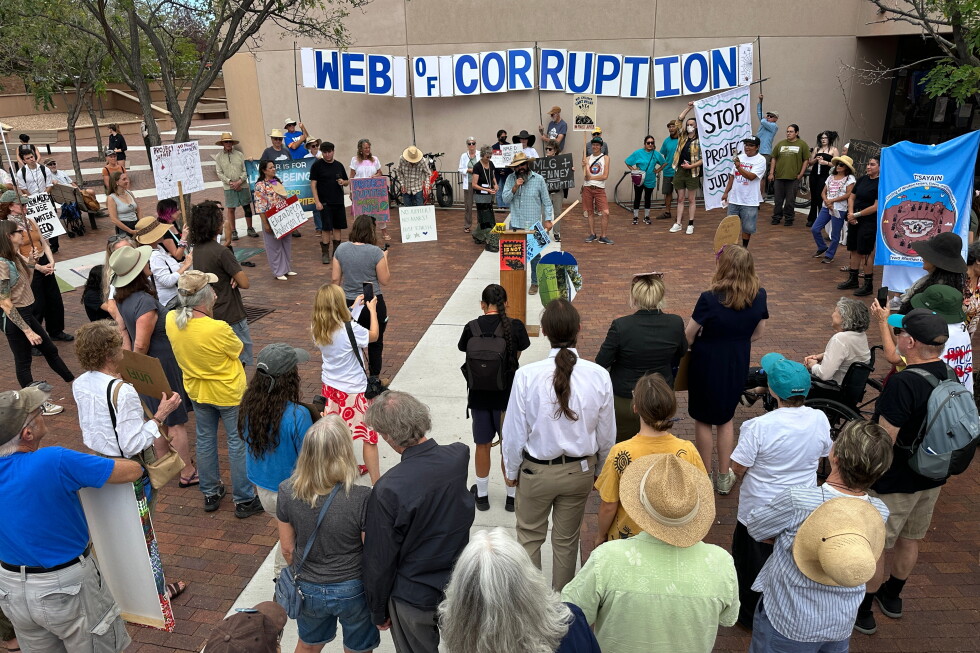
The cross-partisan opposition playing out in Nebraska is mirrored across the country, from Republican-led Texas and Wyoming to swing-state Pennsylvania to Democratic-leaning New Mexico. In southern New Mexico, the $165 billion Project Jupiter data center complex planned by Oracle near the Mexican border has united farmers, ranchers and business owners across the political spectrum around shared fears of strain on already depleted water supplies. New Mexico is grappling with persistent, decades-level drought that has left the state’s largest reservoir at just 1.3% capacity and dried up large stretches of the Rio Grande, while a recent U.S. Supreme Court-approved water settlement requires the state to send increased water flows to Texas. Doña Ana County Commission Republican candidate Samantha Barncastle Salopek, whose family grows pecans in the region, said the issue transcends traditional political divides. “It is not about blue vs. red, or whether we’re a purple state or county,” she said. “This is about the local community coming together and saying, ‘Hold on, hold on.’ We didn’t get enough information, and now we’re very concerned because also we have to cut back our water use anyway.”
Oracle has framed Project Jupiter as a generational economic investment for New Mexico, saying it will generate $4.7 billion in tax revenue, create more than 7,000 construction jobs and 1,500 permanent positions, and include water-efficient closed-loop cooling and fuel-cell systems that will keep long-term water use low. The company has also pledged $50 million for local water infrastructure and partnered on agricultural tech initiatives to help farmers cut water consumption by an estimated 21 million gallons per year. Even so, the Center for Biological Diversity successfully petitioned the New Mexico Supreme Court to issue an emergency halt to well drilling for the project’s construction water, a win that has temporarily paused development amid ongoing legal challenges.
Supporters of expanded data center development draw backing from a bipartisan bloc as well, including former Republican President Donald Trump and many union leaders who typically align with Democratic candidates. They argue that the buildout delivers critical economic benefits for struggling small communities, creates high-quality construction and permanent jobs, helps retain young skilled workers who would otherwise leave rural states, and strengthens U.S. technological competitiveness against China in a high-stakes geopolitical race. “This problem is also a very big opportunity for some small communities,” said Mike Gage, president and secretary-treasurer of the Nebraska State AFL-CIO, noting that a decades-old data center near Omaha still employs roughly 60 local workers today. Heather McKenzie, a labor relations professional in Lincoln, added that data center development can reverse the outward migration of young Nebraska workers: “I don’t think that enough people understand that this is going to create really good jobs. I think a lot of people view it in a negative sense because it’s being sprung on them.”
Trump has framed data centers as a clear win for local communities, arguing they bring jobs, increased tax revenue and lower local tax burdens. His administration has pushed developers to build their own on-site power plants to ease concerns about rising utility costs for local residents, though he has acknowledged that tech firms could improve their public outreach to address community fears. Even so, polling from July shows broad public opposition to local data center development: a Fox News survey found 60% of Republican voters and 53% of MAGA voters oppose new construction in their areas. As a result, politicians across both parties have been forced to adapt to shifting voter sentiment, with leaders from both sides of the aisle adopting anti-development stances to court voters ahead of the midterms.
Prominent state leaders from both parties have already moved to curb rapid development: Democratic New York Governor Kathy Hochul ordered a one-year ban on large new data centers, while Democratic Pennsylvania Governor Josh Shapiro has ended preferential permitting and tax breaks for projects that do not meet strict local standards. On the Republican side, Texas Governor Greg Abbott issued a halt on new data center approvals until full audits of their impact on the state’s electrical grid are completed, saying developers earned backlash by failing to coordinate with state and local officials. “They basically dug their own grave for the problem that’s been caused for them, and that’s why they got the backlash they deserve,” Abbott said.
Wyoming Secretary of State Chuck Gray, a Republican running for an open House seat, has pledged to halt all new data center construction, declaring in a campaign ad: “If Silicon Valley wants to build their liberal empire, they can do it somewhere else.” That rhetoric mirrors a campaign ad from Democratic Scranton Mayor Paige Cognetti, who is challenging a first-term Republican incumbent in a battleground district, who said the city “is not for sale” to data center developers. Across rural East Texas, residents have already complained that data center development has left them living near constant fossil fuel power generation to feed the centers’ huge energy demands, with critics decrying increased air pollution, noise, rising utility costs, and contribution to the climate crisis.
For local opponents, the core grievance is not ideological, but practical: they say development is moving far faster than local regulatory frameworks can manage, leaving communities to cope with lasting impacts to their land, water, and infrastructure that were never debated or approved by the people who live there. As the midterm election season progresses, the cross-partisan backlash over data centers has proven that what was once seen as an obscure local development issue has become a national political flashpoint that could tip the balance in competitive races across the country.