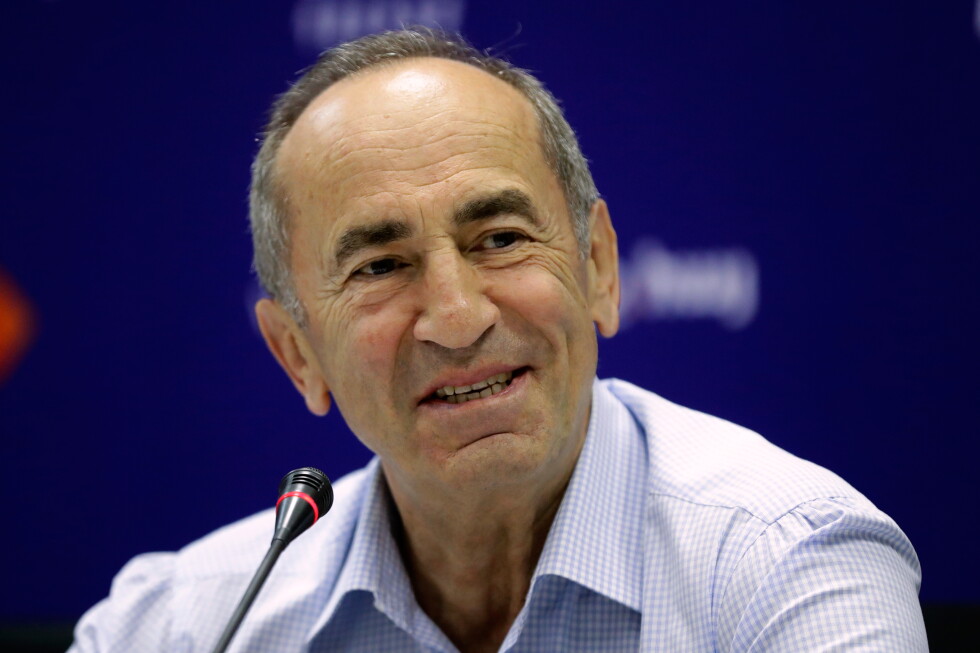
YEREVAN, Armenia — A major upheaval has shaken Armenian politics, with former president and top opposition leader Robert Kocharyan taken into custody alongside his eldest son on Tuesday, following coordinated law enforcement raids on multiple business holdings tied to the Kocharyan family, Armenia’s Anti-Corruption Commission confirmed in an official statement.
The 71-year-old ex-head of state, who currently leads the second-largest opposition bloc in the country’s national parliament, faces three felony charges: abuse of official power, bribery, and large-scale money laundering, according to official announcements from Armenia’s Prosecutor General’s Office. In addition to Kocharyan and his 48-year-old eldest son Sedrak, four other individuals connected to the alleged scheme are also in custody as investigators expand their probe into the reported illegal activities.
The court-ordered raids and subsequent detentions took place less than a full day after a heated, public confrontation between incumbent Prime Minister Nikol Pashinyan and Kocharyan’s younger son Levon during a parliamentary session. The fiery exchange drew immediate attention to escalating tensions between Pashinyan’s ruling administration and the opposition coalition led by the former president.
Anti-corruption investigators are focusing on allegations that during Kocharyan’s presidential tenure from 1998 to 2008, valuable state-owned assets were illegally privatized and sold to connected private entities at prices far below their fair market value, draining public resources for private gain. Armenian media outlets also reported Tuesday that former President Serzh Sargsyan, Kocharyan’s successor in office, has been summoned to appear for questioning at Anti-Corruption Committee headquarters as part of the expanding investigation.
Bagrat Mikoyan, a senior spokesperson for Kocharyan, has framed the detentions as a politically motivated attack by the current government against the former president and his family. Mikoyan also confirmed that after being taken into custody, Kocharyan reported feeling unwell and was transferred to a local hospital for medical evaluation.
The parliamentary clash that preceded the raids centered on allegations of political interference in law enforcement. During a regular question-and-answer session, Levon Kocharyan publicly accused Pashinyan of exerting improper political pressure on Armenia’s courts and law enforcement agencies to target political opponents with fabricated investigations. In his sharp response, Pashinyan challenged the younger Kocharyan to disclose the origin of his family’s extensive accumulated wealth, insisting that any assets acquired improperly at the expense of the Armenian public must be returned to state ownership.
Hours after the detentions, Kocharyan’s Armenia Alliance issued a scathing statement via social media, dismissing the legal case as an act of personal political revenge against the former leader. The alliance called the proceedings “another cynical manifestation of a regime that has lost its legitimacy,” adding, “This is not a legal process; this is the open subjugation of the state apparatus to political interests.”
This is not the first time Kocharyan has faced legal jeopardy. In 2019, he went on trial on charges of ordering the illegal use of lethal force by security forces to suppress anti-government protests following the disputed 2008 presidential election. The 2008 post-election clashes left at least 10 people dead, but the charges against Kocharyan were ultimately dropped, and all legal proceedings in that case concluded in 2021.
Alexander Iskandaryan, director of the Yerevan-based Caucasus Institute and a prominent regional political analyst, told the Associated Press that allegations of corrupt activity during Kocharyan’s time in office have circulated among critics for decades. He added that this latest case will almost certainly escalate the long-running standoff between Pashinyan’s pro-Western government, which has prioritized deepening political and economic ties with the European Union, and the pro-Russian opposition bloc that Kocharyan leads as its most influential figure.
“Of course, this is a signal to the Kremlin,” Iskandaryan noted. “Kocharyan effectively positions himself as a Russian proxy, and we see a clear trend where the authorities have begun to fight — intensively and by all possible means — against political forces aligned with Russia within Armenia’s borders.”
Reporting for this article was contributed by Yuras Karamanau in Tallinn, Estonia.