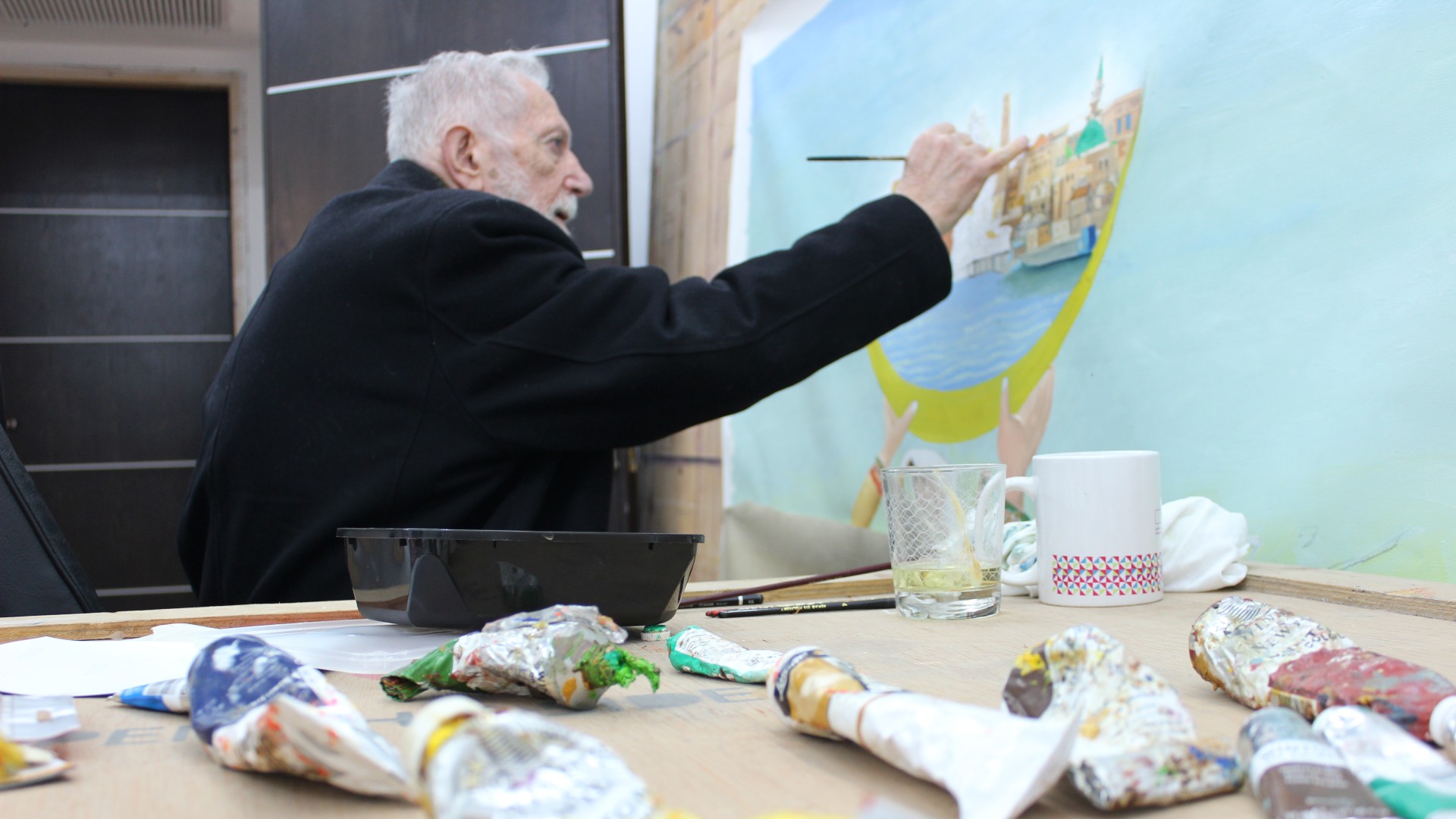
The global art community is mourning the passing of Sliman Mansour, one of the most influential contemporary Palestinian artists, who died over the weekend at the age of 79. His family shared the news of his death in a heartfelt public statement posted to his official Instagram account.
“The final chapter has been written. With hearts heavy beyond words, we share that our beloved father has passed away,” the statement read. “To the world, he leaves behind a life filled with beauty, memory, and a legacy that will continue to live through all those he touched. But to us, we lost a father, our source of love, strength and home.”
Born in 1947 in Birzeit, a small Palestinian town just north of Ramallah, Mansour entered the world just 12 months before the 1948 Nakba — the catastrophic event that saw more than 700,000 Palestinians forcibly displaced from their ancestral homes to make way for the creation of the state of Israel. He discovered his passion for drawing in early childhood, and his raw talent was first recognized by a German tutor at a Bethlehem boarding school, who encouraged him to deepen his painting practice and submit his work to international competitions. In a 2023 interview with Middle East Eye, Mansour recalled that his tutor entered his work into a United Nations ‘Children of the World’ drawing contest, where he took home first prize in 1962 — a milestone that set him on his path as a professional artist.
Throughout his decades-long career, Mansour centered his practice on preserving and elevating the Palestinian historical narrative, pushing back against erasure tactics that sought to minimize Palestinian connection to their homeland. He repeatedly called out the misleading narratives promoted by Israeli officials and Zionist movements, which framed the land as sparsely populated and barren before the arrival of modern Jewish settlers. “That was the very strategy of the Zionist movement, to deny your existence, because when you are not there, it’s much easier to take your land, to kill you, to imprison you,” he told Middle East Eye in the 2023 interview.
Mansour and his fellow Palestinian artists set out to reclaim their people’s story by weaving deeply symbolic imagery — both drawn from ancient cultural traditions and crafted to reflect modern struggle — into every canvas. “As artists, we started to search for images to reflect identity,” he explained, noting that the movement drew heavily on ancient Palestinian culture and the distinctive landscape of historic Palestine. He frequently highlighted how Israeli occupation deliberately altered that landscape, replacing native olive groves with non-native cypress and pine trees to erase traces of Palestinian presence.
Symbolism lay at the heart of all Mansour’s most celebrated works, with each recurring motif carrying specific political and cultural meaning. For example, he once explained that when he painted Jaffa orange trees, he was referencing land seized during the 1948 Nakba, while olive trees represented territory occupied during Israel’s 1967 conquest of the West Bank, East Jerusalem, and Gaza. Other iconic symbols that recur across his oeuvre include tatreez-embroidered traditional thobes, doves for peace and freedom, and the keffiyeh, a globally recognized marker of Palestinian identity.
For decades, Mansour’s work faced systematic repression from Israeli occupying forces. He recalled that as early as 1979, when he and fellow artists began organizing independent exhibitions, Israeli forces regularly seized canvases that they deemed objectionable — even mundane works depicting peasant women working in fields in traditional embroidered clothing.
Among his most famous works is *Last Summer in Palestine*, completed in 1994. The piece reinterprets Leonardo da Vinci’s iconic *The Last Supper*, replacing Jesus with a Palestinian man and the 12 disciples with 12 Palestinian women, centering Palestinian community and experience in one of Western art’s most recognizable compositions. Another of his best-known works, 2005’s *Camel of Burdens*, depicts a frail elderly Palestinian man carrying an eye-shaped orb on his back, with the historic city of Jerusalem contained within the sphere.
Over his career, Mansour earned widespread international acclaim and a dedicated global following for his unflinching, beautiful depictions of Palestinian life and struggle. His many honors include the 2019 UNESCO-Sharjah Prize for Arab Culture, the grand prize at the 1998 Cairo Biennale, and the 1998 Palestine Prize for Visual Arts.
Later in life, Mansour shifted much of his focus to mentoring the next generation of Palestinian artists, instilling in his students the same commitment to cultural identity and resistance that defined his own work. “I firmly believe in the significance of embracing your craft and embracing your connection to your people, their culture, and their pursuit of freedom,” he said. “It is crucial for my students to grasp the sense of belonging and never lose hope.”
As tributes pour in from across the global art and political communities, Mansour’s legacy as a tireless defender of Palestinian narrative and one of the greatest visual artists of his generation remains firmly fixed in the work he leaves behind, and in the countless young artists he inspired.