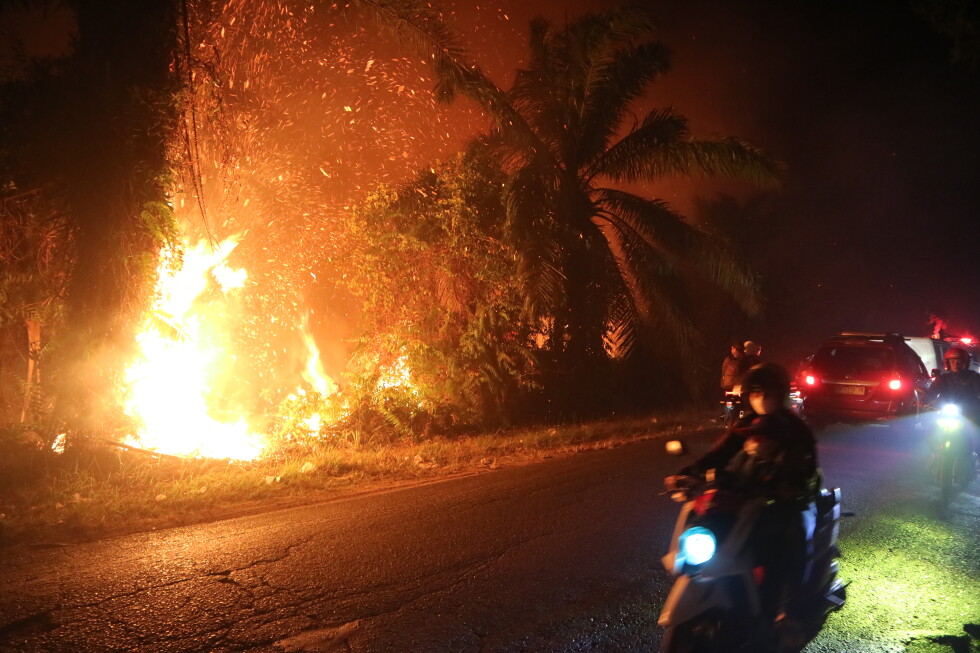
Indonesia escalated large-scale ground and aerial firefighting operations on Monday, as raging wildfires tearing through forests and peatlands in the country’s central and western regions have generated toxic, choking haze that has blanketed major cities and drifted across national borders. The blazes, amplified by the extreme dry conditions driven by a strengthening El Niño weather pattern, represent a sharp annual surge in wildfire activity across the Southeast Asian archipelago, according to Indonesia’s National Disaster Management Agency (BNPB).
Active fire hot spots remain concentrated across high-risk provinces on two of Indonesia’s largest islands: Borneo, which hosts West, Central and South Kalimantan, and Sumatra, which includes Riau, South Sumatra and Jambi. BNPB officials noted that persistent drought, unseasonably strong winds and parched, highly flammable vegetation have severely hampered containment efforts. More than 24,000 ground firefighters have been deployed across Sumatra and Borneo, but dozens of remote hot spots remain unreachable by land teams, forcing local leaders to formally request additional aerial water-bombing support.
Indonesian President Prabowo Subianto has made on-site visits to multiple fire-affected regions to oversee response efforts. After touring fire-ravaged areas of Central Kalimantan Saturday, he traveled to Riau and neighboring South Sumatra Monday to inspect damage and urge local authorities to bring the spreading haze under control. As of the latest official reports, over 36,000 hectares (89,000 acres) of land have burned across 10 Indonesian provinces, with Forestry Ministry data showing nearly 94,000 hectares (232,000 acres) were destroyed by fire in July alone.
Prabowo has pledged full government backing for ongoing firefighting operations, including the deployment of additional water-bombing helicopters and oxygen supplies to protect frontline crews. He has ordered direct, detailed reporting on all suppression progress to his office, and called for expanded public outreach to prevent future blazes: roughly 1,000 military and police personnel will be deployed to work with regional officials on fire prevention education and community awareness campaigns.
Satellite data from Indonesia’s Environment Ministry confirms the scope of the crisis, with South Sumatra recording the highest number of active hot spots nationwide at 1,429. West Kalimantan follows with 1,226 hot spots, Central Kalimantan with 811, East Kalimantan with 576, Riau with 503, West Papua with 468 and Jambi with 458. To boost response capacity, Indonesia’s Transportation Ministry has authorized 35 foreign-registered aircraft to join firefighting missions, including water-bombing runs and aerial surveillance; the aircraft are cleared to rapidly reposition to high-need zones while adhering to Indonesian aviation safety regulations.
Beyond ground and aerial suppression, Indonesia is expanding cloud-seeding operations to induce much-needed rainfall over fire zones, a common weather modification tactic that disperses salt particles into clouds to trigger precipitation. A total of 30 aircraft are currently deployed for cloud-seeding and water-bombing across Kalimantan, with an additional 22 helicopters covering Sumatra. In a coordinated cross-border effort, Malaysia gained permission from Indonesia on Monday to conduct cloud-seeding operations along their shared border, as both nations work to curb the worsening haze crisis.
Malaysian Environment Minister Arthur Joseph Kurup announced the country is finalizing an operational plan and stands ready to provide additional firefighting support to Indonesia if requested. The coordinated action comes as Malaysia prepares for two major upcoming national events: August 31 marks the country’s Independence Day, while September 16’s Malaysia Day, celebrating the nation’s unification, will be held in Sarawak, a Borneo state that is among the regions hardest hit by cross-border haze. Last week, nearly 600 Sarawak schools were closed due to dangerous air quality, displacing roughly 200,000 students, and Malaysian meteorologists forecast that hot, dry conditions will persist through October. As of Monday, Malaysia’s Environment Department recorded 20 areas across Peninsular Malaysia and Sarawak with unhealthy air quality.
Wildfires are a recurring annual crisis during Indonesia’s dry season, a problem rooted in the common practice of clearing land for agricultural plantations and small-scale farming through intentional burning. The blazes generate hazardous particulate haze that cuts visibility, disrupts land and air transportation, and poses severe public health risks, often spilling over to affect neighboring Southeast Asian nations and straining bilateral relations.