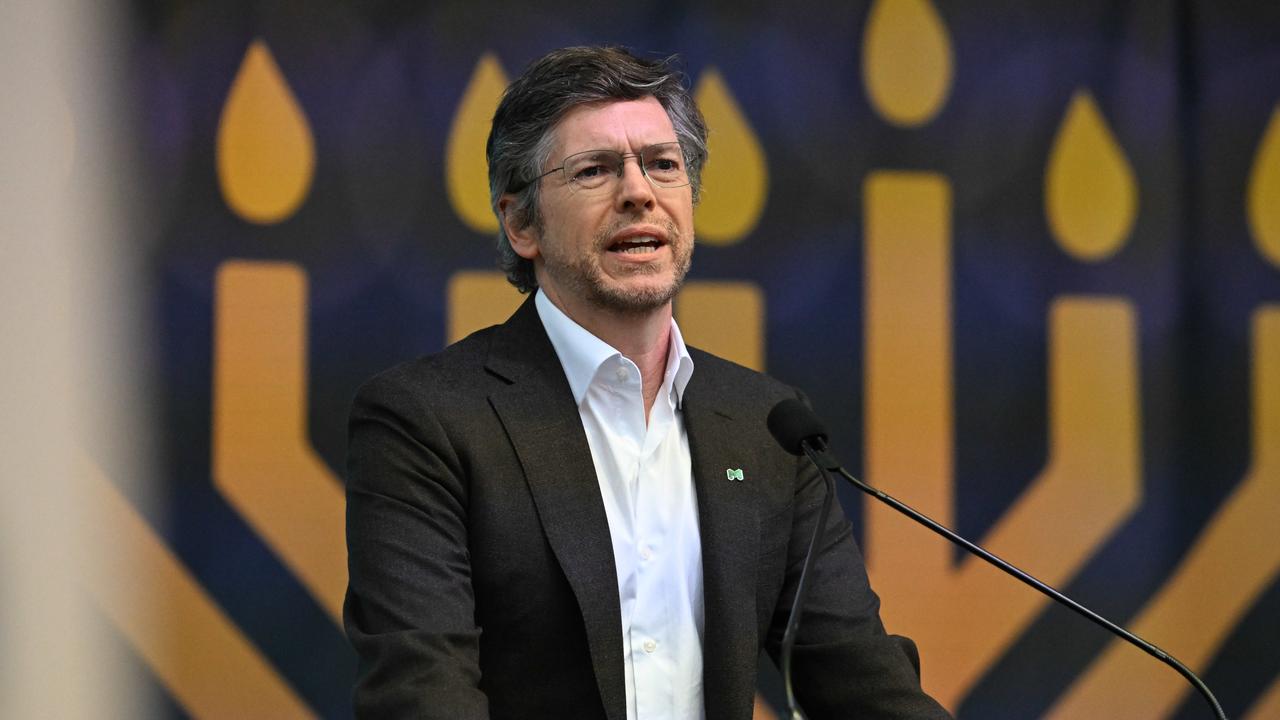
As public hearings wrap up at Australia’s Royal Commission into Anti-Semitism and Social Cohesion, Melbourne’s top local official has made an urgent push for federal financial support to boost security at religious gatherings across cash-strapped municipal jurisdictions.
Appearing before the inquiry on Monday, Lord Mayor Nicholas Reece emphasized that Melbourne is home to Australia’s largest Jewish community, a group that has been woven into the cultural, social and civic fabric of the city since its founding. He then detailed his firsthand experience responding to a 2023 firebombing attack on a Melbourne synagogue, carried out while families were gathering inside for Shabbat dinner.
Reece described the scene as one of the most distressing he has ever witnessed: children and families displaced onto the street, emergency responders from the fire service and Victoria Police surrounding the site, and the entire area cordoned off as an active crime scene. “This is not the Melbourne I have known for most of my life,” he told commissioners, adding that the act of violence was terrifying and entirely unacceptable in a democratic Australian city. The attack, he confirmed, has been linked to an extremist conspiracy originating overseas.
Beyond addressing immediate security needs, Reece also weighed in on the role of local government in debating complex global conflicts, referencing an hours-long council motion held during his time as acting mayor about the Gaza war. He called the process deeply challenging and a poor use of local government resources. While Reece acknowledged that local councils have a legitimate role in international engagement – from supporting cultural exchanges for international students to fostering university partnerships – he argued that nuanced, high-stakes geopolitical conflicts fall outside the core remit of local government.
Instead, Reece recommended that the federal Department of Foreign Affairs and Trade (DFAT) take the lead in facilitating community input on these global issues, modeling the work of community forums previously run by the Australian Agency for International Development (AusAID). He clarified that he does not oppose councils hosting open community debate on any topic, but DFAT is far better positioned to collect and address community perspectives on international matters.
Turning back to security for multicultural religious events, Reece noted that the Melbourne City Council has already been forced to add security measures to major public celebrations for Hanukkah, Ramadan, and Diwali to address rising concerns about social fracturing and the threat of antisocial or violent incidents. So far, the extra precautions have not been needed for active incidents, which Reece called a positive outcome, but the need for the measures themselves underscores the growing risk facing faith communities.
Most critically, Reece stressed that the vast majority of Australian local governments operate under severe resource constraints, with little to no budget available to cover the extra costs of enhanced event security. “I cannot overstate how resource constrained local government is,” Reece told the commission. “Most councils don’t have financial capacity to provide that safety support at some of those events. One of the things the Commission might like to consider is if we do want to see more celebration of faith events, social, multicultural events … then that might be something that requires some funding support in order to deliver.”
Reece also shared shocking data on the scale of persistent antisemitic vandalism across Melbourne over the past two years: his council has removed more than 3,000 pieces of offensive graffiti, with between 800 and 1,000 of those tagged with explicitly antisemitic messaging. In total, the council has cleared nearly 4,000 square meters of antisemitic graffiti, posters, and stickers, he said. To address the ongoing crisis, the city has launched a rapid response program that aims to remove hateful vandalism within one hour of it being reported, though the service does not cover most private property outside of pre-arranged automatic arrangements for public transport assets like trains and trams.
Earlier in the hearing, Tony Jackson, president of the Southbank Elsternwick Rotary club, told commissioners he felt he had failed his members after hearing widespread reports of fear and anxiety among club members about rising antisemitism in the local community. The Royal Commission, overseen by Commissioner Virginia Bell, is drawing to a close after months of public testimony from community leaders, officials, and residents across Australia.