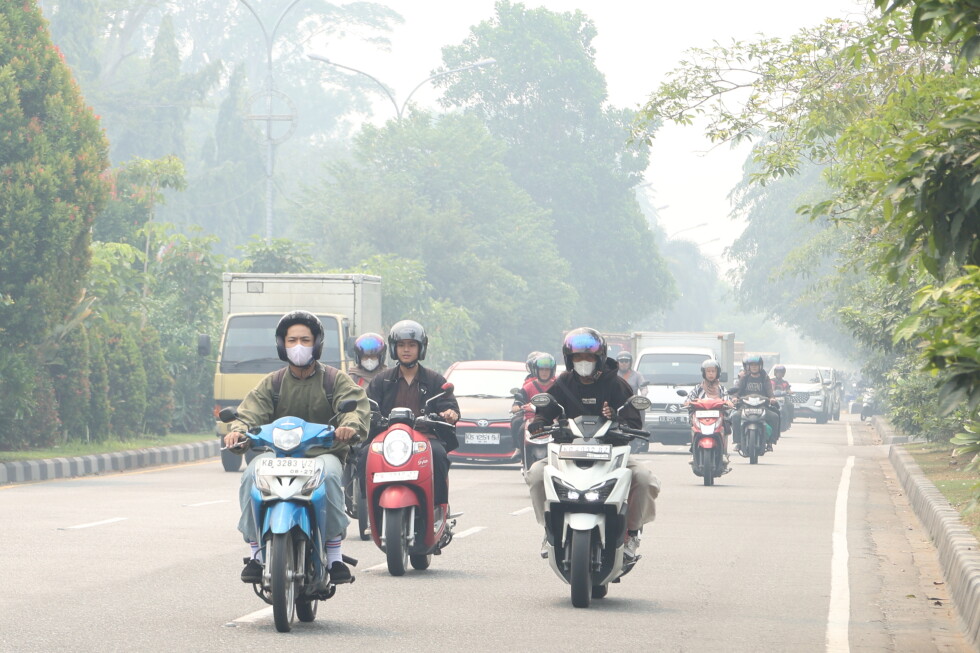
JAKARTA, Indonesia – As massive wildfires on the island of Borneo churn out toxic, choking haze that has blanketed urban centers and drifted across international borders into neighboring Malaysia, Indonesian law enforcement and environmental officials announced Friday that strict legal penalties will be pursued against any individual found starting illegal open burns.
The vast majority of the fire activity is concentrated on Borneo, the world’s third-largest island, which is split between three Southeast Asian nations: Indonesia, Malaysia, and Brunei. Indonesia controls around 75 percent of the island’s territory, and the country’s Ministry of Forestry has documented more than 5,000 distinct fire hot spots across its portion of Borneo. Local media reports confirm that the thick haze has smothered large swathes of Indonesia’s Kalimantan region, cutting visibility to as low as just 1 to 10 meters in the most affected areas. This reduced visibility has already sparked multiple traffic collisions and forced flight delays across the region.
Broadcast television footage from impacted areas shows streets, residential and commercial buildings, and public infrastructure completely obscured by thick gray smoke. Motorists have been forced to drive with full headlights activated during broad daylight, and outdoor photos show residents of all ages, including school-age children, wearing protective face masks to limit smoke inhalation.
Indonesia’s National Disaster Management Agency explained that a strengthening El Niño weather pattern and an unusually long, dry dry season have created ideal conditions for the fires to spread rapidly out of control. The dense smoke plume generated by the blazes has drifted across the maritime border into Malaysia, where the eastern state of Sarawak has borne the brunt of the cross-border pollution. As of Friday, one Sarawak district registered “very unhealthy” air quality readings, while eight additional districts posted scores that fall into the unhealthy range. In response, the Sarawak state government has ordered the closure of nearly 600 schools, disrupting learning for roughly 200,000 enrolled students.
On Indonesia’s side of Borneo, Central Kalimantan Police Chief Iwan Kurniawan confirmed that investigators have already taken 12 suspects into custody over the past week. The detainees are linked to allegations of arson and illegal land clearing to prepare ground for agricultural or plantation development, the common driver of annual fire seasons in the region. “Every forest and land fire incident in Central Kalimantan is investigated,” Kurniawan said, noting that authorities are still working to map the full scope of fire causes and hold all responsible parties accountable.
Forestry Minister Raja Juli Antoni, who toured fire-ravaged areas near the Central Kalimantan provincial capital of Palangka Raya earlier this week, doubled down on the government’s pledge of harsh enforcement. “Whoever they are, big or small, without exception, anyone who destroys nature and forests will face strict legal action,” Antoni said.
Across social media, affected residents have shared widespread accounts of physical distress, reporting ongoing breathing difficulties and growing anxiety about long-term respiratory and cardiovascular health risks from prolonged exposure to the hazardous smoke.
The scale of this year’s fire season has already far outpaced early 2024 activity. In the 24-hour period ending Friday, Indonesia’s Forestry Ministry detected 11,908 hot spots nationwide, almost double the 6,352 hot spots recorded just one day prior. Independent forest monitoring platform Nusantara Atlas reports that roughly 182,000 hectares (450,000 acres) of land were consumed by fire in July alone — an area nearly twice the size of the total scorched across the first six months of the year. To date, the total burned area across Indonesia this fire season has reached approximately 285,000 hectares (704,000 acres).
Transboundary haze has become a recurring annual crisis for Southeast Asia, particularly during intense El Niño cycles that extend dry seasons across Indonesia’s Sumatra and Kalimantan regions. Indonesian authorities have long confirmed that most wildfires in the region are deliberately ignited by parties seeking to clear forest and peatland inexpensively for commercial plantation development, most often for palm oil and pulpwood production. This annual fire activity repeatedly blankets large swathes of Indonesia and neighboring countries in hazardous air pollution that endangers public health across the region.
Associated Press reporters Eileen Ng in Kuala Lumpur, Malaysia, and Edna Tarigan in Jakarta, Indonesia, contributed reporting to this article.