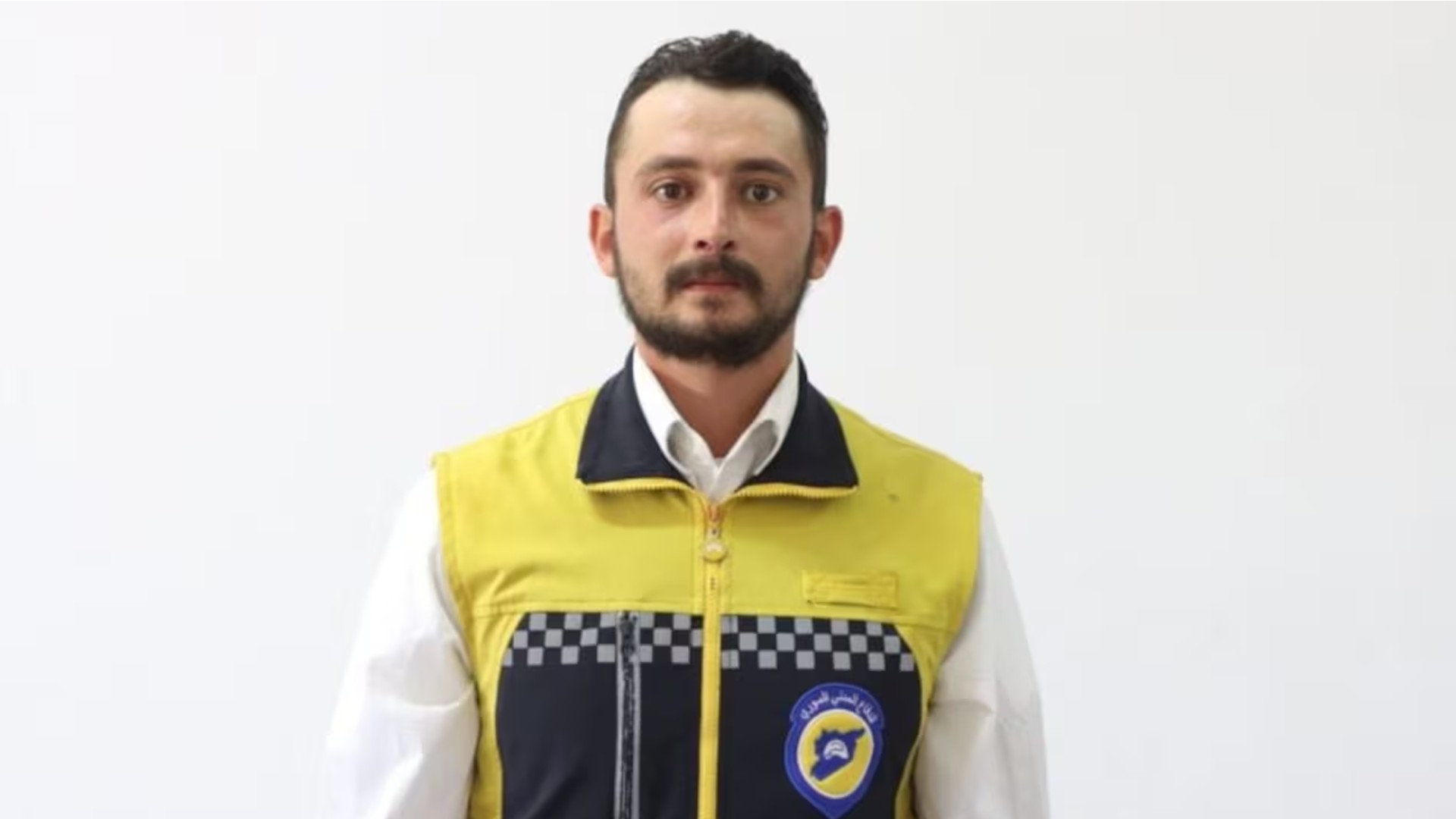
### Custody Death Sparks National Outcry as Syria Navigates Post-Assad Reform
Nearly eight months after the collapse of Bashar al-Assad’s 24-year authoritarian regime, the in-custody death of a 29-year-old former rescue volunteer has ignited widespread public protest and renewed scrutiny of Syria’s transitional government’s efforts to dismantle the legacy of systemic detention abuse. Mohammed Ghamira, a father of two who previously volunteered with the White Helmets civilian rescue organization, was taken into custody earlier this month over an alleged financial dispute. He was transferred from a police station in Latakia province’s al-Haffah district in critical condition, and pronounced dead shortly after arriving at a local hospital.
Official statements from Syrian authorities confirmed Ghamira’s death was caused by cerebral and gastrointestinal hemorrhaging stemming from a beating he received while in detention. The young man lived with hemophilia, a rare bleeding disorder that prevents the body from clotting blood properly after injury. Ghamira’s family confirmed they had explicitly warned detention officials of his pre-existing condition and requested he not be subjected to physical violence before his death.
A three-day official investigation launched by the new Syrian administration concluded Thursday, finding that Ghamira died after being slapped by a police investigator. The officer responsible for the assault has been taken into custody and referred to judicial authorities for prosecution. The probe also uncovered multiple procedural failures and negligence on the part of the local police department’s chief and the investigating officer, most critically the failure to document Ghamira’s known medical condition in official detention records.
News of Ghamira’s death quickly sparked public backlash across the country. Earlier this week, hundreds of demonstrators gathered in Aleppo to demand full accountability for the killing. Many carried signs bearing the message: “Do not repeat the oppression that we revolted against,” echoing widespread public rejection of the abusive detention system that defined the Assad era. Syrian activist Nedal al-Amari called the case a devastating betrayal of the revolution that ousted Assad last December. “After liberation, every Syrian who is killed under torture in state prisons or institutions is a disgrace that we, as people of the revolution, have to carry,” al-Amari wrote on social media platform X.
Ahmed al-Sharaa’s new government took power in December 2024 after a rapid offensive defeated Assad’s forces, ending decades of brutal authoritarian rule. During Assad’s time in power, the regime oversaw a sprawling network of more than 100 detention facilities where systematic torture, extrajudicial killing, and enforced disappearance were widespread. Rights groups documented that between the start of the 2011 pro-democracy protests that sparked the civil war and August 2024, more than 150,000 people—including more than 5,000 children and 10,000 women—were arrested by Assad’s security forces. Tens of thousands of detainees were tortured to death in facilities like Sednaya Prison, which Amnesty International labeled a “human slaughterhouse,” where mass executions, deliberate starvation, and mass unmarked graves of detainees were documented as crimes against humanity.
International and local rights analysts say the public backlash over Ghamira’s death signals a key shift from the Assad era, when open discussion of abuse in custody was strictly forbidden and criticism of the regime carried severe punishment. Saana-Maria Jokinen, a Syria-based human rights researcher and writer, noted that unlike during Assad’s rule, Ghamira’s death is being openly covered by Syrian media, and citizens are freely expressing outrage and demanding accountability without fear of repression. “A very tragic case,” Jokinen wrote on X. “However, in stark contrast to the days of the Assad regime, Ghamira’s death is openly discussed in the Syrian media and Syrians aren’t afraid to voice their criticism.”
Local and international human rights groups acknowledge that the fall of the Assad regime brought an immediate end to the centralized system of mass arbitrary detention, enforced disappearance, and systematic torture that defined the prior era. The Syrian Network for Human Rights (SNHR), a leading independent monitoring group, told Middle East Eye that meaningful progress has already been made under the transitional government. The new Syrian constitution, adopted in March 2025, includes explicit legal protections: Article 18 enshrines guarantees for human dignity and physical integrity, and explicitly bans enforced disappearance as well as physical and psychological torture. SNHR data shows at least 993 detainees have been released from former regime detention facilities in the first half of 2025 alone.
At the same time, the monitoring group documented 192 cases of arbitrary detention by the transitional government in the same six-month period, and warned that a fully compliant, rights-respecting detention system aligned with Syria’s international human rights obligations has not yet been fully built. “These facts show, at one and the same time, a measure of progress and the limits of this progress,” SNHR said. The group rejected claims that the new administration has recreated the abusive detention apparatus of the Assad regime, noting there is no evidence of centrally orchestrated torture or mass arbitrary detention under the current government. Instead, the risks to detainees stem from ongoing institutional gaps and procedural failures.
“A detainee remains at risk when his arrest isn’t registered immediately, his family isn’t informed of his whereabouts, lawyers and doctors can’t reach him quickly, or when he is held in unofficial facilities, his transfers aren’t documented, and independent monitors can’t inspect places of detention without prior notification,” SNHR explained. The organization has called on the transitional government to implement urgent reforms, including creating a unified, public register of all detainees, guaranteeing timely access to legal representation, family visits, and medical care for all people in custody, shutting down unofficial detention facilities that operate outside formal judicial and administrative oversight, and opening all detention sites to independent inspection.