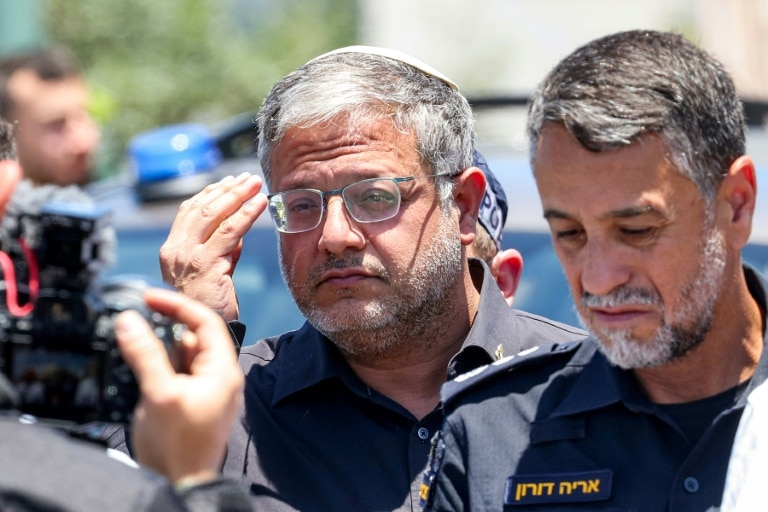
In a wave of global condemnation this Wednesday, major global powers Germany and France, alongside the United Nations, have publicly rejected inflammatory calls for mass nightly killings in Gaza from Itamar Ben Gvir, Israel’s far-right national security minister. Ben Gvir’s remarks, made during a podcast interview with a former Gaza hostage held by Hamas, have reignited long-simmering tensions between Israel and European leaders, who have already pushed for punitive measures against the hardline politician.
During the interview, Ben Gvir argued that Israeli forces should carry out targeted operations to kill “30 or 40” people in Gaza every single night, going so far as to say that the people of Gaza “shouldn’t be alive” and that describing them as human amounted to a compliment. The remarks marked the latest in a string of controversial statements from Ben Gvir that have drawn international ire.
Sebastian Hille, spokesperson for the German government, released a statement confirming that Chancellor Friedrich Merz “strongly condemns the inhumane appeals made by Minister Ben Gvir, which violate international law,” adding that “they are unacceptable.” Jean-Noel Barrot, France’s foreign minister, echoed the condemnation in an interview with regional outlet La Montagne, labeling the comments “intolerable and inhumane.”
A spokesperson for United Nations Secretary-General António Guterres also issued a sharp rebuke, describing Ben Gvir’s words as “appalling. They’re outrageous. They’re dehumanizing, and they’re dangerous.”
The condemnation comes as Ben Gvir already faces growing calls from multiple European nations for bloc-wide sanctions from the European Union. Speaking in a televised interview earlier this week, German Vice Chancellor and Finance Minister Lars Klingbeil noted that Ben Gvir’s comments “must have consequences,” confirming that sanctions discussions are ongoing at the European level. However, the push for EU sanctions has repeatedly stalled, as punitive measures require unanimous approval from all 27 member states, and several pro-Israel member states have blocked the proposal to date.
Calls to blacklist Ben Gvir gained significant traction back in May, after the minister released a video mocking bound activists seized by Israeli forces from a Gaza-bound aid flotilla. In response, France unilaterally banned Ben Gvir from entering its territory and doubled down on calls for EU-wide sanctions, a move that has yet to gain full bloc support.
Beyond the condemnation of Ben Gvir’s Gaza remarks, Germany also issued a formal rebuke of Israeli plans to expand Israeli settlements in the contested E1 area of the occupied West Bank, warning that the expansion threatens the long-term viability of a two-state solution to the Israeli-Palestinian conflict. “Our message is clear: there must be no further steps toward annexation in the West Bank,” Hille stated. “No formal ones, but also no political, structural, or other measures whose impact is increasingly and obviously leading toward annexation. They run counter to a two-state solution.”
France’s Barrot also addressed rising violence by Israeli settlers in the West Bank, where Palestinian residents have faced growing harassment and violent seizures of property by settlers in recent months. Barrot confirmed that further sanctions against violent settlers remain on the table, noting that the EU has already implemented three rounds of sanctions against rogue settlers, with the most recent round approved on May 28. “Further sanctions could be imposed and all options are on the table,” he added.
Israel has maintained military occupation of the West Bank since the 1967 Six-Day War, and successive Israeli governments have steadily expanded illegal settlements in the territory. The pace of expansion has accelerated dramatically under the current coalition government led by Prime Minister Benjamin Netanyahu. Excluding East Jerusalem, more than 500,000 Israeli settlers currently reside in settlements widely deemed illegal under international law, alongside a Palestinian population of roughly 3 million in the occupied territory.