For nearly three years, Ahmed al-Siqali, a Palestinian father of seven, dreaded the day he would step back into the Gaza Strip. Just one week before the outbreak of full-scale conflict in October 2023, he had crossed out of the besieged enclave to take a construction job in Israel, a routine move for thousands of Palestinian laborers who relied on Israeli work permits to support their families. When border crossings closed immediately after hostilities began, al-Siqali found himself stranded in the occupied West Bank, cut off from his wife and children for more than two years. That separation turned to unthinkable tragedy in December 2023, when an Israeli airstrike flattened the Gaza City home where his family was sheltering, killing six of his seven children. Only his daughter Rosan survived alongside his wife Hayat. When Israeli forces finally detained him during a West Bank raid last month and deported him back to Gaza weeks later, al-Siqali stepped into a homecoming no parent should ever face.
Before October 7 2023, cross-border work was a common livelihood for Palestinian men from Gaza. Under a permit system run by Israeli authorities, thousands traveled regularly to Israel for jobs in construction, agriculture and services, sending earnings home to build better futures for their families. Al-Siqali had walked that same path: he had even purchased a new home near the Mediterranean coast in northern Gaza, fulfilling a long-held dream of his children to live steps from the beach. He never imagined that his final goodbye before leaving for work would be the last time he saw six of his children alive.
“I never imagined that the journey meant to build their future would separate our fates, leaving me unable to protect them or even say goodbye,” al-Siqali told Middle East Eye in an interview following his return. As communications across Gaza collapsed repeatedly in the first weeks of the war, reaching his family became nearly impossible. On the rare calls that connected, his children begged him to come home, repeating “We don’t want work or money. We just want you here with us.” The last successful contact came on December 8, 2023, when al-Siqali reached his wife through a rare working eSIM. In the few minutes before the line cut out, he could hear the terror in his family’s voices. Fearing the worst, he asked Hayat to write all the children’s names on their hands so they could be identified if disaster struck. Minutes after the call dropped, a relative called with the devastating news: the shelter had been bombed.
“There are no words that can describe what I felt at that moment. It was something no human being should have to endure,” al-Siqali said. Only two-month-old Eileen, whom he had held just once before leaving Gaza, was among the dead, alongside Mohammed, Muhannad, twins Kinan and Rayan, and Basant. “What did my children do to have their dreams taken away and be killed like this?” he asked. For two years, he remained stranded in the West Bank, passing days re-watching old photos and videos of a family trip to al-Nour resort taken just days before he left. The new coastal home he had worked so hard to buy was destroyed in the fighting, leaving nothing of the future he had planned.
His long wait for reunion ended abruptly on July 21, when Israeli forces raided the Qalqilya compound where he was staying with other displaced Gaza laborers. Al-Siqali, who had already warned his wife of the incoming soldiers, was detained along with all the workers in the building. After two weeks in Ofer Prison, he was transferred back to Gaza alongside 23 other Palestinian workers, cuffed and blindfolded for the four-hour journey to the Kerem Shalom crossing. From there, the International Committee of the Red Cross took the group to Nasser Hospital for processing.
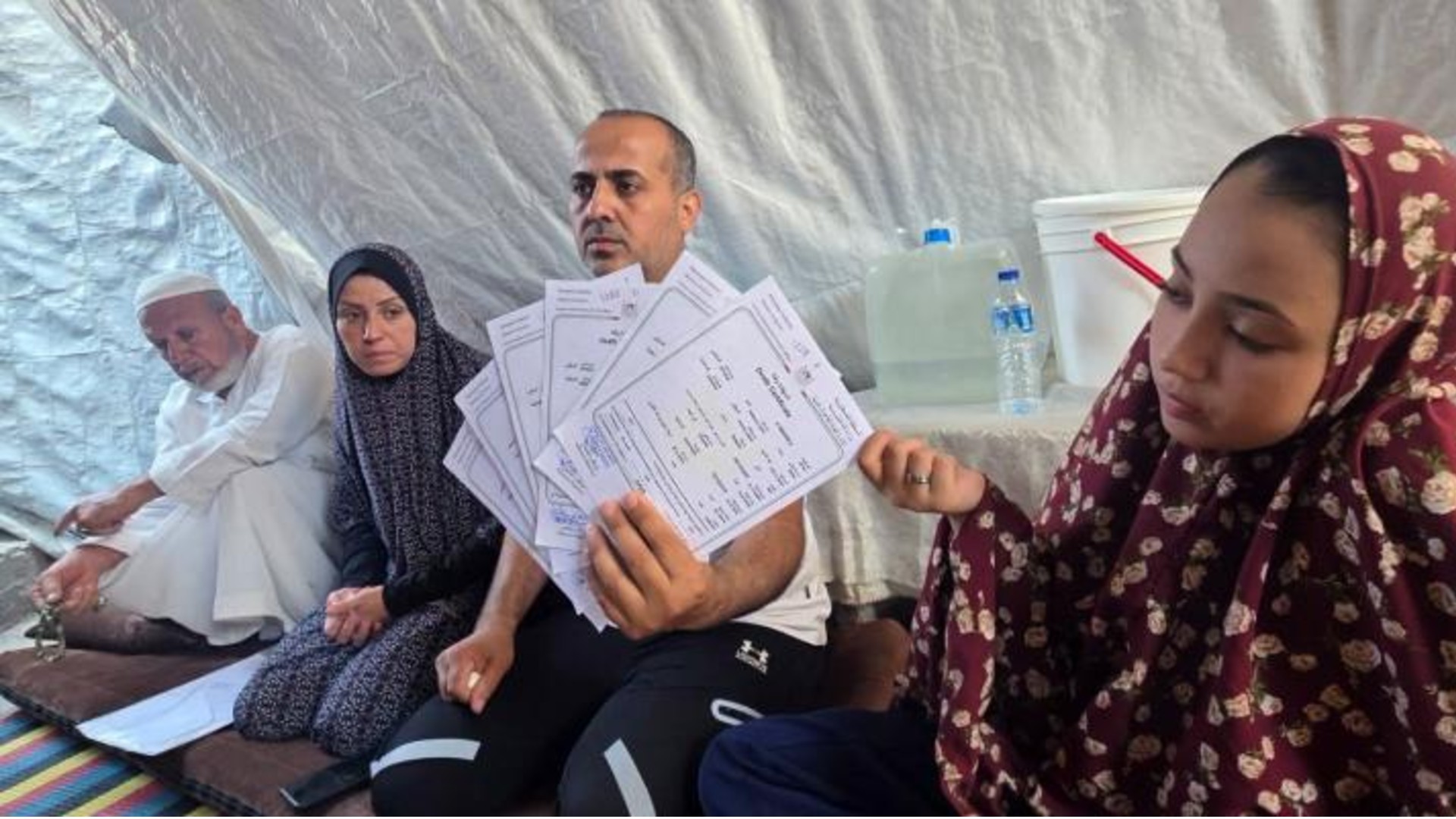
“As I walked towards the crossing, my legs could barely carry me. I felt as though I was about to lose consciousness,” al-Siqali recalled. “All I could think about was my incomplete reunion, the reunion I had waited so long for. It had finally come, but my family was no longer whole. Instead of my children being there to welcome me, I was welcomed by their six death certificates.”
Waiting for him at the hospital was Hayat, who had spent two weeks without any word of al-Siqali’s fate after his arrest. The 36-year-old mother, who survived the airstrike with physical wounds and crippling grief, said her mind froze when the bus pulled in. “My heart pounded, and I wanted to fly to him, yet I didn’t know how to face him without our six children,” she said. When al-Siqali walked toward her, their three-year-awaited reunion was held in silence, broken only by shared tears. Hayat whispered the words that had weighed on her through months of displacement: “Forgive me. I couldn’t protect what you entrusted to me.”
Today, the small surviving family lives in a makeshift tent in al-Mawasi, a displacement camp in southern Gaza. UN data shows that more than 90% of all buildings across Gaza have been damaged or destroyed since the start of the conflict, forcing nearly 1.9 million Palestinians from their homes. More than 800,000 displaced people live in makeshift tent settlements that offer almost no protection from extreme summer heat, disease and harsh weather. Al-Siqali, once a skilled construction worker, now struggles to adjust to the primitive conditions of camp life, with no work to turn to in a completely collapsed local economy.
Most days, he lies on a thin foam mattress in the tent, scrolling through the photos of his six children saved on his phone. Their six death certificates rest beside him. “This is all I have left of them,” he repeats. According to United Nations figures, more than 21,000 children have been killed in Gaza and the West Bank since the start of the war, with thousands more still missing and presumed dead, turning al-Siqali’s story of grief into one of thousands for Palestinian families across the region.