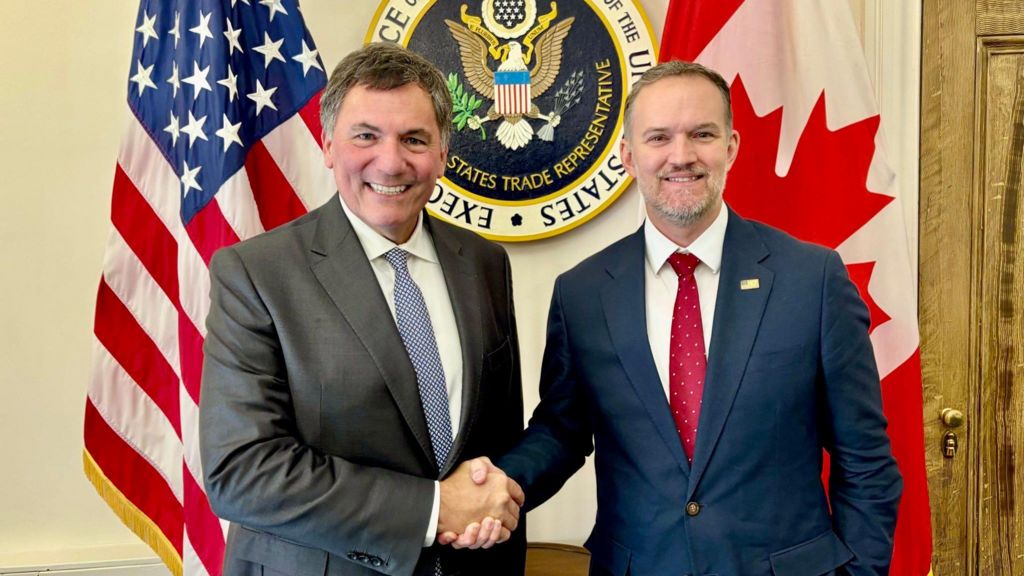
After days of intensive negotiations and a last-minute pause to threatened tariffs, Canada and the United States have reached a tentative framework for a new bilateral trade deal, hailed by leaders on both sides as a landmark win for North American economic ties. The breakthrough comes after the Trump administration suspended a planned wave of 50% tariffs on a broad swathe of Canadian goods that was scheduled to take effect Wednesday, pushing negotiations across the finish line just as the deadline loomed.
US President Donald Trump and Canadian Prime Minister Mark Carney have both publicly touted the tentative agreement as a success for their respective national economies. Trump told reporters the deal will deliver major benefits to American farmers and manufacturers, noting that Canada has agreed to eliminate tariffs on a range of US agricultural products — though he declined to name which specific sectors will gain access. When asked whether the US would reciprocate by rolling back some of its existing tariffs on Canadian imports, Trump confirmed the US would ease tariffs “by a little bit.”
Carney, in a post on X Wednesday, congratulated negotiating teams led by US Trade Representative Jamieson Greer and Canadian Trade Minister Dominic LeBlanc for the “significant progress” they achieved after more than a week of marathon talks in Washington. The tentative deal will lock in “the best terms” for Canada’s most critical strategic sectors and bring much-needed certainty to the long-strained bilateral trading relationship, Carney added.
Speaking to reporters shortly after a 45-minute negotiating session with LeBlanc, Greer said US officials are “very happy” with the outcome of the latest talks. He confirmed the agreement eliminates a number of longstanding trade frictions that have complicated US-Canada trade relations for years. “We feel confident that we’ve reached an agreement that will not only continue to protect American workers, American jobs, American supply chains, but really strengthen the North American economy,” Greer said, adding that he will brief Congress and US industry stakeholders on the full details of the deal in the near future.
LeBlanc, whose team has been stationed in Washington for more than a week to rush a deal before the tariff deadline, moved to reassure domestic audiences that one of Canada’s most sensitive agricultural policies remains untouched. When asked whether the deal included major concessions on dairy access that would undermine Canada’s supply management system — which governs production quotas, fixed pricing, and import limits for dairy, eggs, and poultry — LeBlanc confirmed the program will remain “entirely intact.”
The core sticking points that dominated negotiations align with longstanding priorities from both countries. Canada has pushed for the US to roll back or eliminate existing tariffs on its key exports including steel, aluminum, automobiles and softwood lumber. For its part, Washington has demanded several key concessions from Ottawa: the removal of Canada’s remaining retaliatory tariffs on American automobiles, expanded access to Canada’s dairy market for US cheese producers, and the elimination of the ban on US alcohol sales that most Canadian provinces implemented last year in retaliation for earlier Trump-era tariffs.
Public opinion in Canada remains sharply divided over how far Ottawa should go to reach a deal. Recent polling from Leger shows 56% of Canadian respondents favor a hardline negotiating approach, and a majority would oppose the Carney government making significant concessions to the US to avoid new tariffs. However, business groups on both sides of the border have repeatedly pressured negotiators to reach a deal, warning that new tariffs would inflict broad economic harm on two of the world’s largest trading partners, who share more than $2 billion in daily bilateral trade.
As of Wednesday, many key details of the tentative agreement remain undisclosed: the full scope of policy changes, the specific concessions each side has agreed to, and the remaining outstanding issues that still need to be resolved before the deal can be finalized have not been made public. The threatened 50% tariffs have only been paused until the weekend, giving negotiators a narrow window to iron out the final details of the agreement.